Kirjojen hintavertailu. Mukana 12 432 561 kirjaa ja 12 kauppaa.

Kirjailija

W. Kip Viscusi

Kirjat ja teokset yhdessä paikassa: 17 kirjaa, julkaisuja vuosilta 1980-2020, suosituimpien joukossa Compensation Mechanisms for Job Risks. Vertaile teosten hintoja ja tarkista saatavuus suomalaisista kirjakaupoista.

Mukana myös kirjoitusasut: W Kip Viscusi

17 kirjaa

Kirjojen julkaisuhaarukka 1980-2020.

Compensation Mechanisms for Job Risks

Compensation Mechanisms for Job Risks

Michael J. Moore; W. Kip Viscusi

Princeton University Press
2016
sidottu
In this major new work, Michael J. Moore and W. Kip Viscusi explore the question, "How are workers compensated for exposing themselves to the risk of physical injury while on the job?" The authors detail the diverse nature of labor market responses to job risks and the important role played by compensation-for-risk mechanisms. Following an overview of the literature, they present a number of unprecedented results. Comprehensive and systematic discussions of issues such as wage-risk tradeoffs, the effects of workers' compensation on wages and risk, the role of unions, and the role of product liability suits in job-related injuries make the volume an essential work for all those interested in risk policy and workplace safety. Among the major results presented for the first time are the first estimates of the value of life derived from recently released occupational fatality risk data from the National Traumatic Occupational Fatality Survey. From these same data the authors also demonstrate that higher workers' compensation benefit levels significantly reduce fatalities on the job--a finding that challenges virtually every other treatment of this topic. Originally published in 1990. The Princeton Legacy Library uses the latest print-on-demand technology to again make available previously out-of-print books from the distinguished backlist of Princeton University Press. These editions preserve the original texts of these important books while presenting them in durable paperback and hardcover editions. The goal of the Princeton Legacy Library is to vastly increase access to the rich scholarly heritage found in the thousands of books published by Princeton University Press since its founding in 1905.
Compensation Mechanisms for Job Risks

Compensation Mechanisms for Job Risks

Michael J. Moore; W. Kip Viscusi

Princeton University Press
2014
pokkari
In this major new work, Michael J. Moore and W. Kip Viscusi explore the question, "How are workers compensated for exposing themselves to the risk of physical injury while on the job?" The authors detail the diverse nature of labor market responses to job risks and the important role played by compensation-for-risk mechanisms. Following an overview of the literature, they present a number of unprecedented results. Comprehensive and systematic discussions of issues such as wage-risk tradeoffs, the effects of workers' compensation on wages and risk, the role of unions, and the role of product liability suits in job-related injuries make the volume an essential work for all those interested in risk policy and workplace safety. Among the major results presented for the first time are the first estimates of the value of life derived from recently released occupational fatality risk data from the National Traumatic Occupational Fatality Survey. From these same data the authors also demonstrate that higher workers' compensation benefit levels significantly reduce fatalities on the job--a finding that challenges virtually every other treatment of this topic. Originally published in 1990. The Princeton Legacy Library uses the latest print-on-demand technology to again make available previously out-of-print books from the distinguished backlist of Princeton University Press. These editions preserve the original texts of these important books while presenting them in durable paperback and hardcover editions. The goal of the Princeton Legacy Library is to vastly increase access to the rich scholarly heritage found in the thousands of books published by Princeton University Press since its founding in 1905.
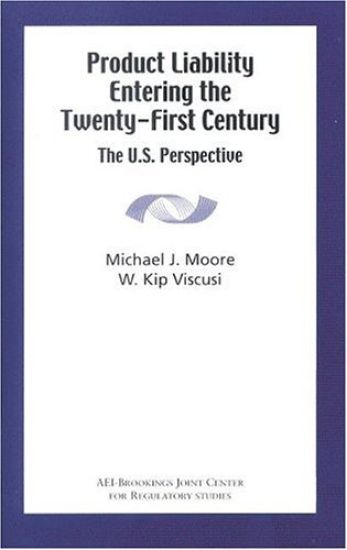
Product Liability Entering the Twenty-First Century

Product Liability Entering the Twenty-First Century

Michael J. Moore; W. Kip Viscusi

Brookings Institution
2001
nidottu
"Are liability ""crises"" an inevitable part of the modern industrial landscape? Does the inherent nature of the insurance industry promote recurring liability crises? What have been the effects of the liability reforms of the 1990s? Should lawyers be given de facto regulatory authority? This report provides perspective on these and other key issues concerning the law and economics of products liability. The authors begins with a brief description of the evolution of products liability doctrine in the U.S., up to the point of the liability crisis of the late 1980s. They discuss the economic implications of product risk for both consumers and producers, offer economic hypothesis on the implications of the increased scope of liability and subsequent reforms, and provide an update of trends in litigation and liability law. The book ends with a discussion of pending legislation and prospects for further improvements. Moore and Viscusi make the point that effective liability policy calls for a balancing of the incentives for improved public safety on one hand, and the benefits of new and existing products on the other."
Pricing Lives

Pricing Lives

W. Kip Viscusi

Princeton University Press
2020
pokkari
How society’s undervaluing of life puts all of us at risk—and the groundbreaking economic measure that can fix itLike it or not, sometimes we need to put a monetary value on people's lives. In the past, government agencies used the financial "cost of death" to monetize the mortality risks of regulatory policies, but this method vastly undervalued life. Pricing Lives tells the story of how the government came to adopt an altogether different approach--the value of a statistical life, or VSL—and persuasively shows how its more widespread use could create a safer and more equitable society for everyone.In the 1980s, W. Kip Viscusi used the method to demonstrate that the benefits of requiring businesses to label hazardous chemicals immensely outweighed the costs. VSL is the risk-reward trade-off that people make about their health when considering risky job choices. With it, Viscusi calculated how much more money workers would demand to take on hazardous jobs, boosting calculated benefits by an order of magnitude. His current estimate of the value of a statistical life is $10 million. In this book, Viscusi provides a comprehensive look at all aspects of economic and policy efforts to price lives, including controversial topics such as whether older people's lives are worth less and richer people's lives are worth more. He explains why corporations need to abandon the misguided cost-of-death approach, how the courts can profit from increased application of VSL in assessing liability and setting damages, and how other countries consistently undervalue risks to life.Pricing Lives proposes sensible economic guideposts to foster more protective policies and greater levels of safety in the United States and throughout the world.
Economics of Regulation and Antitrust

Economics of Regulation and Antitrust

W. Kip Viscusi; Joseph E. Harrington; David E. M. Sappington

MIT Press
2018
sidottu
A thoroughly revised and updated edition of the leading textbook on government and business policy, presenting the key principles underlying sound regulatory and antitrust policy.Regulation and antitrust are key elements of government policy. This new edition of the leading textbook on government and business policy explains how the latest theoretical and empirical economic tools can be employed to analyze pressing regulatory and antitrust issues. The book departs from the common emphasis on institutions, focusing instead on the relevant underlying economic issues, using state-of-the-art analysis to assess the appropriate design of regulatory and antitrust policy. Extensive case studies illustrate fundamental principles and provide insight on key issues in regulation and antitrust policy. This fifth edition has been thoroughly revised and updated, reflecting both the latest developments in economic analysis and recent economic events. The text examines regulatory practices through the end of the Obama and beginning of the Trump administrations. New material includes coverage of global competition and the activities of the European Commission; recent mergers, including Comcast-NBC Universal; antitrust in the new economy, including investigations into Microsoft and Google; the financial crisis of 2007-2008 and the Dodd-Frank Act; the FDA approval process; climate change policies; and behavioral economics as a tool for designing regulatory strategies.
Pricing Lives

Pricing Lives

W. Kip Viscusi

PRINCETON UNIVERSITY PRESS
2018
sidottu
How society’s undervaluing of life puts all of us at risk—and the groundbreaking economic measure that can fix itLike it or not, sometimes we need to put a monetary value on people's lives. In the past, government agencies used the financial "cost of death" to monetize the mortality risks of regulatory policies, but this method vastly undervalued life. Pricing Lives tells the story of how the government came to adopt an altogether different approach--the value of a statistical life, or VSL—and persuasively shows how its more widespread use could create a safer and more equitable society for everyone.In the 1980s, W. Kip Viscusi used the method to demonstrate that the benefits of requiring businesses to label hazardous chemicals immensely outweighed the costs. VSL is the risk-reward trade-off that people make about their health when considering risky job choices. With it, Viscusi calculated how much more money workers would demand to take on hazardous jobs, boosting calculated benefits by an order of magnitude. His current estimate of the value of a statistical life is $10 million. In this book, Viscusi provides a comprehensive look at all aspects of economic and policy efforts to price lives, including controversial topics such as whether older people's lives are worth less and richer people's lives are worth more. He explains why corporations need to abandon the misguided cost-of-death approach, how the courts can profit from increased application of VSL in assessing liability and setting damages, and how other countries consistently undervalue risks to life.Pricing Lives proposes sensible economic guideposts to foster more protective policies and greater levels of safety in the United States and throughout the world.
Risk Regulation Lessons from Mad Cows

Risk Regulation Lessons from Mad Cows

Joseph E. Aldy; W. Kip Viscusi

now publishers Inc
2013
nidottu
Risk Regulation Lesson from Mad Cows analyses and compares the policy responses in the United Kingdom (U.K.) and the United States (U.S.) to the mad cow disease crisis. Although there was not nearly as many deaths related to Creutzfeldt-Jakob disease (vCJD) and bovine spongiform encephalopathy (BSE) as scientist had predicted, the U.K. mad cow experience is widely regarded as a major policy debacle. The authors review the policy failures in the U.K., and also explain why the absence of comparable crisis in the U.S. does not signal that the mad cow experience has been a U.S. policy success story. This monograph draws a number of lessons from the mad cow experience regarding how one should regulate invasive species risks and deal with dimly understood but potentially serious risks to large populations. Risk Regulations Lesson from Mad Cows is organized as follows. After a brief Introduction, Section 2 examines the nature of risks to animals and humans from BSE and vCJD. Section 3 presents a mainstream public policy framework to evaluate the welfare consequences of BSE and vCJD risk mitigation instruments. Section 4 examines how other governments have conceptualized the risks for policy purposes. After providing a chronology of the policy events and policy actions in Section 5, the authors examine issues pertaining to media coverage and risk communication in Section 6. Consumer responses to the informational environment are reviewed in Section 7, and governments' use of trade policy in Section 8. A controversial effort by one beef producer to have its beef certified as being BSE-free brings together a wide set of cross-cutting issues of risk communication, government regulation, litigation, and international trade, and will serve as the main policy case study in Section 9. Lastly, in Section 10 the authors conclude with a review of general lessons for regulatory policy learned from the crisis.
Punitive Damages

Punitive Damages

Cass R. Sunstein; Reid Hastie; John W. Payne; David A. Schkade; W. Kip Viscusi

University of Chicago Press
2003
nidottu
Over the past two decades, the United States has seen a dramatic increase in the number and magnitude of punitive damages verdicts rendered by juries in civil trials. Probably the most extraordinary example is the July 2000 award of $144.8 billion in the Florida class action lawsuit brought against the cigarette manufacturers. More puzzling were two recent verdicts against the auto manufacturer BMW in Alabama. In identical cases, argued in the same court before the same judge, one jury awarded $4 million in punitive damages, while the other awarded no punitive damages at all. In cases involving accidents, civil rights and the environment, multimillion dollar punitive awards have been a subject of intense controversy. But how do juries actually make decisions about punitive damages? To find out, the authors - specialists in psychology, economics and the law - present the results of controlled experiments with over 600 mock juries involving the responses of more than 8,000 jury-eligible citizens. They find that although juries tended to agree in their moral judgements about the defendant's conduct, they rendered erratic and unpredictable dollar awards. Jurors also tended to ignore instructions from the judges; showed "hindsight bias", believing that what happened should have been foreseen; and penalized corporations that had based their decisions on careful cost-benefit analyses. While judges made many of the same errors, they performed better in some areas, suggesting that judges (or other specialists) may be better equipped than juries to decide punitive damages. With a wealth of new data and a host of provocative findings, this book documents a wide range of systematic bias in jury behaviour and should be valuable for anyone interested in punitive damages, jury behaviour, human psychology and the theory of punishment.
Smoke-Filled Rooms

Smoke-Filled Rooms

W. Kip Viscusi

University of Chicago Press
2002
sidottu
The 1998 out-of-court settlements of litigation by the states against the cigarette industry totaled $243 billion, making it the largest payoff ever in our civil justice system. Two key questions drove the lawsuits and the attendant settlement: Do smokers understand the risks of smoking? And does smoking impose net financial costs on the states?With Smoke-Filled Rooms,W. Kip Viscusi provides unexpected answers to these questions, drawing on an impressive range of data on several topics central to the smoking policy debate. Based on surveys of smokers in the United States and Spain, for instance, he demonstrates that smokers actually overestimate the dangers of smoking, indicating that they are well aware of the risks involved in their choice to smoke. And while smoking does increase medical costs to the states, Viscusi finds that these costs are more than financially balanced by the premature mortality of smokers, which reduces their demands on state pension and health programs, so that, on average, smoking either pays for itself or generates revenues for the states.Viscusi's eye-opening assessment of the tobacco lawsuits also includes policy recommendations that could frame these debates in a more productive way, such as his suggestion that the FDA should develop a rating system for cigarettes and other tobacco products based on their relative safety, thus providing an incentive for tobacco manufacturers to compete among themselves to produce safer cigarettes. Viscusi's hard look at the facts of smoking and its costs runs against conventional thinking. But it is also necessary for an informed and realistic debate about the legal, financial, and social consequences of the tobacco lawsuits.People making $50,000 or more pay .08 percent of their income in cigarette taxes, but people with incomes of less than $10,000 pay 1.62 percenttwenty times as much. The maintenance crew at the Capitol will bear more of the "sin tax" levied on cigarettes than will members of Congress who voted to boost it.Cigarettes are not a financial drain to the U.S. In fact, they are self-financing, as a consequence of smokers' premature mortality.The general public estimates that 47 out of 100 smokers will die from lung cancer because they smoke. Smokers believe that 40 out of 100 will die of the disease. Scientists estimate the actual number of 100 smokers who will die from lung cancer to be between 7 and 13.
Punitive Damages

Punitive Damages

Cass R. Sunstein; Reid Hastie; John W. Payne; David A. Schkade; W. Kip Viscusi

University of Chicago Press
2002
sidottu
Over the past two decades, the United States has seen a dramatic increase in the number and magnitude of punitive damages verdicts rendered by juries in civil trials. Probably the most extraordinary example is the July 2000 award of $144.8 billion in the Florida class action lawsuit brought against the cigarette manufacturers. More puzzling were two recent verdicts against the auto manufacturer BMW in Alabama. In identical cases, argued in the same court before the same judge, one jury awarded $4 million in punitive damages, while the other awarded no punitive damages at all. In cases involving accidents, civil rights and the environment, multimillion dollar punitive awards have been a subject of intense controversy. But how do juries actually make decisions about punitive damages? To find out, the authors - specialists in psychology, economics and the law - present the results of controlled experiments with over 600 mock juries involving the responses of more than 8,000 jury-eligible citizens. They find that although juries tended to agree in their moral judgements about the defendant's conduct, they rendered erratic and unpredictable dollar awards. Jurors also tended to ignore instructions from the judges; showed "hindsight bias", believing that what happened should have been foreseen; and penalized corporations that had based their decisions on careful cost-benefit analyses. While judges made many of the same errors, they performed better in some areas, suggesting that judges (or other specialists) may be better equipped than juries to decide punitive damages. With a wealth of new data and a host of provocative findings, this book documents a wide range of systematic bias in jury behaviour and should be valuable for anyone interested in punitive damages, jury behaviour, human psychology and the theory of punishment.
Rational Risk Policy

Rational Risk Policy

W. Kip Viscusi

Clarendon Press
1998
sidottu
Rational Risk Policy is based on Viscusi's Arne Ryde Memorial Lectures, delivered at Lund University in 1996. The organizing principle of these lectures is that the irrationality of individual decisions is often embodied in government regulations. Rather than overcoming the inadequacies in individual risk beliefs and behaviour, governmental regulations often institutionalize them. Viscusi examines how consumers and workers perceive risk and the implications of these risk beliefs and behavioural responses to risk for government policy. Hazard warnings efforts, direct regulation, and liability are among the alternative modes of intervention. The role of risk tradeoffs with respect to the value of life as well as the consequences of wasteful regulatory expenditures are considered in a discussion of riskrisk analysis. Rational Risk Policy also includes a critique of the risk analysis practices used by government agencies as well as a consideration of how liability and social insurance should be integrated into a rational risk management strategy.
Smoking

Smoking

W. Kip Viscusi

Oxford University Press Inc
1993
sidottu
This is a book on smoking that uses rigorous empirical data to explore in detail the character of the tradeoffs that people make in choosing whether to smoke or not to smoke. It is, therefore, not strictly about the hazards of smoking but about how people's perceptions of the risk of smoking affects their smoking behaviour. Some of the interesting and potentially controversial conclusions include: 1) People overestimate the risk of lung cancer compared to the actual incidence of the disease; 2) if people had an accurate perception of the risk of lung cancer national smoking rates would rise by 8%; 3) excise taxes on cigarettes increase people's risk perceptions and decrease smoking rates; 4) people who smoke are more likely to accept work in hazardous professions, and require less extra compensation for hazardous work than non-smokers; 5) young people, who are making the decision whether to smoke have a higher perception of the risks of smoking than older people.
Reforming Products Liability

Reforming Products Liability

W. Kip Viscusi

Harvard University Press
1991
sidottu
The current products liability crisis is both familiar and puzzling: million-dollar awards for apparently frivolous claims, inadequate settlements for thousands of people with severe injuries, skyrocketing insurance premiums, an overburdened judicial system. The adverse effects of this crisis on product innovation may be particularly detrimental to the extent that they deprive consumers of newer and safer goods. W. Kip Viscusi offers the first comprehensive and objective analysis of the crisis. He employs extensive, original empirical data to diagnose the causes and to assess the merits of alternative reform policies.Drawing on both liability insurance trends and litigation patterns, Viscusi shows that the products liability crisis is not simply a phenomenon of the 1980s but has been developing for several decades. He argues that the principal causes have been the expansion of the doctrine of design defect, the emergence of mass toxic torts, and the increase in lawsuits involving hazard warnings. This explanation differs sharply from that of most other scholars, who blame the doctrine of strict liability. Viscusi reformulates the concept of design defect, grounding it in sound economic analysis. He also evaluates public policy regarding hazard warnings and proposes a new national approach.More generally, the author sketches a comprehensive social risk policy, in which tort liability interacts with government health and safety regulation to foster a coherent set of institutional responses to health and safety risks. Reforming Products Liability will be of special interest to lawyers, judges, policymakers, economists, and all those interested in legal policy and health and safety issues.
Employment Hazards

Employment Hazards

W. Kip Viscusi

Harvard University Press
1980
sidottu
The safety of the work place is now a highly visible public issue. Many are calling for tighter regulation to reduce worker risk, while others feel government intervention is ineffective and costly. Here Kip Viscusi explores how well markets for hazardous jobs actually work. According to classical economics, other things being equal, a worker will demand more pay for a hazardous job than a safe one. However, this assumes that job related hazards are known, when often they are not. Using recent advances in the economics of information, Viscusi develops a theory of individual responses to job hazards under conditions of uncertainty.His assumptions are that hazards are uncertain events and that learning about them is a process that takes place over time. He then employs this analysis to study the performance of job markets in matching persons and jobs and in compensating persons for exposure to hazards. Finally he tests his adaptive model of the decision to quit and finds substantial evidence that risks are indeed reflected in wage differentials and quit behavior.