
Kirjailija
W. V. Quine
Kirjat ja teokset yhdessä paikassa: 5 kirjaa, julkaisuja vuosilta 1969-2022, suosituimpien joukossa The Roots of Reference. Vertaile teosten hintoja ja tarkista saatavuus suomalaisista kirjakaupoista.
Mukana myös kirjoitusasut: W V Quine
5 kirjaa
Kirjojen julkaisuhaarukka 1969-2022.
![Elementary Logic [First Edition]](/covers/9781614277576.jpg)
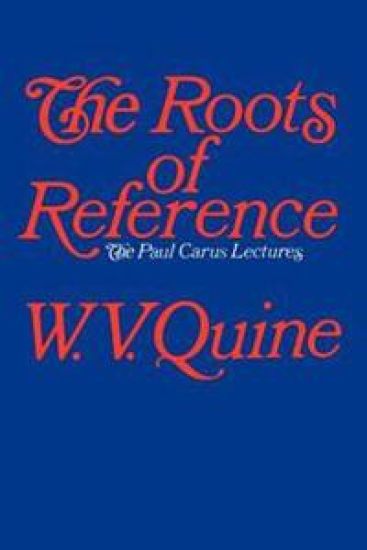
Studies the sensory bases of perception, mechanisms of language learning, and mental processes involved in identification, quantification, and other areas of scientific thought

Rudolf Carnap and W. V. Quine, two of the twentieth century's most important philosophers, corresponded at length - and over a long period of time - on matters personal, professional, and philosophical. Their friendship encompassed issues and disagreements that go to the heart of contemporary philosophic discussions. Carnap (1891-1970) was a founder and leader of the logical positivist school. The younger Quine (1908) began as his staunch admirer but diverged from him increasingly over questions in the analysis of meaning and the justification of belief. That they remained close, relishing their differences through years of correspondence, shows their stature both as thinkers and as friends.The letters are presented here, in full, for the first time. The substantial introduction by Richard Creath offers a lively overview of Carnap's and Quine's careers and backgrounds, allowing the nonspecialist to see their writings in historical and intellectual perspective. Creath also provides a judicious analysis of the philosophical divide between them, showing how deep the issues cut into the discipline, and how to a large extent they remain unresolved.

Traditionally, stability in Asia has relied on America's bilateral alliances with Japan, Australia, and the Republic of Korea. Yet in recent years, emergent and more active multilateral forums& mdash;such as the Six-Party Talks on North Korea and the East Asia Summit& mdash;have taken precedence, engendering both cooperation and competition while reflecting the local concerns of the region.Some are concerned that this process is moving toward less-inclusive, bloc-based "talking shops" and that the future direction and success of these arrangements, along with their implications for global and regional security and prosperity, remain unclear. The fifteen contributors to this volume, all leading scholars in the field, provide national perspectives on regional institutional architecture and their functional challenges. They illuminate areas of cooperation that will move the region toward substantive collaboration, convergence of norms, and strengthened domestic institutions. They also highlight the degree to which institution building in Asia& mdash;a region composed of liberal democracies, authoritarian regimes, and anachronistic dictatorships& mdash;has become an arena for competition among major powers and conflicting norms, and assess the future shape of Asian security architecture., reviewing a previous edition or volume