Kirjojen hintavertailu. Mukana 12 152 606 kirjaa ja 12 kauppaa.

Kirjailija

W. W. Rostow

Kirjat ja teokset yhdessä paikassa: 25 kirjaa, julkaisuja vuosilta 1962-2021, suosituimpien joukossa The Stages of Economic Growth. Vertaile teosten hintoja ja tarkista saatavuus suomalaisista kirjakaupoista.

Mukana myös kirjoitusasut: W W Rostow, W W. Rostow

25 kirjaa

Kirjojen julkaisuhaarukka 1962-2021.

Rich Countries And Poor Countries

Rich Countries And Poor Countries

W. W. Rostow; W W Rostow

Routledge
2021
nidottu
In these ten graceful and learned essays, Professor Rostow addresses the future of the world and its economy from the perspective of his more than forty years of study and reflection on the problems of economic development. Rostow focuses on how we are to create and sustain a civilized and industrious world society in an international trading system beset by historic trends with enormous potential for disruption. These powerful forces—including an industrial revolution of microelectronics, genetic engineering, robots and lasers, and the diffusion of high technology to low-wage areas—are creating different sets of irrevocably intertwined problems for nations around the world. The issues are illuminated here by Rostow’s mastery of economic history as well as the history of political economy. In addition to general discussions placing the issues historically and intellectually, there are essays highlighting the particular concerns of Mexico, India, Japan, and the Pacific Basin. In his final remarks, Rostow speculates on how the large economic trends affecting the superpowers may lead gradually to a truly significant lessening of East-West tensions. This book will be valuable for any citizen or student concerned about the future of the global economy.
History, Policy, and Economic Theory
This collection of professional essays traces the sequence of the great issues of public policy that marked a half-century. It includes information on the problems of method, issues of historical analysis, elaboration of a dynamic theory, issues of current policy and evolution of economic doctrine.
Rich Countries And Poor Countries

Rich Countries And Poor Countries

W. W. Rostow; W W Rostow

Routledge
2019
sidottu
In these ten graceful and learned essays, Professor Rostow addresses the future of the world and its economy from the perspective of his more than forty years of study and reflection on the problems of economic development. Rostow focuses on how we are to create and sustain a civilized and industrious world society in an international trading system beset by historic trends with enormous potential for disruption. These powerful forces—including an industrial revolution of microelectronics, genetic engineering, robots and lasers, and the diffusion of high technology to low-wage areas—are creating different sets of irrevocably intertwined problems for nations around the world. The issues are illuminated here by Rostow’s mastery of economic history as well as the history of political economy. In addition to general discussions placing the issues historically and intellectually, there are essays highlighting the particular concerns of Mexico, India, Japan, and the Pacific Basin. In his final remarks, Rostow speculates on how the large economic trends affecting the superpowers may lead gradually to a truly significant lessening of East-West tensions. This book will be valuable for any citizen or student concerned about the future of the global economy.
History, Policy, and Economic Theory
This collection of professional essays traces the sequence of the great issues of public policy that marked a half-century. It includes information on the problems of method, issues of historical analysis, elaboration of a dynamic theory, issues of current policy and evolution of economic doctrine.
How it all Began (Routledge Revivals)
First published in 1975, this book traces the origins of our modern economy, showing the routes by which nations have either achieved wealth or have been impoverished. W. W. Rostow brings together issues of public policy, international trade and the world of science and technology, arguing that conventional economic thought has failed to relate scientific innovation to the economic process. Chapters consider the politics of modernization, the Commercial Revolution and the development of the world economy between 1783 and 1820.
How it all Began (Routledge Revivals)
First published in 1975, this book traces the origins of our modern economy, showing the routes by which nations have either achieved wealth or have been impoverished. W. W. Rostow brings together issues of public policy, international trade and the world of science and technology, arguing that conventional economic thought has failed to relate scientific innovation to the economic process. Chapters consider the politics of modernization, the Commercial Revolution and the development of the world economy between 1783 and 1820.
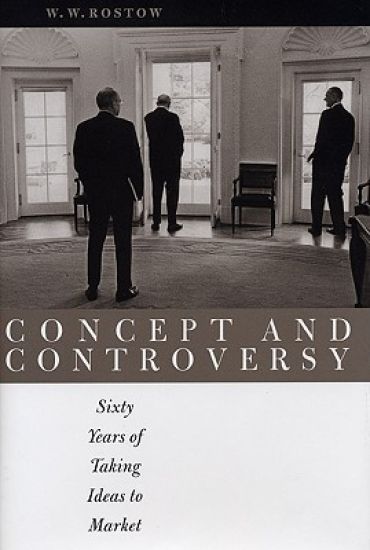
Concept and Controversy

Concept and Controversy

W. W. Rostow

University of Texas Press
2003
pokkari
A trusted advisor to Presidents Eisenhower, Kennedy, and Johnson and one of America's leading professors of economic history, W. W. Rostow has helped shape the intellectual debate and governmental policies on major economic, political, and military issues since World War II. In this thought-provoking memoir, he takes a retrospective look at eleven key policy problems with which he has been involved to show how ideas flow into concrete action and how actions taken or not taken in the short term actually determine the long run that we call "the future." The issues that Rostow discusses are these: The use of air power in Europe in the 1940s Working toward a united Europe during the Cold War The death of Joseph Stalin and early attempts to end the Cold War Eisenhower's Open Skies policy The debate over foreign aid in the 1950s The economic revival of Korea Efforts to control inflation in the 1960s Waiting for democracy in China The Vietnam War and Southeast Asian policy U.S. urban problems in disadvantaged neighborhoods The challenges posed by declining population in the twenty-first century In discussing how he and others have worked to meet these challenges, Rostow builds a compelling case for including long-term forces in the making of current policy. He concludes his memoir with provocative reflections on the twentieth and twenty-first centuries and on how individual actors shape history.
The Great Population Spike and After

The Great Population Spike and After

W. W. Rostow

Oxford University Press Inc
1998
sidottu
This book presents the views of a well known economist on what problems and prospects the world is likely to face in the year 2050. The central argument of the author is that the population of the world, after a growth from 1176 to 2050 will achieve zero growth by the year 2100. Furthermore, the population of the developing nations will have begun to decline.
Theorists of Economic Growth from David Hume to the Present

Theorists of Economic Growth from David Hume to the Present

W. W. Rostow

Oxford University Press Inc
1993
nidottu
This book is the summation of a life's work by a distinguished economist. In it he surveys the important theorists in economics from David Hume and Adam Smith to the present, and explores how they chose to deal or not to deal with the variables and problems posed by the dynamics of economic growth. Each of the three historical sections is organized differently according to the particular way in which growth theory was treated in each period. A concluding section deals with what the author considers the unsolved problems of growth theory and the economic agenda facing the world into the next century. It is Rostow's intention that this work stand alongside Schumpeter's "The History of Economic Analysis" as a landmark work in the history of economic theory.
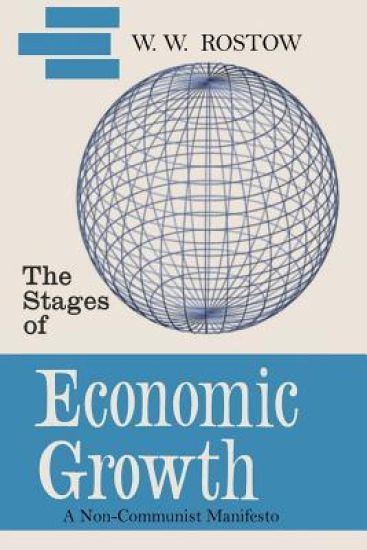
The Stages of Economic Growth

The Stages of Economic Growth

W. W. Rostow

Cambridge University Press
1991
sidottu
A third edition of The Stages of Economic Growth brings this classic work up to date with current economic and political changes. In a new preface and appendix, Professor Rostow extends his analysis to include recent economic and political developments as well as the advances in theory concerning nonlinear and chaotic phenomena. For those coming to his work for the first time, the original text and the introductions and appendices from earlier editions are included. This volume will not only be of interest to those concerned with the theory of economic growth, but also to students of policy since the 1960s. In the text Professor Rostow gives an account of economic growth based on a dynamic theory of production and interpreted in terms of actual societies. Five basic stages of economic growth are distinguished with detailed discussions of each stage including illustrative examples. He also applies the concept of stages of growth to an examination of the problems of military aggression and the nuclear arms race. The final chapter includes a comparison of his non-communist manifesto with Marxist theory. Materials from the second edition include an appendix in which he responds to some of his critics.
The Stages of Economic Growth

The Stages of Economic Growth

W. W. Rostow

Cambridge University Press
1991
pokkari
This third edition of The Stages of Economic Growth, first published in 1991, has a new preface and appendix, Professor Rostow extends his analysis to include economic and political developments as well as the advances in theory concerning nonlinear and chaotic phenomena. For those coming to his work for the first time, the original text and the introductions and appendices from earlier editions are included. This volume will not only be of interest to those concerned with the theory of economic growth, but also to students of policy since the 1960s. In the text Professor Rostow gives an account of economic growth based on a dynamic theory of production and interpreted in terms of actual societies. Five basic stages of economic growth are distinguished with detailed discussions of each stage including illustrative examples. He also applies the concept of stages of growth to an examination of the problems of military aggression and the nuclear arms race. The final chapter includes a comparison of his non-communist manifesto with Marxist theory. Materials from the second edition include an appendix in which he responds to some of his critics.
The Barbaric Counter Revolution

The Barbaric Counter Revolution

W. W. Rostow

University of Texas Press
1983
pokkari
In the 1980s, troubled Americans saw interest rates in the United States climb to an alltime high, unemployment grow to over 10 percent, the federal deficit reach near monumental proportions, and the world economy as a whole fall stagnant. Why did a once booming world economy give way to stagflation? Economist W. W. Rostow finds the roots of the problem in the phenomenon he terms the Barbaric Counter-Revolution-the effort to wring inflation out of the economic system by the rigorous application of a restricted rate of increase in the money supply. This policy was launched by the Carter administration in October 1979, reinforced by President Reagan in mid 1980, and abandoned in August 1982. In the end, it provided the United States with no mechanism for rapid recovery that did not bring with it a return to high interest rates, resumed inflation, and, soon, another recession. In what he terms a Civilized Synthesis, Rostow sets forth a series of new policies that would permit rapid, sustained growth with inflation under control. He argues that fiscal and monetary policy must be joined by an incomes policy that would gear the rate of increase of wages and salaries to the average rate of increase in productivity. He explores how this could be accomplished within the context of American politics and existing institutions. Finally, Rostow identifies four directions for investment that, together, would yield economic and social benefits.
Open Skies

Open Skies

W. W. Rostow

University of Texas Press
1983
pokkari
In 1955 the United States and the Soviet Union were matching steps in a race to develop missiles tipped with thermonuclear weapons. American officials were frustrated and alarmed by their inability to learn the scale and progress of the Soviet program, which directly threatened the security of the United States, and they were convinced that serious arms control measures required reliable means for mutual inspection. The result: President Dwight D. Eisenhower's dramatic Open Skies proposal, advanced-and rejected-at the Geneva summit of 1955. Vetoed by Nikita Khrushchev, Eisenhower's proposal to allow mutual aerial inspection between the United States and the U.S.S.R. was accepted as policy only after satellite photography became feasible. But at the time of the 1955 summit, it was a stunning, if transient, psychological and political victory for the United States and its president. W. W. Rostow was an active participant in this important episode in American history, and his is the first authoritative account of how Eisenhower's Open Skies proposal came to be. His insider's knowledge, combined with data from hitherto unexploited documentary sources, vividly brings to life the discussions and events that preceded the president's proposal. Rostow explores the diplomatic forces that led to Eisenhower's reluctant acceptance of a summit with the Soviets. He tracks the origins of the Open Skies concept to an obscure meeting organized at Quantico Marine Corps Base by presidential adviser Nelson Rockefeller. He describes the tensions between Rockefeller and Secretary of State John Foster Dulles that complicated Eisenhower's task in mounting the initiative for Open Skies and explains the differences between Eisenhower himself and Rockefeller over postsummit policy that provoked the latter's resignation. He examines Soviet motives and objectives at Geneva. Finally, Rostow reflects on the meaning of this fascinating episode in American history, in particular its importance to later arms control negotiations.
Europe After Stalin

Europe After Stalin

W. W. Rostow

University of Texas Press
1982
pokkari
Stalin's death on March 6, 1953, reopened the debate within the Eisenhower administration over whether or not the United States should propose and actively promote the reunification of Germany at a summit conference. Written by an insider, this is the only published firsthand account of this foreign policy decision-a decision that illuminated the dilemmas of the Cold War at an important moment. W. W. Rostow examines the origins of Eisenhower's "peace speech" of April 16, 1953, and of the National Security Council's debate on the German question between John Foster Dulles and presidential adviser C. D. Jackson. Jackson proposed immediate high-level diplomatic contact with the Soviet Union and the countries of Western Europe to discuss German reunification, as well as proposals for the general control of armaments and special security arrangements for Europe. Dulles, however, argued for a more reserved posture, which ruled out summitry and immediate negotiation with the Soviets. Dulles prevailed, but Eisenhower made his famous "peace speech." In his concluding chapter, Rostow explores the question of whether or not anything was lost by this outcome. Was an opportunity for a united Germany forfeited when Eisenhower rejected Churchill's suggestion for a prompt summit meeting and backed Dulles against Jackson in the National Security Council meeting of March 11? This is the third in a series of volumes by the author that probe the relationship between ideas and action in the making of major policy decisions. In this series, Rostow examines historic decision making from an insider's point of view while exploiting fully the rich documentary evidence.
The Division of Europe after World War II

The Division of Europe after World War II

W. W. Rostow

University of Texas Press
1982
pokkari
Should the negotiation of the post–World War II peace treaties in Europe have been pursued separately or should they have been approached within the framework of a general European settlement? The debate on this fundamental foreign policy issue, which has left only faint tracks in the documentary record, is fully explored here for the first time. W. W. Rostow, in his second book in the Ideas and Action Series, describes a meeting that took place on the eve of the departure of Secretary of State James Byrnes for Paris to participate in treaty negotiations. The meeting was probably the only occasion during 1946 when the peace treaty issue as a whole was explicitly addressed at a high level with lucid alternatives on the table. The plan laid before Secretary of State Byrnes by his senior subordinates, Under Secretary Dean Acheson and Assistant Secretary for Economic Affairs Will Clayton, aimed to halt the movement toward the split of Europe and the emergence of hostile blocs. It outlined an all-European settlement, including economic and security institutions linked to the United Nations. Only one part of the proposal gained Byrnes's support and came to life: the United Nations Economic Commission for Europe in Geneva. But the Acheson-Clayton proposal foreshadowed the Marshall Plan. The book's larger theme is the process by which the Cold War came about. Rostow's interpretation differs from either conventional or revisionist views, emphasizing as it does the process of incremental deterioration that occurred in 1946 and the role of uncertainty and weakness in American policy. This second volume in the Ideas and Action Series will interest general readers as well as those with a particular interest in World War II. It should be of special value to political scientists, economists, military historians, and policy makers, and may serve as a case study in a variety of courses.