Kirjojen hintavertailu. Mukana 12 595 353 kirjaa ja 12 kauppaa.

Kirjailija

Wade Trappe

Kirjat ja teokset yhdessä paikassa: 8 kirjaa, julkaisuja vuosilta 2005-2020, suosituimpien joukossa Introduction to Cryptography with Coding Theory. Vertaile teosten hintoja ja tarkista saatavuus suomalaisista kirjakaupoista.

8 kirjaa

Kirjojen julkaisuhaarukka 2005-2020.

Introduction to Cryptography with Coding Theory

Introduction to Cryptography with Coding Theory

Wade Trappe; Lawrence Washington

Pearson
2020
lisenssiavain
A broad spectrum of cryptography topics, covered from a mathematical point of view.Extensively revised and updated, the 3rd Edition of Introduction to Cryptography with Coding Theory mixes applied and theoretical aspects to build a solid foundation in cryptography and security. The authors' lively, conversational tone and practical focus inform a broad coverage of topics from a mathematical point of view, and reflect the most recent trends in the rapidly changing field of cryptography. For courses in Cryptography, Network Security, and Computer Security. Pearson eText is an easy-to-use digital textbook that you can purchase on your own or instructors can assign for their course. The mobile app lets you keep on learning, no matter where your day takes you -- even offline. You can also add highlights, bookmarks, and notes in your Pearson eText to study how you like. NOTE: This ISBN is for the Pearson eText access card. Pearson eText is a fully digital delivery of Pearson content. Before purchasing, check that you have the correct ISBN. To register for and use Pearson eText, you may also need a course invite link, which your instructor will provide. Follow the instructions provided on the access card to learn more.

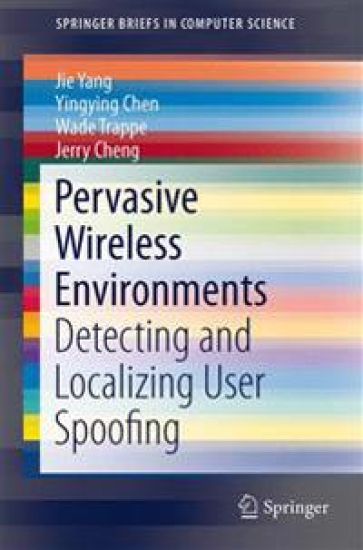
Pervasive Wireless Environments: Detecting and Localizing User Spoofing

Pervasive Wireless Environments: Detecting and Localizing User Spoofing

Jie Yang; Yingying Chen; Wade Trappe; Jerry Cheng

Springer International Publishing AG
2014
nidottu
This Springer Brief provides a new approach to prevent user spoofing by using the physical properties associated with wireless transmissions to detect the presence of user spoofing. The most common method, applying cryptographic authentication, requires additional management and computational power that cannot be deployed consistently. The authors present the new approach by offering a summary of the recent research and exploring the benefits and potential challenges of this method. This brief discusses the feasibility of launching user spoofing attacks and their impact on the wireless and sensor networks. Readers are equipped to understand several system models. One attack detection model exploits the spatial correlation of received signal strength (RSS) inherited from wireless devices as a foundation. Through experiments in practical environments, the authors evaluate the performance of the spoofing attack detection model. The brief also introduces the DEMOTE system, which exploits the correlation within the RSS trace based on each device’s identity to detect mobile attackers. A final chapter covers future directions of this field. By presenting complex technical information in a concise format, this brief is a valuable resource for researchers, professionals, and advanced-level students focused on wireless network security.
Securing Emerging Wireless Systems

Securing Emerging Wireless Systems

Yingying Chen; Wenyuan Xu; Wade Trappe; YanYong Zhang

Springer-Verlag New York Inc.
2010
nidottu
Securing Emerging Wireless Systems: Lower-layer Approaches aims to fill a growing need in the research community for a reference that describes the lower-layer approaches as a foundation towards secure and reliable wireless systems. Whereas most of the references typically address cryptographic attacks by using conventional "network security" approches for securing wireless systems, the proposed book will be differentiated from the rest of the market by its focus on non-cryptographic attacks that cannot easily be addressed by using traditional methods, and further by presenting a collection of defense mechanisms that operate at the lower-layers of the protocol stack and can defend wireless systems before the effects of attacks propagate up to higher-level applications and services. The book will focus on fundamental security problems that involve properties unique to wireless systems, such as the characteristics of radio propagation, or the location of communicating entities, or the properties of the medium access control layer. Specifically, the book provides detection mechanisms and highlights defense strategies that cope with threats to wireless localization infrastructure, attacks on wireless networks that exploit entity identity (i.e. spoofing attacks), jamming and radio interference that can undermine the availability of wireless communications, and privacy threats where an adversary seeks to infer spatial and temporal contextual information surrounding wireless communications. Additionally, the authors explore new paradigms of physical layer security for wireless systems, which can support authentication and confidentiality services by exploiting fading properties unique to wireless communications.
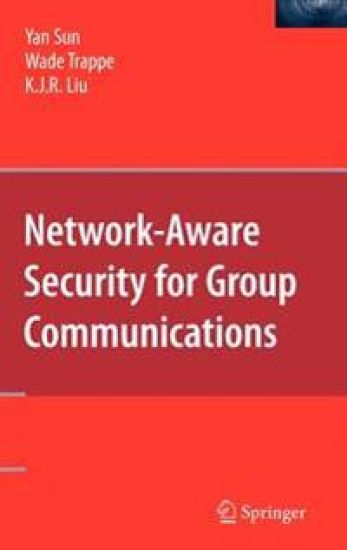
Network-Aware Security for Group Communications

Network-Aware Security for Group Communications

Yan Sun; Wade Trappe; K. J. Ray Liu

Springer-Verlag New York Inc.
2010
nidottu
Group-oriented communications will play a significant role in the next generation of networks as many services, such as pay-per-view media broadcasts and the delivery of network control messages, will rely upon the ability to reliably deliver data simultaneously to a large group of users. As these networks become increasingly pervasive and these multi-user services become increasingly ubiquitous, it will become essential that a complementary suite of security solutions are deployed in order to protect these services from a broad spectrum of security threats that are unique to group communications. This book aims to fill a growing need in the research community for a reference that describes the state of the art in securing group communications. Network-Aware Security for Group Communications focuses on tailoring the security solution to the underlying network architecture (such as the wireless cellular network or the ad hoc/sensor network), or to the application using the security methods (such as multimedia multicasts).
Securing Emerging Wireless Systems

Securing Emerging Wireless Systems

Yingying Chen; Wenyuan Xu; Wade Trappe; YanYong Zhang

Springer-Verlag New York Inc.
2008
sidottu
Securing Emerging Wireless Systems: Lower-layer Approaches aims to fill a growing need in the research community for a reference that describes the lower-layer approaches as a foundation towards secure and reliable wireless systems. Whereas most of the references typically address cryptographic attacks by using conventional "network security" approches for securing wireless systems, the proposed book will be differentiated from the rest of the market by its focus on non-cryptographic attacks that cannot easily be addressed by using traditional methods, and further by presenting a collection of defense mechanisms that operate at the lower-layers of the protocol stack and can defend wireless systems before the effects of attacks propagate up to higher-level applications and services. The book will focus on fundamental security problems that involve properties unique to wireless systems, such as the characteristics of radio propagation, or the location of communicating entities, or the properties of the medium access control layer. Specifically, the book provides detection mechanisms and highlights defense strategies that cope with threats to wireless localization infrastructure, attacks on wireless networks that exploit entity identity (i.e. spoofing attacks), jamming and radio interference that can undermine the availability of wireless communications, and privacy threats where an adversary seeks to infer spatial and temporal contextual information surrounding wireless communications. Additionally, the authors explore new paradigms of physical layer security for wireless systems, which can support authentication and confidentiality services by exploiting fading properties unique to wireless communications.
Network-Aware Security for Group Communications

Network-Aware Security for Group Communications

Yan Sun; Wade Trappe; K. J. Ray Liu

Springer-Verlag New York Inc.
2007
sidottu
Group-oriented communications will play a significant role in the next generation of networks as many services, such as pay-per-view media broadcasts and the delivery of network control messages, will rely upon the ability to reliably deliver data simultaneously to a large group of users. As these networks become increasingly pervasive and these multi-user services become increasingly ubiquitous, it will become essential that a complementary suite of security solutions are deployed in order to protect these services from a broad spectrum of security threats that are unique to group communications. This book aims to fill a growing need in the research community for a reference that describes the state of the art in securing group communications. Network-Aware Security for Group Communications focuses on tailoring the security solution to the underlying network architecture (such as the wireless cellular network or the ad hoc/sensor network), or to the application using the security methods (such as multimedia multicasts).