Kirjojen hintavertailu. Mukana 12 657 676 kirjaa ja 12 kauppaa.
Kirjailija
Walid Saad
Kirjat ja teokset yhdessä paikassa: 8 kirjaa, julkaisuja vuosilta 2011-2022, suosituimpien joukossa Matching Theory for Wireless Networks. Vertaile teosten hintoja ja tarkista saatavuus suomalaisista kirjakaupoista.
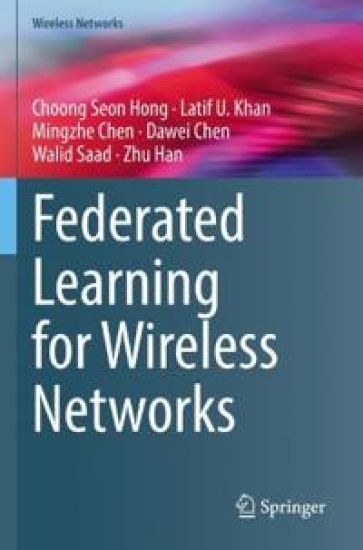
Recently machine learning schemes have attained significant attention as key enablers for next-generation wireless systems. Currently, wireless systems are mostly using machine learning schemes that are based on centralizing the training and inference processes by migrating the end-devices data to a third party centralized location. However, these schemes lead to end-devices privacy leakage. To address these issues, one can use a distributed machine learning at network edge. In this context, federated learning (FL) is one of most important distributed learning algorithm, allowing devices to train a shared machine learning model while keeping data locally. However, applying FL in wireless networks and optimizing the performance involves a range of research topics. For example, in FL, training machine learning models require communication between wireless devices and edge servers via wireless links. Therefore, wireless impairments such as uncertainties among wireless channel states, interference, and noise significantly affect the performance of FL. On the other hand, federated-reinforcement learning leverages distributed computation power and data to solve complex optimization problems that arise in various use cases, such as interference alignment, resource management, clustering, and network control. Traditionally, FL makes the assumption that edge devices will unconditionally participate in the tasks when invited, which is not practical in reality due to the cost of model training. As such, building incentive mechanisms is indispensable for FL networks. This book provides a comprehensive overview of FL for wireless networks. It is divided into three main parts: The first part briefly discusses the fundamentals of FL for wireless networks, while the second part comprehensively examines the design and analysis of wireless FL, covering resource optimization, incentive mechanism, security and privacy. It also presents several solutions based on optimizationtheory, graph theory, and game theory to optimize the performance of federated learning in wireless networks. Lastly, the third part describes several applications of FL in wireless networks.
A thorough treatment of UAV wireless communications and networking research challenges and opportunities. Detailed, step-by-step development of carefully selected research problems that pertain to UAV network performance analysis and optimization, physical layer design, trajectory path planning, resource management, multiple access, cooperative communications, standardization, control, and security is provided. Featuring discussion of practical applications including drone delivery systems, public safety, IoT, virtual reality, and smart cities, this is an essential tool for researchers, students, and engineers interested in broadening their knowledge of the deployment and operation of communication systems that integrate or rely on unmanned aerial vehicles.
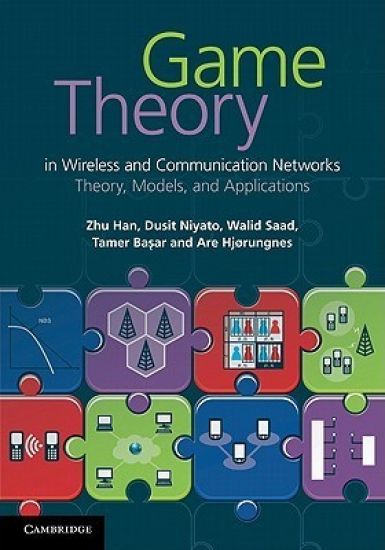
Discover the very latest game-theoretic approaches for designing, modeling, and optimizing emerging wireless communication networks and systems with this unique text. Providing a unified and comprehensive treatment throughout, it explains basic concepts and theories for designing novel distributed wireless networking mechanisms, describes emerging game-theoretic tools from an engineering perspective, and provides an extensive overview of recent applications. A wealth of new tools is covered - including matching theory and games with bounded rationality - and tutorial chapters show how to use these tools to solve current and future wireless networking problems in areas such as 5G networks, network virtualization, software defined networks, cloud computing, the Internet of Things, context-aware networks, green communications, and security. This is an ideal resource for telecommunications engineers, and researchers in industry and academia who are working on the design of efficient, scalable, and robust communication protocols for future wireless networks, as well as graduate students in these fields.
This book provides the fundamental knowledge of the classical matching theory problems. The potentials and challenges of implementing the semi-distributive matching theory framework into the wireless resource allocations are analyzed both theoretically and through implementation examples.
This book provides the fundamental knowledge of the classical matching theory problems. It builds up the bridge between the matching theory and the 5G wireless communication resource allocation problems. The potentials and challenges of implementing the semi-distributive matching theory framework into the wireless resource allocations are analyzed both theoretically and through implementation examples. Academics, researchers, engineers, and so on, who are interested in efficient distributive wireless resource allocation solutions, will find this book to be an exceptional resource.
This brief introduces overlapping coalition formation games (OCF games), a novel mathematical framework from cooperative game theory that can be used to model, design and analyze cooperative scenarios in future wireless communication networks. The concepts of OCF games are explained, and several algorithmic aspects are studied. In addition, several major application scenarios are discussed. These applications are drawn from a variety of fields that include radio resource allocation in dense wireless networks, cooperative spectrum sensing for cognitive radio networks, and resource management for crowd sourcing. For each application, the use of OCF games is discussed in detail in order to show how this framework can be used to solve relevant wireless networking problems. Overlapping Coalition Formation Games in Wireless Communication Networks provides researchers, students and practitioners with a concise overview of existing works in this emerging area,exploring the relevant fundamental theories, key techniques, and significant applications.
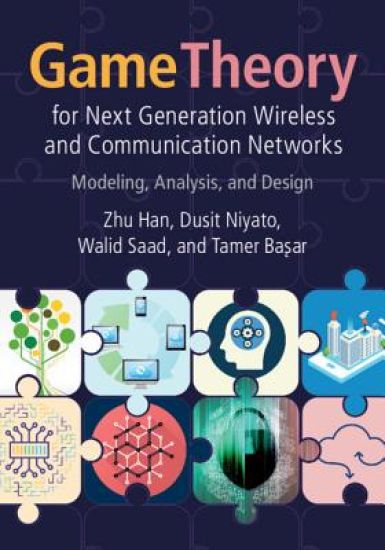
This unified treatment of game theory focuses on finding state-of-the-art solutions to issues surrounding the next generation of wireless and communications networks. Future networks will rely on autonomous and distributed architectures to improve the efficiency and flexibility of mobile applications, and game theory provides the ideal framework for designing efficient and robust distributed algorithms. This book enables readers to develop a solid understanding of game theory, its applications and its use as an effective tool for addressing wireless communication and networking problems. The key results and tools of game theory are covered, as are various real-world technologies including 3G networks, wireless LANs, sensor networks, dynamic spectrum access and cognitive networks. The book also covers a wide range of techniques for modeling, designing and analysing communication networks using game theory, as well as state-of-the-art distributed design techniques. This is an ideal resource for communications engineers, researchers, and graduate and undergraduate students.