Kirjojen hintavertailu. Mukana 12 390 323 kirjaa ja 12 kauppaa.

Kirjailija

Wallace Clement

Kirjat ja teokset yhdessä paikassa: 7 kirjaa, julkaisuja vuosilta 1989-2007, suosituimpien joukossa Changing Canada. Vertaile teosten hintoja ja tarkista saatavuus suomalaisista kirjakaupoista.

7 kirjaa

Kirjojen julkaisuhaarukka 1989-2007.

Understanding Canada

Understanding Canada

Wallace Clement

McGill-Queen's University Press
1996
nidottu
As corporations are restructured, governments cut back, and the international economy transformed, there is an increasing need to understand the economic and political forces involved, evaluate their implications, and develop strategies to modify them to meet society's interests. In light of the current situation, the study of political economy is more relevant than ever. Understanding Canada examines a variety of topics from viewpoints ranging from the established to the interdisciplinary. Issues such as gender, Native peoples, race, ethnicity and migration, globalization, foreign policy, the welfare state, regulation, communications, popular culture, and space and the environment are examined, as are the more traditional subjects of economic growth, resources and The new Canadian political economy has emerged from its infancy and is now regarded as a respected and innovative field of scholarship. Understanding Canada furthers this tradition by focusing on current issues in an accessible and informative way. Contents Introduction: Whither the New Canadian Political Economy? - Wallace Clement - Economic Growth and Economic Crisis: Canadian Capitalism Through the Ages - Mel Watkins (Toronto) - Resources and Manufacturing in Canada's Political Economy - Wallace Clement and Glen Williams (Carleton) - Labour in the New Canadian Political Economy - Paul Philips (Manitoba) - Gender at Work: Canadian Feminist Political Economy after 1988 - Meg Luxton (York) and Heather Jon Maroney (Carleton) - Understanding What Happened Here: The Political Economy of Indigenous Peoples - Frances Abele (Carleton) - The Political Economy of Race, Ethnicity, and Migration - Daiva Stasiulis (Carleton) - Going Global: The Politics of Canada's Foreign Policy - Mark Neufeld (Trent) and Sandy Whitworth (York) - Re-mapping Canada: The State in the Era of Globalism - Greg Albo (York) and Jane Jenson (Montreal) - The New Political Economy of Regions - Janine Brodie (York) - The Challenges of the Quebec Question: Paradigm and Counter-Paradigm - Daniel Salee (Concordia) and William Coleman (McMaster) - From the Post-War to the Post-Liberal Keynesian Welfare State - Isabella Bakker (York) and Katherine Scott (?) - Displacing the Welfare State - Liora Salter (York) and Rick Salter (?) - Public Discourse and the Structures of Communication - Ted Magder (York) - The (Real) Integrated Circus: Political Economy, Popular Culture, and Major League Sport - David Whitson (Alberta) and Richard Gruneau (affil?) - Contested Terrains: Social Space and the Canadian Environment - Iain Wallace (Carleton) and Rob Shields (Carleton).
Understanding Canada

Understanding Canada

Wallace Clement

McGill-Queen's University Press
1996
sidottu
As corporations are restructured, governments cut back, and the international economy transformed, there is an increasing need to understand the economic and political forces involved, evaluate their implications, and develop strategies to modify them to meet society's interests. In light of the current situation, the study of political economy is more relevant than ever. Understanding Canada examines a variety of topics from viewpoints ranging from the established to the interdisciplinary. Issues such as gender, Native peoples, race, ethnicity and migration, globalization, foreign policy, the welfare state, regulation, communications, popular culture, and space and the environment are examined, as are the more traditional subjects of economic growth, resources and The new Canadian political economy has emerged from its infancy and is now regarded as a respected and innovative field of scholarship. Understanding Canada furthers this tradition by focusing on current issues in an accessible and informative way. Contents Introduction: Whither the New Canadian Political Economy? - Wallace Clement - Economic Growth and Economic Crisis: Canadian Capitalism Through the Ages - Mel Watkins (Toronto) - Resources and Manufacturing in Canada's Political Economy - Wallace Clement and Glen Williams (Carleton) - Labour in the New Canadian Political Economy - Paul Philips (Manitoba) - Gender at Work: Canadian Feminist Political Economy after 1988 - Meg Luxton (York) and Heather Jon Maroney (Carleton) - Understanding What Happened Here: The Political Economy of Indigenous Peoples - Frances Abele (Carleton) - The Political Economy of Race, Ethnicity, and Migration - Daiva Stasiulis (Carleton) - Going Global: The Politics of Canada's Foreign Policy - Mark Neufeld (Trent) and Sandy Whitworth (York) - Re-mapping Canada: The State in the Era of Globalism - Greg Albo (York) and Jane Jenson (Montreal) - The New Political Economy of Regions - Janine Brodie (York) - The Challenges of the Quebec Question: Paradigm and Counter-Paradigm - Daniel Salee (Concordia) and William Coleman (McMaster) - From the Post-War to the Post-Liberal Keynesian Welfare State - Isabella Bakker (York) and Katherine Scott (?) - Displacing the Welfare State - Liora Salter (York) and Rick Salter (?) - Public Discourse and the Structures of Communication - Ted Magder (York) - The (Real) Integrated Circus: Political Economy, Popular Culture, and Major League Sport - David Whitson (Alberta) and Richard Gruneau (affil?) - Contested Terrains: Social Space and the Canadian Environment - Iain Wallace (Carleton) and Rob Shields (Carleton).
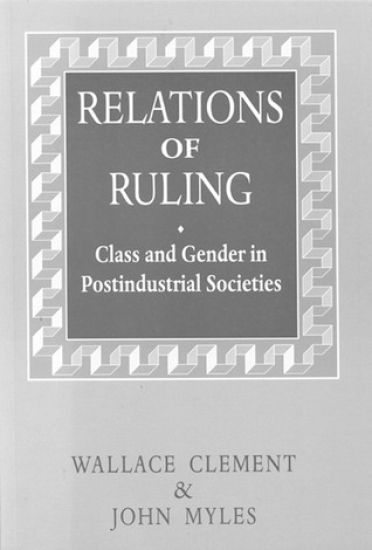
Relations of Ruling

Relations of Ruling

Wallace Clement; John Myles

McGill-Queen's University Press
1994
nidottu
For some, the postindustrial world promises a new kind of capitalism that will draw its vitality from an expansion of knowledge and the creative capacities of working men and women. Others have highlighted postindustrialism's darker side and concluded that it is simply the next stage in the degradation of labour. For some, the massive entry of women into paid labour that accompanies postindustrialism will finally liberate women from domestic patriarchy. For others, it is no more than an extension of private patriarchy into the public sphere. The authors show that historical residues and the contemporary impact of major economic and political factors have produced not one but several postindustrial trajectories. They reveal how postindustrialism has brought a new distribution of productive forces and of effective powers over people, and show that the shape of that distribution varies considerably in different countries and different fields as a result of both institutionalized practices (inherited from industrial capitalism) and the contemporary effects of state policies, organized labour, and the women's movement. Addressing issues of class and gender, Relations of Ruling deals with problems involved in regulating paid labour as well as the relationship between paid and domestic labour. It will be of particular interest to specialists in gender issues and scholars in women's, family, and labour studies.
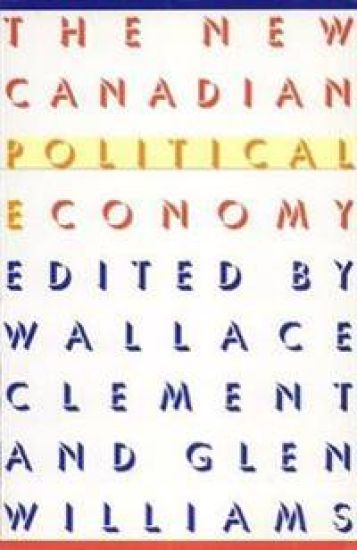
The New Canadian Political Economy

The New Canadian Political Economy

Wallace Clement; Glen Williams

McGill-Queen's University Press
1989
nidottu
Wallace Clement and Glen Williams have ensured that all areas of the field are discussed, with chapters on the state, resources, industrialization, the provinces and regions, labour, gender, culture, Quebec, race and ethnicity, the legal system, capital formation, and Canada's position in the international sphere of political economy. The editors' introduction defines the field of political economy in the 1980s by comparing it to traditional studies of Innis and others and evaluates the strengths and weaknesses of the new approach. The New Canadian Political Economy suggests important new directions for continued study. Contributors include: Frances Abele and Daiva Stasiulis, Gregory Albo and Jane Jenson, Isabella Bakker, Amy Bartholomew and Susan Boyd, Janine Brodie, Neil Bradford, Wallace Clement, William D. Coleman, Paul Phillips, Ted Magder, Mel Watkins, and Glen Williams.