Kirjojen hintavertailu. Mukana 12 595 353 kirjaa ja 12 kauppaa.

Kirjailija

Walter C. Labys

Kirjat ja teokset yhdessä paikassa: 10 kirjaa, julkaisuja vuosilta 1994-2025, suosituimpien joukossa Industrial Development and Environmental Degradation. Vertaile teosten hintoja ja tarkista saatavuus suomalaisista kirjakaupoista.

10 kirjaa

Kirjojen julkaisuhaarukka 1994-2025.

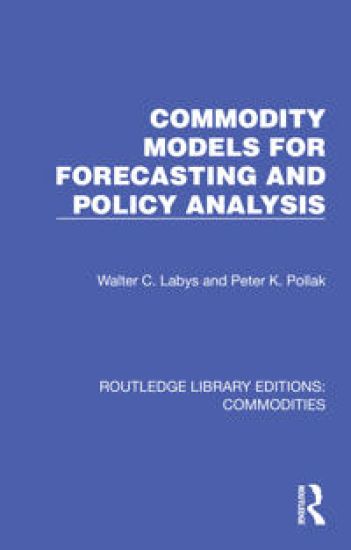
Commodity Models for Forecasting and Policy Analysis

Commodity Models for Forecasting and Policy Analysis

Walter C. Labys; Peter K. Pollak

TAYLOR FRANCIS LTD
2025
nidottu
Originally published in 1984 this book remains as relevant as when it was first published. At that time the oil crises of the 1970s and the growing international debt burden highlighted the extent to which events in primary commodity markets continue to influence the economies of developing and industrialized economies alike. Commodity modelling has become a valuable tool in efforts to predict and understand the behaviour of commodity markets and thereby reduce their fluctuations. This book provides an overview of the nature of the different types of commodity model as well as their diverse applications. In non-technical language the reader is introduced to the underlying modelling methodologies, including their advantages, limitations and commodity specific implications. The book will be of interest to commodity economists, traders and analysts, economic planners and those involved in agricultural, mineral and energy modelling.

Routledge Library Editions: Commodities

Routledge Library Editions: Commodities

Fiona Gordon-Ashworth; Michael Atkin; Edgar Graham; Walter C. Labys; Peter K. Pollak; Alasdair Macbean; D Nguyen; William Robertson

TAYLOR FRANCIS LTD
2024
muu
Originally published between 1982 and 1989, the volumes in this set were written at a time of instability in the global commodity markets. Then, just as now with the effects of the war in Ukraine, these volumes highlighted the extent to which events in primary commodity markets continue to influence the economies of developing and industrialized economies alike.They discuss the adequacy of world mineral supplies and the problems of resource conservation; examine patterns of trade, changing demand and the effects of fluctuations in spot and futures markets, all of which are crucially important for developing countries which above all need stability in primary commodities trade to guarantee their future development; provide an overview of the nature of the different types of commodity model as well as their diverse applications; introduce modelling methodologies, including their advantages, limitations and commodity specific implications; explain the role of futures and options in agriculture and their uses in reducing risks and maximizing profits; offer an analytical appraisal of international commodity controls, from their origins in the 1920s to their widespread acceptance as an important element in international trade policy in the 1970s.
Commodity Models for Forecasting and Policy Analysis

Commodity Models for Forecasting and Policy Analysis

Walter C. Labys; Peter K. Pollak

TAYLOR FRANCIS LTD
2024
sidottu
Originally published in 1984 this book remains as relevant as when it was first published. At that time the oil crises of the 1970s and the growing international debt burden highlighted the extent to which events in primary commodity markets continue to influence the economies of developing and industrialized economies alike. Commodity modelling has become a valuable tool in efforts to predict and understand the behaviour of commodity markets and thereby reduce their fluctuations. This book provides an overview of the nature of the different types of commodity model as well as their diverse applications. In non-technical language the reader is introduced to the underlying modelling methodologies, including their advantages, limitations and commodity specific implications. The book will be of interest to commodity economists, traders and analysts, economic planners and those involved in agricultural, mineral and energy modelling.
Modeling and Forecasting Primary Commodity Prices
Recent economic growth in China and other Asian countries has led to increased commodity demand which has caused price rises and accompanying price fluctuations not only for crude oil but also for the many other raw materials. Such trends mean that world commodity markets are once again under intense scrutiny. This book provides new insights into the modeling and forecasting of primary commodity prices by featuring comprehensive applications of the most recent methods of statistical time series analysis. The latter utilize econometric methods concerned with structural breaks, unobserved components, chaotic discovery, long memory, heteroskedasticity, wavelet estimation and fractional integration. Relevant tests employed include neural networks, correlation dimensions, Lyapunov exponents, fractional integration and rescaled range. The price forecasting involves structural time series trend plus cycle and cyclical trend models. Practical applications focus on the price behaviour of more than twenty international commodity markets.
Modeling Mineral and Energy Markets

Modeling Mineral and Energy Markets

Walter C. Labys

Springer-Verlag New York Inc.
2012
nidottu
This book provides a framework for analyzing and forecasting a variety of mineral and energy markets and related industries. Such modeling activity has been at the forefront of the economic and engineering professions for some time, having received a major stimulus fC?llowing the first oil price shock in 1973. Since that time, other shocks have affected these markets and industries, causing disequilibrium economic adjustments which are difficult to analyze and to predict. Moreover, geopolitics remains an important factor which can destabilize crude oil markets and associated refining industries. Mineral and energy modeling, consequently, has become a major interest of energy-related corporations, mining and drilling companies, metal manufacturers, public utilities, investment banks,. national government agencies and international organizations. This book hopes to advance mineral and energy modeling as follows: (1) The modeling process is presented sequentially by leading the model builder from model specification, estimation, simulation, and validation to practical model applications, including explaining history, analyzing policy, and market and price forecasting; (2) New developments in modeling approaches are presented which encompass econometric market and industry models, spatial equilibrium and programming models, optimal resource depletion models, input-output models, economic sector models, and macro­ oriented energy interaction models (including computable general equilibrium); (3) The verification and application of the models is considered not only individually but also in relation to the performance of alternative modeling approaches; and (4) The modeling framework includes a perspective on new directions, so that the present model building advice willextend into the future.
Modeling and Forecasting Primary Commodity Prices

Modeling and Forecasting Primary Commodity Prices

Walter C. Labys

Ashgate Publishing Limited
2006
sidottu
Recent economic growth in China and other Asian countries has led to increased commodity demand which has caused price rises and accompanying price fluctuations not only for crude oil but also for the many other raw materials. Such trends mean that world commodity markets are once again under intense scrutiny. This book provides new insights into the modeling and forecasting of primary commodity prices by featuring comprehensive applications of the most recent methods of statistical time series analysis. The latter utilize econometric methods concerned with structural breaks, unobserved components, chaotic discovery, long memory, heteroskedasticity, wavelet estimation and fractional integration. Relevant tests employed include neural networks, correlation dimensions, Lyapunov exponents, fractional integration and rescaled range. The price forecasting involves structural time series trend plus cycle and cyclical trend models. Practical applications focus on the price behaviour of more than twenty international commodity markets.
Modeling Mineral and Energy Markets

Modeling Mineral and Energy Markets

Walter C. Labys

Springer
1998
sidottu
This book provides a framework for analyzing and forecasting a variety of mineral and energy markets and related industries. Such modeling activity has been at the forefront of the economic and engineering professions for some time, having received a major stimulus fC?llowing the first oil price shock in 1973. Since that time, other shocks have affected these markets and industries, causing disequilibrium economic adjustments which are difficult to analyze and to predict. Moreover, geopolitics remains an important factor which can destabilize crude oil markets and associated refining industries. Mineral and energy modeling, consequently, has become a major interest of energy-related corporations, mining and drilling companies, metal manufacturers, public utilities, investment banks,. national government agencies and international organizations. This book hopes to advance mineral and energy modeling as follows: (1) The modeling process is presented sequentially by leading the model builder from model specification, estimation, simulation, and validation to practical model applications, including explaining history, analyzing policy, and market and price forecasting; (2) New developments in modeling approaches are presented which encompass econometric market and industry models, spatial equilibrium and programming models, optimal resource depletion models, input-output models, economic sector models, and macro­ oriented energy interaction models (including computable general equilibrium); (3) The verification and application of the models is considered not only individually but also in relation to the performance of alternative modeling approaches; and (4) The modeling framework includes a perspective on new directions, so that the present model building advice willextend into the future.
Industrial Development and Environmental Degradation

Industrial Development and Environmental Degradation

Se H. Park; Walter C. Labys

Edward Elgar Publishing Ltd
1998
sidottu
Industrialization to achieve economic development has resulted in global environmental degradation. While the impacts of industrial activity on the natural environment are a major concern in developed countries, much less is known about these impacts in developing countries. This source book identifies and quantifies the environmental consequences of industrial growth, and provides policy advice, including the use of clean technologies and environmentally sound production techniques, with special reference to the developing world.The developing world is often seen as having a high percentage of heavily polluting activities within its industrial sector. This, combined with a substantial agricultural sector, which contributes to deforestation, the erosion of the top soil and desertification, has lead to extreme pressures on the environment and impoverishes the population by destroying its natural resource base. This crisis suggests that sound industrialization policies are of paramount importance in a developing countries' economic development, and calls for the management of natural resources and the adoption of low-waste or environmentally clean technologies. The authors consider the industrial sector as a pollutant vis-a-vis other sectors of the economy, and then focus on some industry-specific pollutants within the manufacturing sector and some process-specific industrial pollutants. They conclude by reviewing the economic implications of promoting environmentally sound industrial development, specifically addressing the question of the conflict or complementarity which may exist between environmental goods and industrial production.The book will be essential to those working in industry, development and environmental economics.
Multivariate Tests for Time Series Models

Multivariate Tests for Time Series Models

Jeffrey B. Cromwell; Walter C. Labys; Michael J. Hannan; Michel Terraza

SAGE Publications Inc
1994
nidottu
Which time series test should a researcher chose to best describe the interactions among a set of time series variables? Aimed at providing social scientists with practical guidelines for identifying the appropriate multivariate time series model to use, this book explores the nature and application of these increasingly complex tests. Other topics it covers are joint stationarity, testing for cointegration, testing for Granger causality, and testing for model order, and forecast accuracy. Related models explained include transfer function, vector autoregression, error correction models, and others. Readers with a working knowledge of time series regression will find this helpful book accessible.
Univariate Tests for Time Series Models

Univariate Tests for Time Series Models

Jeffrey B. Cromwell; Walter C. Labys; Michel Terraza

SAGE Publications Inc
1994
nidottu
Taking a sequential approach to time-series model building, this book explores how to test for stationarity, normality, independence, linearity, model order, and properties of the residual process. The authors clearly define each testing procedure and offer examples to illustrate each concept. The authors also provide advice on how to perform the tests using different software packages. "This provides a nice roadmap for those doing time series analysis, and the authors should be applauded for this... Their approach is straightforward and logical and I believe will be useful many practicing statisticians." --Technometrics