Kirjojen hintavertailu. Mukana 12 595 353 kirjaa ja 12 kauppaa.

Kirjailija

Walter F. Baber

Kirjat ja teokset yhdessä paikassa: 4 kirjaa, julkaisuja vuosilta 1983-2021, suosituimpien joukossa Organizing the Future. Vertaile teosten hintoja ja tarkista saatavuus suomalaisista kirjakaupoista.

4 kirjaa

Kirjojen julkaisuhaarukka 1983-2021.

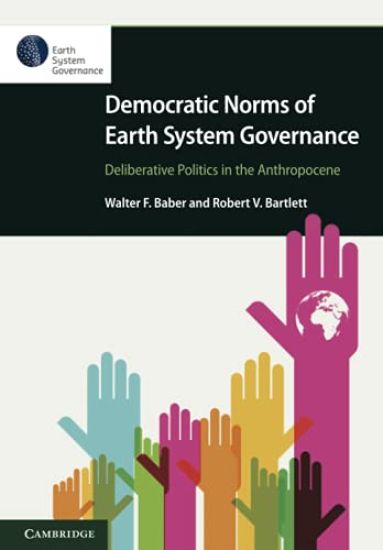
Democratic Norms of Earth System Governance

Democratic Norms of Earth System Governance

Walter F. Baber; Robert V. Bartlett

Cambridge University Press
2021
pokkari
Deliberative democracy is well-suited to the challenges of governing in the Anthropocene. But deliberative democratic practices are only suited to these challenges to the extent that five prerequisites - empoweredness, embeddedness, experimentality, equivocality, and equitableness - are successfully institutionalized. Governance must be: created by those it addresses, applicable equally to all, capable of learning from (and adapting to) experience, rationally grounded, and internalized by those who adopt and experience it. This book analyzes these five major normative principles, pairing each with one of the Earth System Governance Project's analytical problems to provide an in-depth discussion of the minimal conditions for environmental governance that can be truly sustainable. It is ideal for scholars and graduate students in global environmental politics, earth system governance, and international environmental policy. This is one of a series of publications associated with the Earth System Governance Project. For more publications, see www.cambridge.org/earth-system-governance.
Democratic Norms of Earth System Governance

Democratic Norms of Earth System Governance

Walter F. Baber; Robert V. Bartlett

Cambridge University Press
2021
sidottu
Deliberative democracy is well-suited to the challenges of governing in the Anthropocene. But deliberative democratic practices are only suited to these challenges to the extent that five prerequisites - empoweredness, embeddedness, experimentality, equivocality, and equitableness - are successfully institutionalized. Governance must be: created by those it addresses, applicable equally to all, capable of learning from (and adapting to) experience, rationally grounded, and internalized by those who adopt and experience it. This book analyzes these five major normative principles, pairing each with one of the Earth System Governance Project's analytical problems to provide an in-depth discussion of the minimal conditions for environmental governance that can be truly sustainable. It is ideal for scholars and graduate students in global environmental politics, earth system governance, and international environmental policy. This is one of a series of publications associated with the Earth System Governance Project. For more publications, see www.cambridge.org/earth-system-governance.
Environmental Human Rights in Earth System Governance

Environmental Human Rights in Earth System Governance

Walter F. Baber; Robert V. Bartlett

Cambridge University Press
2020
pokkari
Environmental rights are a category of human rights necessarily central to both democracy and effective earth system governance (any environmental-ecological-sustainable democracy). For any democracy to remain democratic, some aspects must be beyond democracy and must not be allowed to be subjected to any ordinary democratic collective choice processes shy of consensus. Real, established rights constitute a necessary boundary of legitimate everyday democratic practice. We analyze how human rights are made democratically and, in particular, how they can be made with respect to matters environmental, especially matters that have import beyond the confines of the modern nation state.