Kirjojen hintavertailu. Mukana 12 595 353 kirjaa ja 12 kauppaa.

Kirjailija

Walter Greiner

Kirjat ja teokset yhdessä paikassa: 22 kirjaa, julkaisuja vuosilta 1995-2024, suosituimpien joukossa Quantum Electrodynamics of Strong Fields. Vertaile teosten hintoja ja tarkista saatavuus suomalaisista kirjakaupoista.

22 kirjaa

Kirjojen julkaisuhaarukka 1995-2024.

Quantum Electrodynamics of Strong Fields

Quantum Electrodynamics of Strong Fields

Walter Greiner; B. Müller; J. Rafelski

Springer-Verlag Berlin and Heidelberg GmbH Co. K
2011
nidottu
The fundamental goal of physics is an understanding of the forces of nature in their simplest and most general terms. Yet there is much more involved than just a basic set of equations which eventually has to be solved when applied to specific problems. We have learned in recent years that the structure of the ground state of field theories (with which we are generally concerned) plays an equally funda­ mental role as the equations of motion themselves. Heisenberg was probably the first to recognize that the ground state, the vacuum, could acquire certain prop­ erties (quantum numbers) when he devised a theory of ferromagnetism. Since then, many more such examples are known in solid state physics, e. g. supercon­ ductivity, superfluidity, in fact all problems concerned with phase transitions of many-body systems, which are often summarized under the name synergetics. Inspired by the experimental observation that also fundamental symmetries, such as parity or chiral symmetry, may be violated in nature, it has become wide­ ly accepted that the same field theory may be based on different vacua. Practical­ ly all these different field phases have the status of more or less hypothetical models, not (yet) directly accessible to experiments. There is one magnificent ex­ ception and this is the change of the ground state (vacuum) of the electron-posi­ tron field in superstrong electric fields.
Extended Lagrange And Hamilton Formalism For Point Mechanics And Covariant Hamilton Field Theory

Extended Lagrange And Hamilton Formalism For Point Mechanics And Covariant Hamilton Field Theory

Jurgen Struckmeier; Walter Greiner

World Scientific Publishing Co Pte Ltd
2024
sidottu
This book presents the extended Lagrange and Hamilton formalisms of point mechanics and field theory in the usual tensor language of standard textbooks on classical dynamics. The notion 'extended' signifies that the physical time of point dynamics as well as the space-time in field theories are treated as dynamical variables. It thus elaborates on some important questions including: How do we convert the canonical formalisms of Lagrange and Hamilton that are built upon Newton's concept of an absolute time into the appropriate form of the post-Einstein era? How do we devise a Hamiltonian field theory with space-time as a dynamical variable in order to also cover General Relativity?In this book, the authors demonstrate how the canonical transformation formalism enables us to systematically devise gauge theories. With the extended canonical transformation formalism that allows to map the space-time geometry, it is possible to formulate a generalized theory of gauge transformations. For a system that is form-invariant under both a local gauge transformation of the fields and under local variations of the space-time geometry, we will find a formulation of General Relativity to emerge naturally from basic principles rather than being postulated.
Channeling and Radiation in Periodically Bent Crystals

Channeling and Radiation in Periodically Bent Crystals

Andrey V. Korol; Andrey V. Solov'yov; Walter Greiner

Springer-Verlag Berlin and Heidelberg GmbH Co. K
2016
nidottu
The development of coherent radiation sources for sub-angstrom wavelengths - i.e. in the hard X-ray and gamma-ray range - is a challenging goal of modern physics. The availability of such sources will have many applications in basic science, technology and medicine and in particular, they may have a revolutionary impact on nuclear and solid state physics, as well as on the life sciences. The present state-of-the-art lasers are capable of emitting electromagnetic radiation from the infrared to the ultraviolet, while free electron lasers (X-FELs) are now entering the soft X-ray region. Moving further, i.e. into the hard X and/or gamma ray band, however, is not possible without new approaches and technologies.In this book we introduce and discuss one such novel approach -the radiation formed in a Crystalline Undulator - whereby electromagnetic radiation is generated by a bunch of ultra-relativistic particles channeling through a periodically bent crystalline structure. Under certain conditions, such a device can emit intensive spontaneous monochromatic radiation and even reach the coherence of laser light sources.Readers will be presented with the underlying fundamental physics and be familiarized with the theoretical, experimental and technological advances made during the last one and a half decades in exploring the various features of investigations into crystalline undulators. This research draws upon knowledge from many research fields - such as materials science, beam physics, the physics of radiation, solid state physics and acoustics, to name but a few. Accordingly, much care has been taken by the authors to make the book as self-contained as possible in this respect, so as to also provide a useful introduction to this emerging field to a broad readership of researchers and scientist with various backgrounds.This new edition has been revised and extended to take recent developments in the field into account.
Pseudo-Complex General Relativity

Pseudo-Complex General Relativity

Peter O. Hess; Mirko Schäfer; Walter Greiner

Springer International Publishing AG
2016
nidottu
This book explores the role of singularities in general relativity (GR): The theory predicts that when a sufficient large mass collapses, no known force is able to stop it until all mass is concentrated at a point. The question arises, whether an acceptable physical theory should have a singularity, not even a coordinate singularity. The appearance of a singularity shows the limitations of the theory. In GR this limitation is the strong gravitational force acting near and at a super-massive concentration of a central mass. First, a historical overview is given, on former attempts to extend GR (which includes Einstein himself), all with distinct motivations. It will be shown that the only possible algebraic extension is to introduce pseudo-complex (pc) coordinates, otherwise for weak gravitational fields non-physical ghost solutions appear. Thus, the need to use pc-variables. We will see, that the theory contains a minimal length, with important consequences. After that, the pc-GR is formulated and compared to the former attempts. A new variational principle is introduced, which requires in the Einstein equations an additional contribution. Alternatively, the standard variational principle can be applied, but one has to introduce a constraint with the same former results. The additional contribution will be associated to vacuum fluctuation, whose dependence on the radial distance can be approximately obtained, using semi-classical Quantum Mechanics. The main point is that pc-GR predicts that mass not only curves the space but also changes the vacuum structure of the space itself. In the following chapters, the minimal length will be set to zero, due to its smallness. Nevertheless, the pc-GR will keep a remnant of the pc-description, namely that the appearance of a term, which we may call "dark energy", is inevitable. The first application will be discussed in chapter 3, namely solutions of central mass distributions. For a non-rotating massive object it is the pc-Schwarzschild solution, for a rotating massive object the pc-Kerr solution and for a charged massive object it will be the Reissner-Nordström solution. This chapter serves to become familiar on how to resolve problems in pc-GR and on how to interpret the results. One of the main consequences is, that we can eliminate the event horizon and thus there will be no black holes. The huge massive objects in the center of nearly any galaxy and the so-called galactic black holes are within pc-GR still there, but with the absence of an event horizon! Chapter 4 gives another application of the theory, namely the Robertson-Walker solution, which we use to model different outcomes of the evolution of the universe. Finally the capability of this theory to predict new phenomena is illustrated.
Pseudo-Complex General Relativity

Pseudo-Complex General Relativity

Peter O. Hess; Mirko Schäfer; Walter Greiner

Springer International Publishing AG
2015
sidottu
This book explores the role of singularities in general relativity (GR): The theory predicts that when a sufficient large mass collapses, no known force is able to stop it until all mass is concentrated at a point. The question arises, whether an acceptable physical theory should have a singularity, not even a coordinate singularity. The appearance of a singularity shows the limitations of the theory. In GR this limitation is the strong gravitational force acting near and at a super-massive concentration of a central mass. First, a historical overview is given, on former attempts to extend GR (which includes Einstein himself), all with distinct motivations. It will be shown that the only possible algebraic extension is to introduce pseudo-complex (pc) coordinates, otherwise for weak gravitational fields non-physical ghost solutions appear. Thus, the need to use pc-variables. We will see, that the theory contains a minimal length, with important consequences. After that, the pc-GR is formulated and compared to the former attempts. A new variational principle is introduced, which requires in the Einstein equations an additional contribution. Alternatively, the standard variational principle can be applied, but one has to introduce a constraint with the same former results. The additional contribution will be associated to vacuum fluctuation, whose dependence on the radial distance can be approximately obtained, using semi-classical Quantum Mechanics. The main point is that pc-GR predicts that mass not only curves the space but also changes the vacuum structure of the space itself. In the following chapters, the minimal length will be set to zero, due to its smallness. Nevertheless, the pc-GR will keep a remnant of the pc-description, namely that the appearance of a term, which we may call "dark energy", is inevitable. The first application will be discussed in chapter 3, namely solutions of central mass distributions. For a non-rotating massive object it is the pc-Schwarzschild solution, for a rotating massive object the pc-Kerr solution and for a charged massive object it will be the Reissner-Nordström solution. This chapter serves to become familiar on how to resolve problems in pc-GR and on how to interpret the results. One of the main consequences is, that we can eliminate the event horizon and thus there will be no black holes. The huge massive objects in the center of nearly any galaxy and the so-called galactic black holes are within pc-GR still there, but with the absence of an event horizon! Chapter 4 gives another application of the theory, namely the Robertson-Walker solution, which we use to model different outcomes of the evolution of the universe. Finally the capability of this theory to predict new phenomena is illustrated.
Channeling and Radiation in Periodically Bent Crystals

Channeling and Radiation in Periodically Bent Crystals

Andrey V. Korol; Andrey V. Solov'yov; Walter Greiner

Springer-Verlag Berlin and Heidelberg GmbH Co. K
2014
sidottu
The development of coherent radiation sources for sub-angstrom wavelengths - i.e. in the hard X-ray and gamma-ray range - is a challenging goal of modern physics. The availability of such sources will have many applications in basic science, technology and medicine and in particular, they may have a revolutionary impact on nuclear and solid state physics, as well as on the life sciences. The present state-of-the-art lasers are capable of emitting electromagnetic radiation from the infrared to the ultraviolet, while free electron lasers (X-FELs) are now entering the soft X-ray region. Moving further, i.e. into the hard X and/or gamma ray band, however, is not possible without new approaches and technologies.In this book we introduce and discuss one such novel approach -the radiation formed in a Crystalline Undulator - whereby electromagnetic radiation is generated by a bunch of ultra-relativistic particles channeling through a periodically bent crystalline structure. Under certain conditions, such a device can emit intensive spontaneous monochromatic radiation and even reach the coherence of laser light sources.Readers will be presented with the underlying fundamental physics and be familiarized with the theoretical, experimental and technological advances made during the last one and a half decades in exploring the various features of investigations into crystalline undulators. This research draws upon knowledge from many research fields - such as materials science, beam physics, the physics of radiation, solid state physics and acoustics, to name but a few. Accordingly, much care has been taken by the authors to make the book as self-contained as possible in this respect, so as to also provide a useful introduction to this emerging field to a broad readership of researchers and scientist with various backgrounds.This new edition has been revised and extended to take recent developments in the field into account.
Physics of Strong Fields

Physics of Strong Fields

Walter Greiner

Springer-Verlag New York Inc.
2014
nidottu
The NATO Advanced Study Institute on Physios of St~ong Fields was held at Maratea/Italy from 1-14 June, 1986. The school was devoted to the advances, theoretical and experimental, in physics of strong fields made during the past five years. The topic of the first week was almost exclusively quantum electrodynamics, with dis­ cussions of symmetry breaking in the ground state, of the physics of strong fields in heavy ion collisions and of precision tests of perturba­ tive quantum electrodynamics. The famous positron lines found at GSI (Darmstadt) and the related question "new particle versus vacuum decay" - (yes or no or both) - constituted the center of experimental advances. This was followed in the second week by the presentation of a broad range of other areas where strong fields occur, reaching from nuclear physics over quantum chromodynamics to gravitation theory and astrophysics. We were fortunate to be able to calIon a body of lecturers who not only made considerable personal contributions to this research but who are also noted for their lecturing skills. Their enthusiasm and dedication for their work was readily transmitted to the students resulting in a very suc­ cessful school.
Classical Mechanics

Classical Mechanics

Walter Greiner

Springer-Verlag Berlin and Heidelberg GmbH Co. K
2009
nidottu
More than a generation of German-speaking students around the world have worked theirwaytoanunderstandingandappreciationofthepowerandbeautyofmodernt- oretical physics-with mathematics, the most fundamental of sciences-using Walter Greiner's textbooks as their guide. The idea of developing a coherent, complete presentation of an entire eld of s- ence in a series of closely related textbooks is not a new one. Many older physicians remember with real pleasure their sense of adventure and discovery as they worked their ways through the classic series by Sommerfeld, by Planck, and by Landau and Lifshitz. From the students' viewpoint, there are a great many obvious advantages to be gained through the use of consistent notation, logical ordering of topics, and - herence of presentation; beyond this, the complete coverage of the science provides a unique opportunity for the author to convey his personal enthusiasm and love for his subject. These volumes on classical physics, nally available in English, complement Greiner's texts on quantum physics, most of which have been available to Engli- speaking audiences for some time. The complete set of books will thus provide a coherent view of physics that includes, in classical physics, thermodynamics and s- tistical mechanics, classical dynamics, electromagnetism, and general relativity; and in quantumphysics, quantummechanics,symmetries, relativistic quantummechanics, quantum electro- and chromodynamics, and the gauge theory of weak interactions.
Gauge Theory of Weak Interactions

Gauge Theory of Weak Interactions

Walter Greiner; Berndt Müller

Springer-Verlag Berlin and Heidelberg GmbH Co. K
2009
nidottu
"Gauge Theory of Weak Interactions" treats the unification of electromagnetic and weak interactions and considers related phenomena. First, the Fermi theory of beta decay is presented, followed by a discussion of parity violation, clarifying the importance of symmetries. Then the concept of a spontaneously broken gauge theory is introduced, and all necessary mathematical tools are carefully developed. The "standard model" of unified electroweak interactions is thoroughly discussed including current developments. The final chapter contains an introduction to unified theories of strong and electroweak interactions. Numerous solved examples and problems make this volume uniquely suited as a text for an advanced course. This fourth edition has been carefully revised.
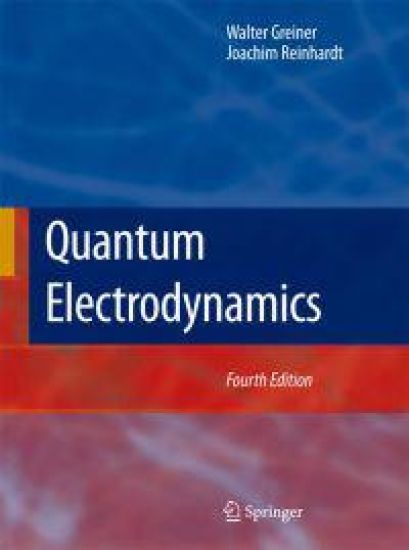
Quantum Electrodynamics

Quantum Electrodynamics

Walter Greiner; Joachim Reinhardt

Springer-Verlag Berlin and Heidelberg GmbH Co. K
2008
nidottu
We are pleased by the positive resonance of our book which now necessitates a fourth edition. We have used this opportunity to implement corrections of misprints and amendments at several places, and to extend and improve the discussion of many of the exercises and examples. We hope that our presentation of the method of equivalent photons (Example 3. 17), the form factor of the electron (Example 5. 7), the infrared catastrophe (Example 5. 8) and the energy shift of atomic levels (Example 5. 9)arenow even better to understand. The new Exercise 5. 10 shows in detail how to arrive at the non-relativistic limit for the calculation of form factors. Moreover, we have brought up-to-date the Biographical Notes about physicists who have contributed to the dev- opment of quantum electrodynamics, and references to experimental tests of the t- ory. For example, there has been recent progress in the determination of the electric and magnetic form factors of the proton (discussed in Exercise 3. 5 on the Rosenbluth formula) and the Lamb shift of high-Z atoms (discussed in Example 5. 9 on the energy shift of atomic levels), while the experimental veri cation of the birefringence of the QED vacuum in a strong magnetic eld (Example 7. 8) remains unsettled and is a topic of active ongoing research.
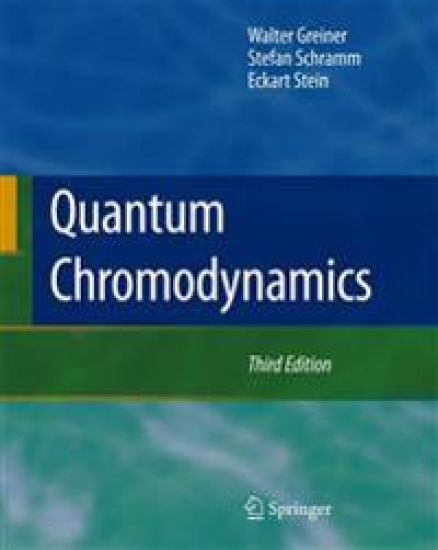
Quantum Chromodynamics

Quantum Chromodynamics

Walter Greiner; Stefan Schramm; Eckart Stein

Springer-Verlag Berlin and Heidelberg GmbH Co. K
2006
nidottu
The third edition of this outstanding volume has been extensively revised and enlarged to cover all new aspects in Quantum chromodynamics. It first reviews relativistic quantum field theory and details scattering theory in the framework of scalar quantum electrodynamics. The book then introduces the gauge theory of quarks and gluons. In addition, more advanced chapters present a through discussion of perturbative and nonperturbative techniques in state-of-the-art QCD. Throughout, worked-out examples provide hands-on experience for students in theoretical physics. Research scientists will also find the book an ideal reference.
Classical Mechanics

Classical Mechanics

Walter Greiner

Springer-Verlag New York Inc.
2003
nidottu
More than a generation of German-speaking students around the world have worked their way to an understanding and appreciation of the power and beauty of modern theoretical physics—with mathematics, the most fundamental of sciences—using Walter Greiner’s textbooks as their guide. The idea of developing a coherent, complete presentation of an entire ?eld of science in a series of closely related textbooks is not a new one. Many older physicians remember with real pleasure their sense of adventure and discovery as they worked their ways through the classic series by Sommerfeld, by Planck, and by Landau and Lifshitz. From the students’ viewpoint, there are a great many obvious advantages to be gained through the use of consistent notation, logical ordering of topics, and coherence of presentation; beyond this, thecompletecoverageofthescienceprovidesauniqueopportunityfortheauthortoconvey his personal enthusiasm and love for his subject. These volumes on classical physics, ?nally availablein English, complement Greiner’s textsonquantumphysics,mostofwhichhavebeenavailabletoEnglish-speakingaudiences for some time. The complete set of books will thus provide a coherent view of physics that includes, in classical physics, thermodynamics and statistical mechanics, classical dyn- ics, electromagnetism, and general relativity; and in quantum physics, quantum mechanics, symmetries, relativistic quantum mechanics, quantum electro- and chromodynamics, and the gauge theory of weak interactions.
Quantum Mechanics

Quantum Mechanics

Walter Greiner; D. Allan Bromley

Springer-Verlag Berlin and Heidelberg GmbH Co. K
2000
nidottu
This text lays the foundations for the rest of the course on advanced quantum mechanics and field theory. Starting from black-body radiation, the photoelectric effect, and wave-particle duality, the author goes on to discuss the uncertainty relations, spin, many-body systems, and other topics.
Relativistic Quantum Mechanics. Wave Equations

Relativistic Quantum Mechanics. Wave Equations

D.A. Bromley; Walter Greiner

Springer-Verlag Berlin and Heidelberg GmbH Co. K
2000
nidottu
This text concentrates mainly on the wave equations for spin-0 and spin-1/2 particles. It deals with the Klein-Gordon equation, the Dirac equation, and numerous applications are discussed such as the two-centre Dirac equation, hole theory, CPT symmetry, Klein's paradox and more.
Mécanique quantique. Une introduction

Mécanique quantique. Une introduction

Walter Greiner

Springer-Verlag Berlin and Heidelberg GmbH Co. K
1999
nidottu
L'ouvrage Mécanique Quantique - Introduction - jette les bases du cours de mécanique quantique et de la théorie des champs. En partant de la radiation du corps noir, de l'effet photoélectrique et de la dualité onde - particule, l'auteur expose les relations de l'incertitude, le spin, et les systèmes à plusieurs corps. Il inclut les applications à l'atome d'hydrogène et les expériences de Stern-Gerlach, et de Einstein-de Haas. Sont aussi présentés en détails l'aspect mathématique de la théorie de représentation, les matrices S, la théorie de la pertubation, les problèmes des valeurs propres, les équations différentielles hypergéometriques. Le lecteur trouvera aussi plus de 80 exemples et exercices, ainsi que leur corrigé, et ceci afin de consolider le propos du livre. Chaque exercice a été soigneusement choisi et traité pour que l'ouvrage soit l'outil de base et de référence de son lecteur.
Thermodynamique et mécanique statistique

Thermodynamique et mécanique statistique

Walter Greiner; Ludwig Neise; Horst Stöcker

Springer-Verlag Berlin and Heidelberg GmbH Co. K
1999
nidottu
L'ouvrage Thermodynamique et mécanique statistique jette les bases du cours en couvrant la thermodynamique, la mécanique statistique, la statistique quantique, des gaz réels et des transitions de phase. En partant d'une méthode inductive - qui est la plus proche de la méthodologie de la recherche en physique - le texte commence avec des observations expérimentales "clef" pour développer le cadre de la théorie par la suite. Après avoir obtenu les équations fondamentales des phénomènes nouveaux sont traités à partir de la.
Mécanique quantique. Symétries

Mécanique quantique. Symétries

Walter Greiner; Berndt Müller

Springer-Verlag Berlin and Heidelberg GmbH Co. K
1999
nidottu
L'ouvrage traite d'un concept particulièrement attractif du cours de mécanique quantique avancé, c'est à dire les symétries. Après une brève introduction aux symétries en mécanique classique, le texte s'attache à leur place en mécanique quantique, aux conséquences de la symétrie de rotation, ainsi qu'à la théorie générale des groupes de Lie. Les groupes isospin, l'hypercharge SU(3), et leurs applications sont traités avant les chapitres sur les quarks et leur charme, SU(4), ainsi que les symétries dynamiques et les frontières de la recherche en physique des particules. Ce texte unique comprend plus de 120 problèmes et exercices très détaillés et corrigés, afin d'en faire l'ouvrage de référence en la matière.
Classical Electrodynamics

Classical Electrodynamics

Walter Greiner; D.A. Bromley

Springer-Verlag New York Inc.
1998
nidottu
More than a generation of German-speaking students around the world have worked their way to an understanding and appreciation of the power and beauty of modern theoretical physics-with mathematics, the most fundamental of sciences-using Walter Greiner's textbooks as their guide. The idea of developing a coherent, complete presentation of an entire field of science in a series of closely related textbooks is not a new one. Many older physicians remember with real pleasure their sense of adventure and discovery as they worked their ways through the classic series by Sommerfeld, by Planck, and by Landau and Lifshitz .. From the students' viewpoint, there are a great many obvious advantages to be gained through the use of consistent notation, logical ordering of topics, and coherence of presentation; beyond this, the complete coverage of the science provides a unique opportunity for the author to convey his personal enthusiasm and love for his subject. These volumes on classical physics,finally available in English, complement Greiner's texts on quantum physics, most of which have been available to English-speaking audiences for some time. The complete set of books will thus provide a coherent view of physics that includes, in classical physics, thermodynamics and statistical mechanics, classical dynam­ ics, electromagnetism, and general relativity; and in quantum physics, quantum mechanics, symmetries, relativistic quantum mechanics, quantum electro-and chromodynamics, and the gauge theory of weak interactions.
Quantum Mechanics

Quantum Mechanics

Walter Greiner

Springer-Verlag Berlin and Heidelberg GmbH Co. K
1997
nidottu
Quantum Mechanics -- Special Chapters is an important additional course for third-year students. Starting with the quantization of a free electromagnetic field and its interaction with matter, it discusses second quantization and interacting quantum fields. After re-normalization problems and a general treatment of nonrelativistic quantum field theory, these methods are applied to problems from solid-state physics and plasma physics: quantum gas, superfluidity, plasmons, and photons. The book concludes with an introduction to quantum statistics, the structure of atoms and molecules, and the Schrödinger wave equation formulated by Feynman path integrals. 72 fully and carefully worked examples and problems consolidate the material.
Nuclear Models

Nuclear Models

Walter Greiner; D.A. Bromley; Joachim A. Maruhn

Springer-Verlag Berlin and Heidelberg GmbH Co. K
1996
nidottu
Theoretical physics has become a many-faceted science. For the young student it is difficult enough to cope with the overwhelming amount of new scientific material that has to be learned, let alone to obtain an overview of the entire field, which ranges from mechanics through electrodynamics, quantum mechanics, field theory, nuclear and heavy-ion science, statistical mechanics, thermodynamics, and solid­ state theory to elementary-particle physics. And this knowledge should be acquired in just 8-10 semesters during which, in addition, a Diploma or Master's thesis has to be worked on or examinations prepared for. All this can be achieved only if the university teachers help to introduce the student to the new disciplines as early on as possible, in order to create interest and excitement that in turn set free essential new energy. Naturally, all inessential material must simply be eliminated. At the Johann Wolfgang Goethe University in Frankfurt we therefore confront the student with theoretical physics immediately in the first semester. Theoretical Mechanics I and II, Electrodynamics, and Quantum Mechanics I - an Introduction are the basic courses during the first two years. These lectures are supplemented with many mathematical explanations and much support material. After the fourth semester of studies, graduate work begins and Quantum Mechanics II - Symme­ tries, Statistical Mechanics and Thermodynamics, Relativistic Quantum Mechanics, Quantum Electrodynamics, the Gauge Theory of Weak Interactions, and Quantum Chromodynamics are obligatory.