Kirjojen hintavertailu. Mukana 12 657 676 kirjaa ja 12 kauppaa.
Kirjailija
Walter Jerrold
Kirjat ja teokset yhdessä paikassa: 84 kirjaa, julkaisuja vuosilta 1993-2026, suosituimpien joukossa Charles Lamb. Vertaile teosten hintoja ja tarkista saatavuus suomalaisista kirjakaupoista.
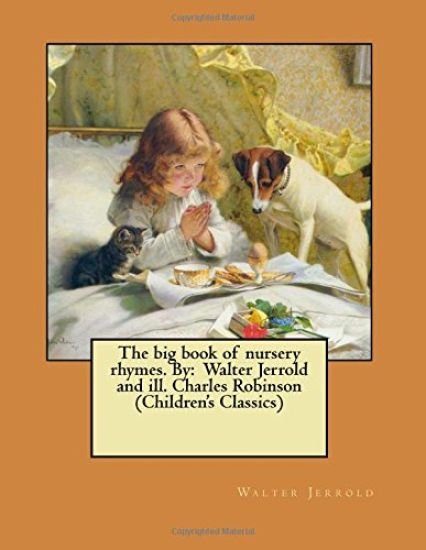
This republication of "The Big Book of Nursery Rhymes," newly arranged to best display the rhymes and their original illustrations, while maintaining the original pagination, is intended to reintroduce the nursery rhymes of a century past to the children of today. Nursery rhymes carry fragments of the history, culture, religion, and ideas of the 15th or 16th through the 19th Centuries, which should be preserved and passed on to new generations. Parents and children will love reading these rhymes, and will delight in the wonderful illustrations. Originally Edited by Walter Jerrold. Illustrated by Charles Robinson. Published by Blackie and Son, Ltd., London, 1920. From the Introduction: "The very title, Nursery Rhymes, which has come to be associated with a great body of familiar verse, is in itself sufficient indication of the manner in which that verse has been passed down from generation to generation. Who composed the little pieces it is, save in a few cases, impossible to say: some are certainly very old and were doubtless repeated thousands of times before their first appearance in print. References to certain favourites may be found in the pages of the dramatists of Elizabeth's time. "Attempts are sometimes made to read into these Rhymes a deeper significance than the obvious and simple one which has accounted for their enduring popularity in the Nursery, but this volume has no concern with such profound interpretations, any more than have the little people who love the old jingles best. "Students divide our rhymes into narrative pieces, historical, folk-lore, game rhymes, counting-out rhymes, jingles, fragments, and so forth, but for the children for whom and by whom they are remembered, and for whose sake they are here collected and pictured anew, they are just-Nursery Nursery Rhymes." Caution to Parents: Nursery rhymes that were acceptable for children of the 19th Century might prove confusing or unsettling for children of the 21st Century, so far removed in tiome from the manners and issues of that time; parents are encouraged to read these rhymes with their children.
The Virginians: A Tale of the Last Century (1857-59) is a historical novel by William Makepeace Thackeray which forms a sequel to his Henry Esmond and is also loosely linked to Pendennis. PLOT: It tells the story of Henry Esmond's twin grandsons, George and Henry Warrington. Henry's romantic entanglements with an older woman lead up to his taking a commission in the British army and fighting under the command of General Wolfe at the capture of Quebec. On the outbreak of the American War of Independence he takes the revolutionary side. George, who is also a British officer, thereupon resigns his commission rather than take up arms against his brother.... William Makepeace Thackeray (18 July 1811 - 24 December 1863) was an English novelist of the 19th century. He is known for his satirical works, particularly Vanity Fair, a panoramic portrait of English society. BIOGRAPHY: Thackeray, an only child, was born in Calcutta, British India, where his father, Richmond Thackeray (1 September 1781 - 13 September 1815), was secretary to the Board of Revenue in the British East India Company. His mother, Anne Becher (1792-1864), was the second daughter of Harriet Becher and John Harman Becher, who was also a secretary (writer) for the East India Company. Richmond died in 1815, which caused Anne to send her son to England in 1816, while she remained in British India. The ship on which he travelled made a short stopover at St. Helena, where the imprisoned Napoleon was pointed out to him. Once in England he was educated at schools in Southampton and Chiswick, and then at Charterhouse School, where he became a close friend of John Leech. Thackeray disliked Charterhouse, and parodied it in his fiction as "Slaughterhouse". Nevertheless, Thackeray was honoured in the Charterhouse Chapel with a monument after his death. Illness in his last year there, during which he reportedly grew to his full height of six foot three, postponed his matriculation at Trinity College, Cambridge, until February 1829. citation needed]Never too keen on academic studies, Thackeray left Cambridge in 1830, but some of his earliest published writing appeared in two university periodicals, The Snob and The Gownsman. Thackeray then travelled for some time on the continent, visiting Paris and Weimar, where he met Goethe. He returned to England and began to study law at the Middle Temple, but soon gave that up. On reaching the age of 21 he came into his inheritance from his father, but he squandered much of it on gambling and on funding two unsuccessful newspapers, The National Standard and The Constitutional, for which he had hoped to write. He also lost a good part of his fortune in the collapse of two Indian banks. Forced to consider a profession to support himself, he turned first to art, which he studied in Paris, but did not pursue it, except in later years as the illustrator of some of his own novels and other writings. Thackeray's years of semi-idleness ended after he married, on 20 August 1836, Isabella Gethin Shawe (1816-1893), second daughter of Isabella Creagh Shawe and Matthew Shawe, a colonel who had died after distinguished service, primarily in India. The Thackerays had three children, all girls: Anne Isabella (1837-1919), Jane (who died at eight months old) and Harriet Marian (1840-1875), who married Sir Leslie Stephen, editor, biographer and philosopher. Walter Copeland Jerrold (1865-1929) was an English writer, biographer and newspaper editor. Ernest Percival Rhys ( 17 July 1859 - 25 May 1946) was a Welsh-English writer, best known for his role as founding editor of the Everyman's Library series of affordable classics. He wrote essays, stories, poetry, novels and plays.
INTRODUCTION THE very title "Nursery Rhymes", which has come to be associated with a A great body of familiar verse, is in itself sufficient evidence ot how that verse has been passed down from generation to generation. Some pieces date, perhaps, from hundreds of years ago, and had been repeated thousands of times betore they were printed. There are not wanting learned tolk who tell us that there was once, in Britain, a King Cole, and that the only relic of his reign which we have is the verse in which he is shown calling for his pipe, his bowl, and his fiddlers three. Such wise people forget that pipes were not smoked here before the days of Queen Elizabeth, and that fiddles were not known before the sixteenth century. It is certain, however, that some ot these rhymes were familiar in those great days; Shakespeare seems to reter to one
For combined beauty and interest-varied beauty and historical interest-there is no place "within easy reach of London", certainly no place within the suburban radius, that can compare with the stately Tudor palace which stands on the left bank of the Thames, little more than a dozen miles from the metropolis and, though hidden in trees, within eye-reach of Richmond.