

Kirjailija
Walter Pater
Kirjat ja teokset yhdessä paikassa: 206 kirjaa, julkaisuja vuosilta 1910-2025, suosituimpien joukossa The Works Of Walter Pater. Vertaile teosten hintoja ja tarkista saatavuus suomalaisista kirjakaupoista.
206 kirjaa
Kirjojen julkaisuhaarukka 1910-2025.
Walter Pater (1839–94) was the foremost Victorian writer on art and aesthetic experience. He brought his knowledge of the history of art to bear on the new problem of how to explain the very personal affective response to beauty, and raised this into a central concern of aesthetic and philosophical thought. His ideas still shape modern assumptions about how art plays on our feelings and intellectual responses. This edition of Pater's complete works was published in 1900–1 in a limited edition of 775 copies. It comprises eight volumes of his major works with an additional volume of critical essays. Following the publication of his novel in 1885, Pater continued his experiments with thinking through fiction in these short portraits of historical figures, published as Imaginary Portraits (1887) and Gaston de Latour (1888–9). The theme of talented, beautiful young men who die young reflects Pater's aesthetic outlook.
Walter Pater (1839–94) was the foremost Victorian writer on art and on aesthetic experience. He brought his extensive knowledge of the history of art to bear on the new problem of how to explain the very personal affective response to beauty, and raised this into a central concern of aesthetic and philosophical thought. His ideas still shape modern assumptions about how art plays on our feelings and intellectual responses. This edition of Pater's complete works was published in 1900–1 in a limited edition of 775 copies. It comprises eight volumes with an additional volume of critical essays first published in The Guardian. This is the first of two volumes of Marius the Epicurean (1885), Pater's only full-length fiction. A novel of ideas, combining history and philosophy with a fictional narrative set in the late Roman Empire, the work is a fascinating experiment in the boundaries of genre.

Reproduction of the original. The publishing house Megali specialises in reproducing historical works in large print to make reading easier for people with impaired vision.

Reproduction of the original. The publishing house Megali specialises in reproducing historical works in large print to make reading easier for people with impaired vision.

Walter Pater's book Marius the Epicurean is split into two parts. After the success of the first book, the second one is called Marius The Epicurean Vol 2 'His Sensations and Ideas.' The book goes on with the story of Marius, a young Roman prince who is looking for a way to live that will make him happy. In this volume, Marius goes to Athens to study philosophy with Marcus Aurelius, who is a Stoic scholar. Marius's time in Athens gives him a chance to think about duty, ethics, and the nature of the soul. He looks at how art and life are connected and how beauty and pleasure can help us understand the world better. The book is also known for how it looks at the conflict between Christianity and paganism. Marius struggles to find a balance between his Christian faith and his desire to live a fun life.


Marius the Epicurean (Volume 1) has been regarded as significant work throughout human history, and in order to ensure that this work is never lost, we have taken steps to ensure its preservation by republishing this book in a contemporary format for both current and future generations. This entire book has been retyped, redesigned, and reformatted. Since these books are not made from scanned copies, the text is readable and clear.
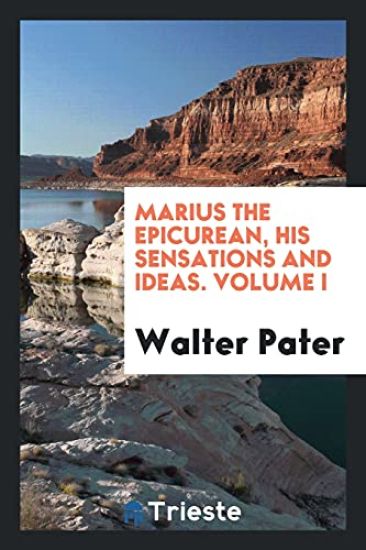
Marius the Epicurean, His Sensations and Ideas. Volume I
Walter Pater
Trieste Publishing
2018
nidottu


Walter Pater (1839–94) was the foremost Victorian writer on art and on aesthetic experience. He brought his extensive knowledge of the history of art to bear on the new problem of how to explain the very personal affective response to beauty, and raised this into a central concern of aesthetic and philosophical thought. His ideas still shape modern assumptions about how art plays on our feelings and intellectual responses. This edition of Pater's complete works was published in 1900–1 in a limited edition of 775 copies. It comprises eight volumes with an additional volume of critical essays first published in The Guardian. These lectures on Plato were a product of Pater's teaching at the University of Oxford, but underwent several rounds of revision before being published in 1893. Pater analyses several aspects of Plato's thought, his relationship with Socrates, and his major works.
Walter Pater (1839–94) was the foremost Victorian writer on art and aesthetic experience. He brought his knowledge of the history of art to bear on the new problem of how to explain the very personal affective response to beauty, and raised this into a central concern of aesthetic and philosophical thought. His ideas still shape modern assumptions about our response to art. This edition of Pater's complete works was published in 1900–1 in a limited edition of 775 copies. It comprises eight volumes of his major works with an additional volume of essays first published in The Guardian. This volume reissues Pater's magazine articles along with his early essay 'Diaphanitè', a work that had been controversial for its homoerotic subtext. The collection was first published in 1895 as part of his literary executor C. L. Shadwell's aim to promote Pater's work. This version includes a chronology of Pater's writings.
Walter Pater (1839–94) was the foremost Victorian writer on art and on aesthetic experience. He brought his extensive knowledge of the history of art to bear on the new problem of how to explain the very personal affective response to beauty, and raised this into a central concern of aesthetic and philosophical thought. His ideas still shape modern assumptions about how art plays on our feelings and intellectual responses. This edition of Pater's complete works was published in 1900–1 in a limited edition of 775 copies. It comprises eight volumes of his major works with an additional volume of critical essays first published in The Guardian. The collection of Pater's articles on ancient Greek thought, poetry, sculpture and architecture presented in this volume had previously been published in 1895 under the editorship of Pater's friend and literary executor C. L. Shadwell.