Kirjojen hintavertailu. Mukana 12 137 604 kirjaa ja 12 kauppaa.

Kirjailija

Walter Zucchini

Kirjat ja teokset yhdessä paikassa: 6 kirjaa, julkaisuja vuosilta 2002-2021, suosituimpien joukossa Estimating Animal Abundance. Vertaile teosten hintoja ja tarkista saatavuus suomalaisista kirjakaupoista.

6 kirjaa

Kirjojen julkaisuhaarukka 2002-2021.

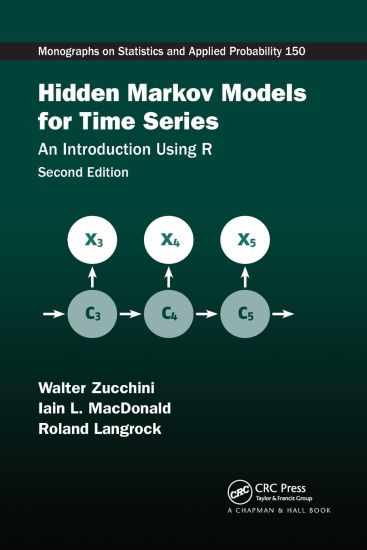
Hidden Markov Models for Time Series

Hidden Markov Models for Time Series

Walter Zucchini; Iain L. MacDonald; Roland Langrock

TAYLOR FRANCIS LTD
2021
nidottu
Hidden Markov Models for Time Series: An Introduction Using R, Second Edition illustrates the great flexibility of hidden Markov models (HMMs) as general-purpose models for time series data. The book provides a broad understanding of the models and their uses.After presenting the basic model formulation, the book covers estimation, forecasting, decoding, prediction, model selection, and Bayesian inference for HMMs. Through examples and applications, the authors describe how to extend and generalize the basic model so that it can be applied in a rich variety of situations.The book demonstrates how HMMs can be applied to a wide range of types of time series: continuous-valued, circular, multivariate, binary, bounded and unbounded counts, and categorical observations. It also discusses how to employ the freely available computing environment R to carry out the computations.FeaturesPresents an accessible overview of HMMsExplores a variety of applications in ecology, finance, epidemiology, climatology, and sociologyIncludes numerous theoretical and programming exercisesProvides most of the analysed data sets online New to the second editionA total of five chapters on extensions, including HMMs for longitudinal data, hidden semi-Markov models and models with continuous-valued state processNew case studies on animal movement, rainfall occurrence and capture-recapture data
Hidden Markov Models for Time Series

Hidden Markov Models for Time Series

Walter Zucchini; Iain L. MacDonald; Roland Langrock

Apple Academic Press Inc.
2016
sidottu
Hidden Markov Models for Time Series: An Introduction Using R, Second Edition illustrates the great flexibility of hidden Markov models (HMMs) as general-purpose models for time series data. The book provides a broad understanding of the models and their uses.After presenting the basic model formulation, the book covers estimation, forecasting, decoding, prediction, model selection, and Bayesian inference for HMMs. Through examples and applications, the authors describe how to extend and generalize the basic model so that it can be applied in a rich variety of situations.The book demonstrates how HMMs can be applied to a wide range of types of time series: continuous-valued, circular, multivariate, binary, bounded and unbounded counts, and categorical observations. It also discusses how to employ the freely available computing environment R to carry out the computations.FeaturesPresents an accessible overview of HMMsExplores a variety of applications in ecology, finance, epidemiology, climatology, and sociologyIncludes numerous theoretical and programming exercisesProvides most of the analysed data sets online New to the second editionA total of five chapters on extensions, including HMMs for longitudinal data, hidden semi-Markov models and models with continuous-valued state processNew case studies on animal movement, rainfall occurrence and capture-recapture data
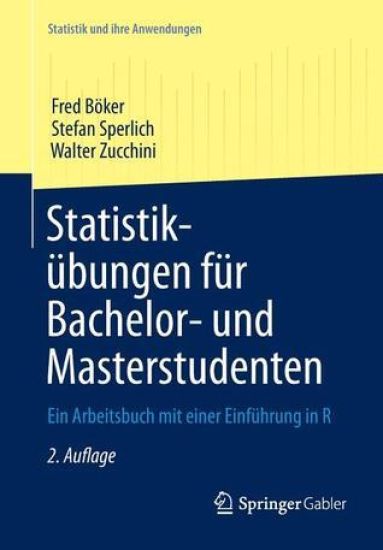
Statistikübungen für Bachelor- und Masterstudenten

Statistikübungen für Bachelor- und Masterstudenten

Fred Böker; Stefan Sperlich; Walter Zucchini

Springer-Verlag Berlin and Heidelberg GmbH Co. K
2013
nidottu
Das Übungsbuch stellt eine ausgesuchte Sammlung von Problemstellungen und Lösungen bereit, die durch eine Formelsammlung mit den wichtigsten im Buch verwendeten Formeln abgerundet wird. Zusätzlich wird ein umfangreiches Set von Programmen in R zur Verfügung gestellt, die zur Aufgabenstellung und Lösung geschrieben wurden. Der Anhang des Buches beinhaltet daher auch eine kurze Einführung in die Statistik-Software R.Der Inhalt, Organisation inklusive Kapitelaufteilung orientiert sich an dem bei Springer erschienenem Werk "Statistik für Bachelor- und Masterstudenten: Eine Einführung für Wirtschafts- und Sozialwissenschaftler"
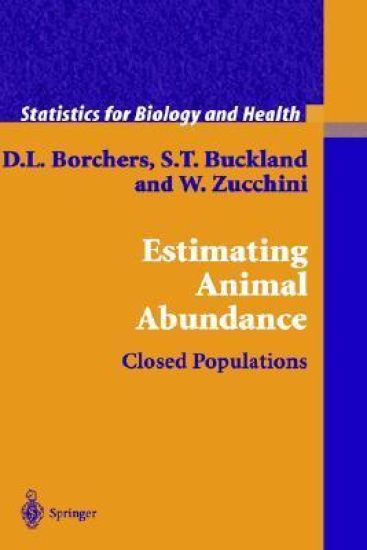
Estimating Animal Abundance

Estimating Animal Abundance

D.L. Borchers; Stephen T. Buckland; Walter Zucchini

Springer London Ltd
2010
nidottu
We hope this book will make the bewildering variety of methods for estimat­ ing the abundance of animal populations more accessible to the uninitiated and more coherent to the cogniscenti. We have tried to emphasize the fun­ damental similarity of many methods and to draw out the common threads that underlie them. With the exception of Chapter 13, we restrict ourselves to closed populations (those that do not change in composition over the period(s) being considered). Open population methods are in many ways simply extensions of closed population methods, and we have tried to pro­ vide the reader with a foundation on which understanding of both closed and open population methods can develop. We would like to thank Miguel Bernal for providing the St Andrews example dataset used frequently in the book; Miguel Bernal and Jeff Laake for commenting on drafts of the book; Jeff Laake for providing Figure 10.1; NRC Research Press for allowing us to use Figures 10.2, 10.3, 10.4, 10.5, 10.6 and10.7; the International Whaling Commission for allowing us to use Figure 12.1; Sharon Hedley for providing Figures 12.1 and 12.2. D.L.B. is eternally indebted to Carol, Alice and Aidan for their support through writing the book, and for the many evenings and weekends that it has taken from them.
Statistik für Bachelor- und Masterstudenten

Statistik für Bachelor- und Masterstudenten

Walter Zucchini; Andreas Schlegel; Oleg Nenadic; Stefan Sperlich

Springer-Verlag Berlin and Heidelberg GmbH Co. K
2009
nidottu
Dieses Buch ist speziell auf die Bedürfnisse von Anfängern im Fach Statistik zugeschnitten. Es eignet sich für Bachelor- und Masterstudenten aller Disziplinen, auch wenn die Beispiele ihren Schwerpunkt in den Wirtschaftswissenschaften finden. Die wesentlichen Konzepte, ihre Ideen und Umsetzung werden im Detail erklärt und anhand von Beispielen erläutert. Das Buch enthält viele, meist einfache Beispiele aus der Praxis, die das Interesse der Leser wecken und die Anwendung der Methoden illustrieren sollen. Der Stil ist betont mathematisch informell, und nimmt dem Leser daher die Angst vor den ansonsten recht technisch geschriebenen Konkurrenzwerken - ohne jedoch dadurch auf eine exakte Darstellung zu verzichten. Unter anderem aus diesem Grund ist der Text auch sehr für das Selbststudium zu empfehlen.
Estimating Animal Abundance

Estimating Animal Abundance

D.L. Borchers; Stephen T. Buckland; Walter Zucchini

Springer London Ltd
2002
sidottu
We hope this book will make the bewildering variety of methods for estimat­ ing the abundance of animal populations more accessible to the uninitiated and more coherent to the cogniscenti. We have tried to emphasize the fun­ damental similarity of many methods and to draw out the common threads that underlie them. With the exception of Chapter 13, we restrict ourselves to closed populations (those that do not change in composition over the period(s) being considered). Open population methods are in many ways simply extensions of closed population methods, and we have tried to pro­ vide the reader with a foundation on which understanding of both closed and open population methods can develop. We would like to thank Miguel Bernal for providing the St Andrews example dataset used frequently in the book; Miguel Bernal and Jeff Laake for commenting on drafts of the book; Jeff Laake for providing Figure 10.1; NRC Research Press for allowing us to use Figures 10.2, 10.3, 10.4, 10.5, 10.6 and10.7; the International Whaling Commission for allowing us to use Figure 12.1; Sharon Hedley for providing Figures 12.1 and 12.2. D.L.B. is eternally indebted to Carol, Alice and Aidan for their support through writing the book, and for the many evenings and weekends that it has taken from them.