Kirjojen hintavertailu. Mukana 12 593 641 kirjaa ja 12 kauppaa.

Kirjailija

Warsame Hassan Ali

Kirjat ja teokset yhdessä paikassa: 5 kirjaa, julkaisuja vuosilta 2019-2025, suosituimpien joukossa Signals and Systems. Vertaile teosten hintoja ja tarkista saatavuus suomalaisista kirjakaupoista.

5 kirjaa

Kirjojen julkaisuhaarukka 2019-2025.

Computer Aided Engineering Design and Manufacturing

Computer Aided Engineering Design and Manufacturing

Wasim Ahmed Khan; Volkan Esat; Muhammad Hammad; Warsame Hassan Ali; Muhammad Qasim Zafar; Rashid Ali

Springer International Publishing AG
2025
sidottu
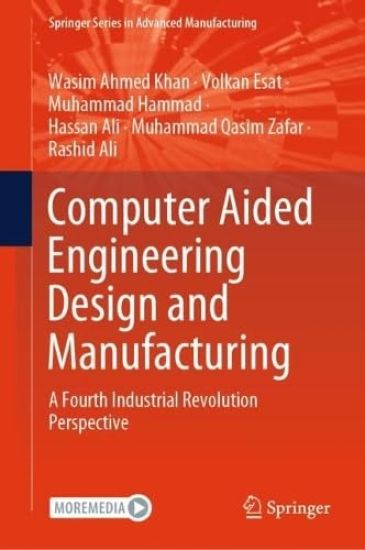
This text introduces the modern concepts relevant to system engineering design and manufacturing from a 4th Industrial Revolution perspective. The book surveys the current status and cutting edge in Computer Aided Design and Computer Aided Manufacturing (CAD/CAM). This bridges the gaps between academic research and industry. It consists of seven parts and seventeen chapters that first structure the subject areas and later detail the main topics under consideration. Each part of the book and each chapter contains a prelude guiding the reader in a systematic way to the next part or topic. The book explains concepts using state-of-the-art teaching methods, using objectives, learning outcomes and review questions. MS PowerPoint Slides and Solution Manual for instructors are available online as well as videos.
Signals and Systems

Signals and Systems

Matthew N. O. Sadiku; Warsame Hassan Ali; Sarhan M. Musa

TAYLOR FRANCIS LTD
2024
sidottu
The idea of signals and systems arises in different disciplines such as science, engineering, economics, politics, and medicine. Typical examples of systems include radio and television, telephone networks, radar systems, computer networks, wireless communication, military surveillance systems, and satellite communication systems. Knowledge of a broad range of signals and systems is of practical value to engineering students because engineers must be familiar with signal and system concepts to analyze some specific signals and systems they will deal with in their professional lives. This book is intended to serve as a textbook for junior-level students in electrical and computer engineering. The main aim of this second edition is to improve the clarity of the first edition and fulfill the same objective as the first, which is to present continuous-time and discrete-time signals and systems to electrical and computer engineering students in a manner that is clearer, more interesting, and easier to understand than other texts.
Fundamentals of Electric Machines: A Primer with MATLAB

Fundamentals of Electric Machines: A Primer with MATLAB

Warsame Hassan Ali; Matthew N. O. Sadiku; Samir Abood

TAYLOR FRANCIS LTD
2021
nidottu
An electric machine is a device that converts mechanical energy into electrical energy or vice versa. It can take the form of an electric generator, electric motor, or transformer. Electric generators produce virtually all electric power we use all over the world. Electric machine blends the three major areas of electrical engineering: power, control and power electronics. This book presents the relation of power quantities for the machine as the current, voltage power flow, power losses, and efficiency. This book will provide a good understanding of the behavior and its drive, beginning with the study of salient features of electrical dc and ac machines.
Signals and Systems

Signals and Systems

Matthew N. O. Sadiku; Warsame Hassan Ali

CRC Press
2020
nidottu
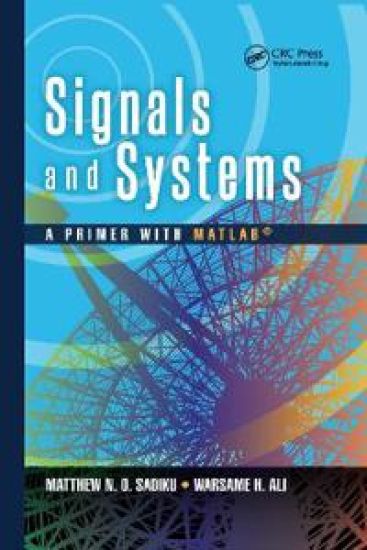
Signals and Systems: A Primer with MATLAB® provides clear, interesting, and easy-to-understand coverage of continuous-time and discrete-time signals and systems. Each chapter opens with a historical profile or career talk, followed by an introduction that states the chapter objectives and links the chapter to the previous ones. All principles are presented in a lucid, logical, step-by-step approach. As much as possible, the authors avoid wordiness and detail overload that could hide concepts and impede understanding. In recognition of the requirements by the Accreditation Board for Engineering and Technology (ABET) on integrating computer tools, the use of MATLAB® is encouraged in a student-friendly manner. MATLAB is introduced in Appendix B and applied gradually throughout the book.Each illustrative example is immediately followed by a practice problem along with its answer. Students can follow the example step by step to solve the practice problem without flipping pages or looking at the end of the book for answers. These practice problems test students’ comprehension and reinforce key concepts before moving on to the next section.Toward the end of each chapter, the authors discuss some application aspects of the concepts covered in the chapter. The material covered in the chapter is applied to at least one or two practical problems or devices. This helps students see how the concepts are applied to real-life situations.In addition, thoroughly worked examples are given liberally at the end of every section. These examples give students a solid grasp of the solutions as well as the confidence to solve similar problems themselves. Some of the problems are solved in two or three ways to facilitate a deeper understanding and comparison of different approaches. Ten review questions in the form of multiple-choice objective items are provided at the end of each chapter with answers. The review questions are intended to cover the "little tricks" that the examples and end-of-chapter problems may not cover. They serve as a self-test device and help students determine chapter mastery. Each chapter also ends with a summary of key points and formulas.Designed for a three-hour semester course on signals and systems, Signals and Systems: A Primer with MATLAB® is intended as a textbook for junior-level undergraduate students in electrical and computer engineering. The prerequisites for a course based on this book are knowledge of standard mathematics (including calculus and differential equations) and electric circuit analysis.
Fundamentals of Electric Machines: A Primer with MATLAB

Fundamentals of Electric Machines: A Primer with MATLAB

Warsame Hassan Ali; Matthew N. O. Sadiku; Samir Abood

CRC Press
2019
sidottu
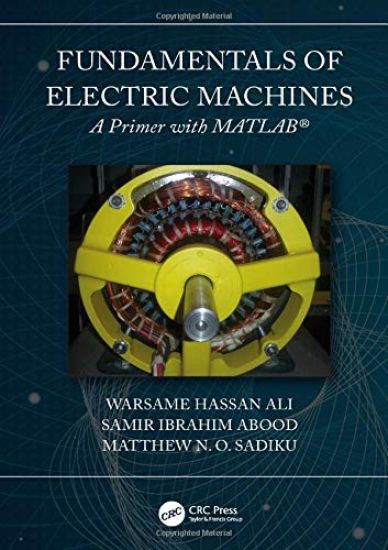
An electric machine is a device that converts mechanical energy into electrical energy or vice versa. It can take the form of an electric generator, electric motor, or transformer. Electric generators produce virtually all electric power we use all over the world. Electric machine blends the three major areas of electrical engineering: power, control and power electronics. This book presents the relation of power quantities for the machine as the current, voltage power flow, power losses, and efficiency. This book will provide a good understanding of the behavior and its drive, beginning with the study of salient features of electrical dc and ac machines.