Kirjojen hintavertailu. Mukana 12 595 353 kirjaa ja 12 kauppaa.

Kirjailija

Webb Keane

Kirjat ja teokset yhdessä paikassa: 9 kirjaa, julkaisuja vuosilta 1997-2026, suosituimpien joukossa Four Lectures on Ethics – Anthropological Perspectives. Vertaile teosten hintoja ja tarkista saatavuus suomalaisista kirjakaupoista.

9 kirjaa

Kirjojen julkaisuhaarukka 1997-2026.

Four Lectures on Ethics – Anthropological Perspectives

Four Lectures on Ethics – Anthropological Perspectives

Michael Lambek; Veena Das; Didier Fassin; Webb Keane

HAU
2015
nidottu
Anthropology has recently seen a lively interest in the subject of ethics and comparative notions of morality and freedom. This masterclass brings together four of the most eminent anthropologists working in this field-Michael Lambek, Veena Das, Didier Fassin, and Webb Keane-to discuss, via lectures and responses, important topics facing anthropological ethics and the theoretical debates that surround it. The authors explore the ways we understand morality across many different cultural settings, asking questions such as: How do we recognize the ethical in different ethnographic worlds? What constitutes agency and awareness in everyday life? What might an anthropology of ordinary ethics look like? And what happens when ethics approaches the political in both Western and non-Western societies. Contrasting perspectives and methods-and yet in complimentary ways-this masterclass will serve as an essential guide for how an anthropology of ethics can be formulated in the twenty-first century.

Animals, Robots, Gods

Animals, Robots, Gods

Webb Keane

PENGUIN BOOKS LTD
2025
pokkari
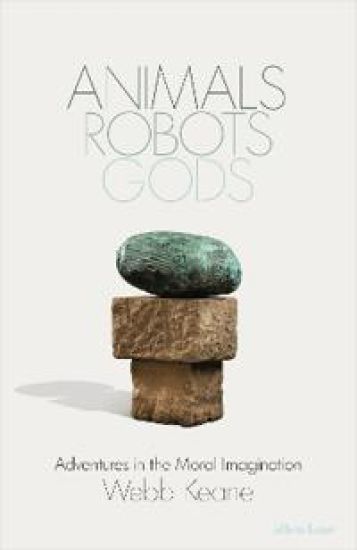
How do we live ethical lives alongside others? A fascinating, mind-expanding exploration of our moral universe We have always lived with ethically significant others, whether they are the pets we keep, the gods we believe in or the machines we are endowing with life. How should we treat them as our world changes? In Animals, Robots, Gods, acclaimed anthropologist Webb Keane provides a new vision of ethics, defined less by our minds, religion or society, and more by our interactions with those around us. Drawing on ground-breaking research by fieldworkers around the world, he explores the underpinnings of our moral universe. Along the way we investigate the ethical dilemmas of South Asian animal rights activists, Balinese cockfighters, Japanese robot fanciers -- even macho cowboys. We meet a hunter in the Yukon who explains his prey generously gives itself up to him; a cancer sufferer in Thailand who sees his tumour as a reincarnated ox; a computer that gets you to confess your anxieties as if you were on the psychiatrist's couch. With charm, wit and insight, Keane offers us a better understanding of our doubts and certainties, showing how centuries of conversations between us and non-humans inform our conceptions of morality, and will continue to guide us in the age of AI and beyond.
Animals, Robots, Gods: Adventures in the Moral Imagination
A mind-expanding exploration of the ethical bonds we share with the nonhuman Moral relationships saturate the living world, and the line between the human and nonhuman is blurrier than we might think. Animals, Robots, Gods provides a bold new vision of ethics defined less by the individual mind or society and more by our interactions with those around us, whether they are the pets we keep, the gods we believe in, or the machines we endow with life. Drawing on pioneering fieldwork around the globe by some of today's leading researchers, acclaimed anthropologist Webb Keane invites us to expand our moral imagination. We learn about the ethical dilemmas of South Asian animal rights activists, Balinese cockfighters, cowboys, and Japanese robot fanciers. We meet a hunter in the Yukon who explains to a bear why it must come out of hibernation and generously give itself up to him, a cancer sufferer in Thailand who sees his tumor as a reincarnated ox, and a computer that persuades users to confess their anxieties as if they were patients on a psychiatrist's couch. Through these and other stories, Keane challenges us to rethink our most basic ideas about who--and what--we deem worthy of moral consideration. Brimming with charm, wit, and insight, Animals, Robots, Gods reveals how centuries of conversations between us and nonhumans inform our conceptions of morality and will continue to guide us in the age of AI and beyond.
Animals, Robots, Gods

Animals, Robots, Gods

Webb Keane

PENGUIN BOOKS LTD
2024
sidottu
'The book I didn't know I'd been waiting for - a fascinating trip through time and space, likening the uncanniness of A.I. not to science fiction but to religious mysteries and the near-humanness of animals. . . erudite and original' Larissa MacFarquharHow do we live ethical lives alongside others? A fascinating, mind-expanding exploration of our moral universe We have always lived with ethically significant others, whether they are the pets we keep, the gods we believe in or the machines we are endowing with life. How should we treat them as our world changes? In Animals, Robots, Gods, acclaimed anthropologist Webb Keane provides a new vision of ethics, defined less by our minds, religion or society, and more by our interactions with those around us. Drawing on ground-breaking research by fieldworkers around the world, he explores the underpinnings of our moral universe. Along the way we investigate the ethical dilemmas of South Asian animal rights activists, Balinese cockfighters, Japanese robot fanciers -- even macho cowboys. We meet a hunter in the Yukon who explains his prey generously gives itself up to him; a cancer sufferer in Thailand who sees his tumour as a reincarnated ox; a computer that gets you to confess your anxieties as if you were on the psychiatrist's couch. With charm, wit and insight, Keane offers us a better understanding of our doubts and certainties, showing how centuries of conversations between us and non-humans inform our conceptions of morality, and will continue to guide us in the age of AI and beyond.
Ethical Life

Ethical Life

Webb Keane

Princeton University Press
2017
pokkari
The human propensity to take an ethical stance toward oneself and others is found in every known society, yet we also know that values taken for granted in one society can contradict those in another. Does ethical life arise from human nature itself? Is it a universal human trait? Or is it a product of one's cultural and historical context? Webb Keane offers a new approach to the empirical study of ethical life that reconciles these questions, showing how ethics arise at the intersection of human biology and social dynamics. Drawing on the latest findings in psychology, conversational interaction, ethnography, and history, Ethical Life takes readers from inner city America to Samoa and the Inuit Arctic to reveal how we are creatures of our biology as well as our history--and how our ethical lives are contingent on both. Keane looks at Melanesian theories of mind and the training of Buddhist monks, and discusses important social causes such as the British abolitionist movement and American feminism. He explores how styles of child rearing, notions of the person, and moral codes in different communities elaborate on certain basic human tendencies while suppressing or ignoring others. Certain to provoke debate, Ethical Life presents an entirely new way of thinking about ethics, morals, and the factors that shape them.
Ethical Life

Ethical Life

Webb Keane

Princeton University Press
2015
sidottu
The human propensity to take an ethical stance toward oneself and others is found in every known society, yet we also know that values taken for granted in one society can contradict those in another. Does ethical life arise from human nature itself? Is it a universal human trait? Or is it a product of one's cultural and historical context? Webb Keane offers a new approach to the empirical study of ethical life that reconciles these questions, showing how ethics arise at the intersection of human biology and social dynamics. Drawing on the latest findings in psychology, conversational interaction, ethnography, and history, Ethical Life takes readers from inner city America to Samoa and the Inuit Arctic to reveal how we are creatures of our biology as well as our history--and how our ethical lives are contingent on both. Keane looks at Melanesian theories of mind and the training of Buddhist monks, and discusses important social causes such as the British abolitionist movement and American feminism. He explores how styles of child rearing, notions of the person, and moral codes in different communities elaborate on certain basic human tendencies while suppressing or ignoring others. Certain to provoke debate, Ethical Life presents an entirely new way of thinking about ethics, morals, and the factors that shape them.
Christian Moderns

Christian Moderns

Webb Keane

University of California Press
2007
pokkari
Across much of the postcolonial world, Christianity has often become inseparable from ideas and practices linking the concept of modernity to that of human emancipation. To explore these links, Webb Keane undertakes a rich ethnographic study of the century-long encounter, from the colonial Dutch East Indies to post-independence Indonesia, among Calvinist missionaries, their converts, and those who resist conversion. Keane's analysis of their struggles over such things as prayers, offerings, and the value of money challenges familiar notions about agency. Through its exploration of language, materiality, and morality, this book illuminates a wide range of debates in social and cultural theory. It demonstrates the crucial place of Christianity in semiotic ideologies of modernity and sheds new light on the importance of religion in colonial and postcolonial histories.
Signs of Recognition

Signs of Recognition

Webb Keane

University of California Press
1997
pokkari
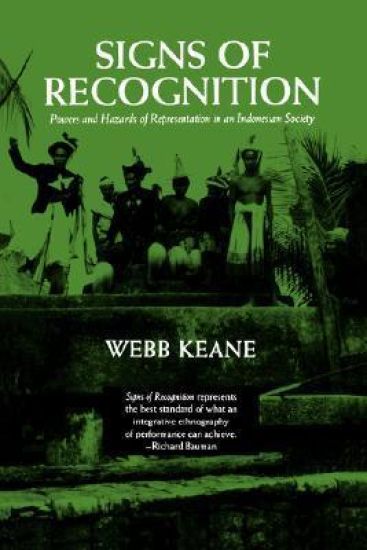
Webb Keane argues that by looking at representations as concrete practices we may find them to be thoroughly entangled in the tensions and hazards of social existence. This book explores the performances and transactions that lie at the heart of public events in contemporary Anakalang, on the Indonesian island of Sumba. Weaving together sharply observed narrative, close analysis of poetic speech and valuable objects, and far-reaching theoretical discussion, Signs of Recognition explores the risks endemic in representational practices. An awareness of risk is embedded in the very forms of ritual speech and exchange. The possibilities for failure and slippage reveal people's mutual vulnerabilities and give words and things part of their power. Keane shows how the dilemmas posed by the effort to use and control language and objects are implicated with general problems of power, authority, and agency. He persuades us to look differently at ideas of voice and value. Integrating the analysis of words and things, this book contributes to a wide range of fields, including linguistic anthropology, cultural studies, social theory, and the studies of material culture, art, and political economy.