Kirjojen hintavertailu. Mukana 12 595 353 kirjaa ja 12 kauppaa.

Kirjailija

Wendy Bellion

Kirjat ja teokset yhdessä paikassa: 3 kirjaa, julkaisuja vuosilta 2019-2025, suosituimpien joukossa Iconoclasm in New York. Vertaile teosten hintoja ja tarkista saatavuus suomalaisista kirjakaupoista.

3 kirjaa

Kirjojen julkaisuhaarukka 2019-2025.

Citizen Spectator

Citizen Spectator

Wendy Bellion

THE UNIVERSITY OF NORTH CAROLINA PRESS
2025
pokkari
In this richly illustrated study, the first book-length exploration of illusionistic art in the early United States, Wendy Bellion investigates Americans' experiences with material forms of visual deception and argues that encounters with illusory art shaped their understanding of knowledge, representation, and subjectivity between 1790 and 1825. Focusing on the work of the well-known Peale family and their Philadelphia Museum, as well as other Philadelphians, Bellion explores the range of illusions encountered in public spaces, from trompe l'oeil paintings and drawings at art exhibitions to ephemeral displays of phantasmagoria, "Invisible Ladies," and other spectacles of deception. Bellion reconstructs the elite and vernacular sites where such art and objects appeared and argues that early national exhibitions doubled as spaces of citizen formation. Within a post-Revolutionary culture troubled by the social and political consequences of deception, keen perception signified able citizenship. Setting illusions into dialogue with Enlightenment cultures of science, print, politics, and the senses, Citizen Spectator demonstrates that pictorial and optical illusions functioned to cultivate but also to confound discernment. Bellion reveals the equivocal nature of illusion during the early republic, mapping its changing forms and functions, and uncovers surprising links between early American art, culture, and citizenship.
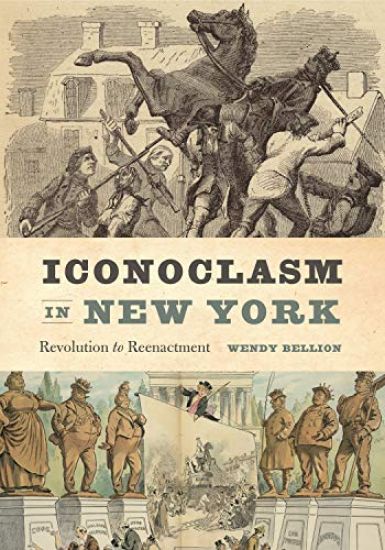
Iconoclasm in New York

Iconoclasm in New York

Wendy Bellion

Pennsylvania State University Press
2021
pokkari
King George III will not stay on the ground. Ever since a crowd in New York City toppled his equestrian statue in 1776, burying some of the parts and melting the rest into bullets, the king has been riding back into American culture, raising his gilded head in visual representations and reappearing as fragments. In this book, Wendy Bellion asks why Americans destroyed the statue of George III—and why they keep bringing it back.Locating the statue’s destruction in a transatlantic space of radical protest and material violence—and tracing its resurrection through pictures and performances—Bellion advances a history of American art that looks beyond familiar narratives of paintings and polite spectators to encompass a riotous cast of public sculptures and liberty poles, impassioned crowds and street protests, performative smashings and yearning re-creations. Bellion argues that iconoclasm mobilized a central paradox of the national imaginary: it was at once a destructive phenomenon through which Americans enacted their independence and a creative phenomenon through which they continued to enact British cultural identities.Persuasive and engaging, Iconoclasm in New York demonstrates how British monuments gave rise to an American creation story. This fascinating cultural history will captivate art historians, specialists in iconoclasm, and general readers interested in American history and New York City.
Iconoclasm in New York

Iconoclasm in New York

Wendy Bellion

Pennsylvania State University Press
2019
sidottu
King George III will not stay on the ground. Ever since a crowd in New York City toppled his equestrian statue in 1776, burying some of the parts and melting the rest into bullets, the king has been riding back into American culture, raising his gilded head in visual representations and reappearing as fragments. In this book, Wendy Bellion asks why Americans destroyed the statue of George III—and why they keep bringing it back.Locating the statue’s destruction in a transatlantic space of radical protest and material violence—and tracing its resurrection through pictures and performances—Bellion advances a history of American art that looks beyond familiar narratives of paintings and polite spectators to encompass a riotous cast of public sculptures and liberty poles, impassioned crowds and street protests, performative smashings and yearning re-creations. Bellion argues that iconoclasm mobilized a central paradox of the national imaginary: it was at once a destructive phenomenon through which Americans enacted their independence and a creative phenomenon through which they continued to enact British cultural identities.Persuasive and engaging, Iconoclasm in New York demonstrates how British monuments gave rise to an American creation story. This fascinating cultural history will captivate art historians, specialists in iconoclasm, and general readers interested in American history and New York City.