Kirjojen hintavertailu. Mukana 12 390 323 kirjaa ja 12 kauppaa.

Kirjailija

Wes Sharrock

Kirjat ja teokset yhdessä paikassa: 16 kirjaa, julkaisuja vuosilta 1995-2022, suosituimpien joukossa Theory and Methods in Sociology. Vertaile teosten hintoja ja tarkista saatavuus suomalaisista kirjakaupoista.

16 kirjaa

Kirjojen julkaisuhaarukka 1995-2022.

Ethnomethodology, Conversation Analysis and Constructive Analysis

Ethnomethodology, Conversation Analysis and Constructive Analysis

Graham Button; Michael Lynch; Wes Sharrock

TAYLOR FRANCIS LTD
2022
nidottu
This book revisits the arguments by which Harvey Sacks and Harold Garfinkel opposed the widespread attempt in the social sciences to construct disciplinary theories and methods in place of common-sense knowledge of human action, and proposed instead an alternative that would investigate the organised methods of natural language use and common-sense reasoning that constitute social orders – arguments that led to the establishment and proliferation of ethnomethodology and conversation analysis. As the very "constructive analysis" that they opposed has begun to be incorporated into influential lines of research in ethnomethodology and conversation analysis, the authors return to the founding insights of the field and reiterate the importance of Garfinkel and Sacks’ original and controversial proposals for an "alternate" sociology of practical action and practical reasoning. Showing how constructive analysis has become entrenched in ethnomethodology and conversation analysis and arguing for a need to "re-boot" these approaches, this volume constitutes a call for a renewal of the radical alternative proposed by Garfinkel and Sacks.
Ethnomethodology, Conversation Analysis and Constructive Analysis

Ethnomethodology, Conversation Analysis and Constructive Analysis

Graham Button; Michael Lynch; Wes Sharrock

TAYLOR FRANCIS LTD
2022
sidottu
This book revisits the arguments by which Harvey Sacks and Harold Garfinkel opposed the widespread attempt in the social sciences to construct disciplinary theories and methods in place of common-sense knowledge of human action, and proposed instead an alternative that would investigate the organised methods of natural language use and common-sense reasoning that constitute social orders – arguments that led to the establishment and proliferation of ethnomethodology and conversation analysis. As the very "constructive analysis" that they opposed has begun to be incorporated into influential lines of research in ethnomethodology and conversation analysis, the authors return to the founding insights of the field and reiterate the importance of Garfinkel and Sacks’ original and controversial proposals for an "alternate" sociology of practical action and practical reasoning. Showing how constructive analysis has become entrenched in ethnomethodology and conversation analysis and arguing for a need to "re-boot" these approaches, this volume constitutes a call for a renewal of the radical alternative proposed by Garfinkel and Sacks.
There is No Such Thing as a Social Science

There is No Such Thing as a Social Science

Phil Hutchinson; Rupert Read; Wes Sharrock

Routledge
2016
nidottu
The death of Peter Winch in 1997 sparked a revived interest in his work with this book arguing his work suffered misrepresentation in both recent literature and in contemporary critiques of his writing. Debates in philosophy and sociology about foundational questions of social ontology and methodology often claim to have adequately incorporated and moved beyond Winch's concerns. Re-establishing a Winchian voice, the authors examine how such contentions involve a failure to understand central themes in Winch's writings and that the issues which occupied him in his Idea of a Social Science and its Relation to Philosophy and later papers remain central to social studies. The volume offers a careful reading of the text in alliance with Wittgensteinian insights and alongside a focus on the nature and results of social thought and inquiry. It draws parallels with other movements in the social studies, notably ethnomethodology, to demonstrate how Winch's central claim is both more significant and more difficult to transcend than sociologists and philosophers have hitherto imagined.
Choice

Choice

Richard Harper; Dave Randall; Wes Sharrock

Polity Press
2015
nidottu
We make decisions every day. Yet we are sometimes perplexed by these decisions and the decisions of others. To complicate things further, we live in an age where there are more things to choose from than ever before ? the Internet is transforming our choices and making us more accountable for them: what we choose is recorded, modelled and used to predict our future behaviour. So are we in a position to make better choices today than we were a decade ago? Certainly there are some who believe so. Psychologists claim we are subject to hidden mental processes that lead us to one thing rather than another; economists offer predictions about what people will buy; and some philosophers claim that our choices echo our evolutionary past. Are these claims merited? Do they reflect the beginnings of a new science of choice? This book offers a critical overview of these and other claims, showing where they are justified and where they are exaggerated. It will be an essential reference for anyone interested in whether science can help us to understand both the ways people make choices in their everyday lives and how these may be changing.
Choice

Choice

Richard Harper; Dave Randall; Wes Sharrock

Polity Press
2015
sidottu
We make decisions every day. Yet we are sometimes perplexed by these decisions and the decisions of others. To complicate things further, we live in an age where there are more things to choose from than ever before ? the Internet is transforming our choices and making us more accountable for them: what we choose is recorded, modelled and used to predict our future behaviour. So are we in a position to make better choices today than we were a decade ago? Certainly there are some who believe so. Psychologists claim we are subject to hidden mental processes that lead us to one thing rather than another; economists offer predictions about what people will buy; and some philosophers claim that our choices echo our evolutionary past. Are these claims merited? Do they reflect the beginnings of a new science of choice? This book offers a critical overview of these and other claims, showing where they are justified and where they are exaggerated. It will be an essential reference for anyone interested in whether science can help us to understand both the ways people make choices in their everyday lives and how these may be changing.
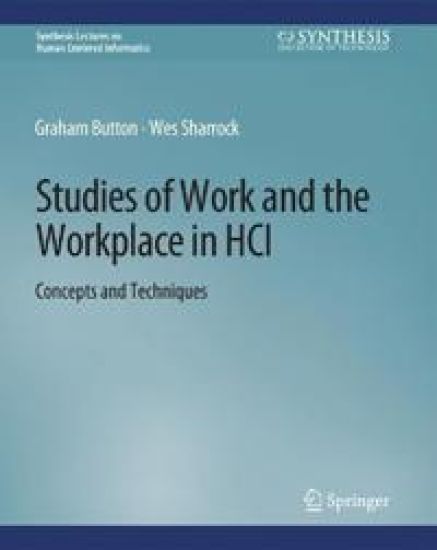
Studies of Work and the Workplace in HCI

Studies of Work and the Workplace in HCI

Graham Button; Wes Sharrock

Springer International Publishing AG
2009
nidottu
This book has two purposes. First, to introduce the study of work and the workplace as a method for informing the design of computer systems to be used at work. We primarily focus on the predominant way in which the organization of work has been approached within the field of human-computer interaction (HCI), which is from the perspective of ethnomethodology. We locate studies of work in HCI within its intellectual antecedents, and describe paradigmatic examples and case studies. Second, we hope to provide those who are intending to conduct the type of fieldwork that studies of work and the workplace draw off with suggestions as to how they can go about their own work of developing observations about the settings they encounter. These suggestions take the form of a set of maxims that we have found useful while conducting the studies we have been involved in. We draw from our own fieldwork notes in order to illustrate these maxims. In addition we also offer some homilies about how to make observations; again, these are ones we have found useful in our own work. Table of Contents: Motivation / Overview: A Paradigmatic Case / Scientific Foundations / Detailed Description / Case Study / How to Conduct Ethnomethodological Studies of Work / Making Observations / Current Status
There is No Such Thing as a Social Science

There is No Such Thing as a Social Science

Phil Hutchinson; Rupert Read; Wes Sharrock

Ashgate Publishing Limited
2008
sidottu
The death of Peter Winch in 1997 sparked a revived interest in his work with this book arguing his work suffered misrepresentation in both recent literature and in contemporary critiques of his writing. Debates in philosophy and sociology about foundational questions of social ontology and methodology often claim to have adequately incorporated and moved beyond Winch's concerns. Re-establishing a Winchian voice, the authors examine how such contentions involve a failure to understand central themes in Winch's writings and that the issues which occupied him in his Idea of a Social Science and its Relation to Philosophy and later papers remain central to social studies. The volume offers a careful reading of the text in alliance with Wittgensteinian insights and alongside a focus on the nature and results of social thought and inquiry. It draws parallels with other movements in the social studies, notably ethnomethodology, to demonstrate how Winch's central claim is both more significant and more difficult to transcend than sociologists and philosophers have hitherto imagined.
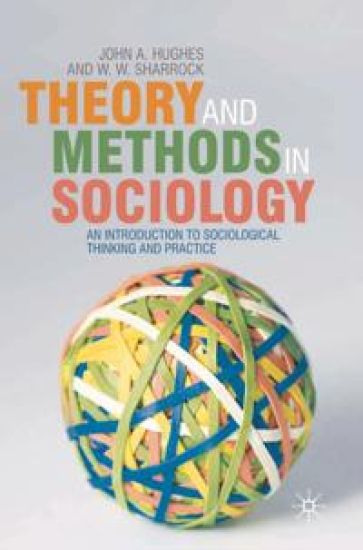
Theory and Methods in Sociology

Theory and Methods in Sociology

John Hughes; Wes Sharrock

Red Globe Press
2007
sidottu
This book offers a guide to sociology that explores its theoretical and methodological dimensions. Aiming to provide the reader with a sense of the reasoned character of the discipline, it traces how different theories and methods relate to one another, exploring the particular problems they spawn and the debates that have arisen in response.
Theory and Methods in Sociology

Theory and Methods in Sociology

John Hughes; Wes Sharrock

Red Globe Press
2007
nidottu
This book offers a guide to sociology that explores its theoretical and methodological dimensions. Aiming to provide the reader with a sense of the reasoned character of the discipline, it traces how different theories and methods relate to one another, exploring the particular problems they spawn and the debates that have arisen in response.
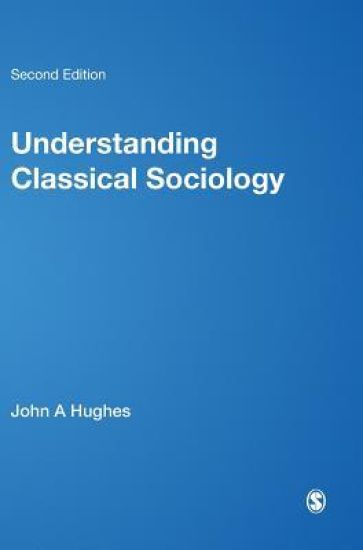
Understanding Classical Sociology

Understanding Classical Sociology

John Hughes; Wes Sharrock; Peter J Martin

SAGE Publications Inc
2003
sidottu
Praise for the First Edition: `Totally reliable… the authors have produced a book urgently needed by all those charged with introducing students to the classics… quite indispensable' - Times Higher Education Supplement This is a fully updated and expanded new edition of the successful undergraduate text. Providing a lucid examination of the pivotal theories of Marx, Durkheim and Weber, the authors submit that these figures have decisively shaped the discipline. They show how the classical apparatus is in use, even though it is being directed in new ways in response to the changing character of society. Written with the needs of undergraduates in mind, the text is essential reading for students in sociology and social theory.
Understanding Modern Sociology

Understanding Modern Sociology

Wes Sharrock; John Hughes; Alan Pratt

SAGE Publications Inc
2003
nidottu
From the team that brought you the bestselling Understanding Classical Sociology (SAGE Publications, 1995), we now have a companion volume dealing with the modern period of social theory. An introductory chapter situates the reader in the main changes in society and sociology following the classic period. This is then followed by separate chapters giving a detailed account of four perspectives that are regarded to be of seminal importance - Functionalism, Critical Theory, Structuralism and Symbolic Interactionism. All of the popular features of Understanding Classical Sociology are reproduced in this book: · Clarity of exposition and criticism · A passion for the importance and relevance of sociological reasoning and explanation · A commitment to treat social theory as a living tradition of thought In addition, the volume comes with a variety of pedagogic aids including summary points and key definitions to facilitate learning and study. This is a book that enhances the sociological imagination. It draws on the authors deep understanding and experience of teaching the subject over many decades. It will be welcomed by lecturers as a vital new teaching and research aid, and students will be stimulated and enriched by the unfussy and reliable advice on doing sociology that it imparts.
Understanding Modern Sociology

Understanding Modern Sociology

Wes Sharrock; John Hughes; Alan Pratt

SAGE Publications Inc
2003
sidottu
From the team that brought you the bestselling Understanding Classical Sociology (SAGE Publications, 1995), we now have a companion volume dealing with the modern period of social theory. An introductory chapter situates the reader in the main changes in society and sociology following the classic period. This is then followed by separate chapters giving a detailed account of four perspectives that are regarded to be of seminal importance - Functionalism, Critical Theory, Structuralism and Symbolic Interactionism. All of the popular features of Understanding Classical Sociology are reproduced in this book: · Clarity of exposition and criticism · A passion for the importance and relevance of sociological reasoning and explanation · A commitment to treat social theory as a living tradition of thought In addition, the volume comes with a variety of pedagogic aids including summary points and key definitions to facilitate learning and study. This is a book that enhances the sociological imagination. It draws on the authors deep understanding and experience of teaching the subject over many decades. It will be welcomed by lecturers as a vital new teaching and research aid, and students will be stimulated and enriched by the unfussy and reliable advice on doing sociology that it imparts.
Understanding Classical Sociology

Understanding Classical Sociology

John Hughes; Wes Sharrock; Peter J Martin

SAGE Publications Inc
2003
nidottu
Praise for the First Edition: `Totally reliable… the authors have produced a book urgently needed by all those charged with introducing students to the classics… quite indispensable' - Times Higher Education Supplement This is a fully updated and expanded new edition of the successful undergraduate text. Providing a lucid examination of the pivotal theories of Marx, Durkheim and Weber, the authors submit that these figures have decisively shaped the discipline. They show how the classical apparatus is in use, even though it is being directed in new ways in response to the changing character of society. Written with the needs of undergraduates in mind, the text is essential reading for students in sociology and social theory.
Kuhn

Kuhn

Wes Sharrock; Rupert Read

Polity Press
2002
sidottu
Thomas Kuhn's shadow hangs over almost every field of intellectual inquiry. His book The Structure of Scientific Revolutions has become a modern classic. His influence on philosophy, social science, historiography, feminism, theology, and (of course) the natural sciences themselves is unparalleled. His epoch-making concepts of ‘new paradigm’ and ‘scientific revolution’ make him probably the most influential scholar of the twentieth century. Sharrock and Read take the reader through Kuhn's work in a careful and accessible way, emphasizing Kuhn's detailed studies of the history of science, which often assist the understanding of his more abstract philosophical work. These historical studies provide vital insight into what Kuhn was actually trying to achieve in his The Structure of Scientific Revolutions: an endeavour far less extreme than either his ‘foes’ or his ‘fans’ claim. In the book's second half, Sharrock and Read provide excellent explications, defences and, where appropriate, criticisms of Kuhn's central concept of ‘incommensurability’, and tackle head on the crucial issue of whether Kuhn's insights concerning the natural sciences can be extrapolated to other disciplines, such as the social sciences. This is the first comprehensive introduction to the work of Kuhn and it will be of particular interest to students and scholars in philosophy, theory of science, management science and anthropology.
Kuhn

Kuhn

Wes Sharrock; Rupert Read

JOHN WILEY AND SONS LTD
2002
nidottu
This text takes the introductory reader through Kuhn's work. It is sympathetic to his enormous and even more enormously-misunderstood achievement: the giving of a concrete and accurate account of the nature of stability, ordinary work and the conceptual change in the natural sciences.
Computers, Minds and Conduct

Computers, Minds and Conduct

Graham Button; Jeff Coulter; John Lee; Wes Sharrock

Polity Press
1995
nidottu
This book provides a sustained and penetrating critique of a wide range of views in modern cognitive science and philosophy of the mind, from Turing's famous test for intelligence in machines to recent work in computational linguistic theory. While discussing many of the key arguments and topics, the authors also develop a distinctive analytic approach. Drawing on the methods of conceptual analysis first elaborated by Wittgenstein and Ryle, the authors seek to show that these methods still have a great deal to offer in the field of the cognitive theory and the philosophy of mind, providing a powerful alternative to many of the positions put forward in the contemporary literature. Amoung the many issues discussed in the book are the following: the Cartesian roots of modern conceptions of mind; Searle's 'Chinese Room' thought experiment; Fodor's 'language of thought' hypothesis; the place of 'folk psychology' in cognitivist thought; and the question of whether any machine may be said to 'think' or 'understand' in the ordinary senses of these words. Wide ranging, up-to-date and forcefully argued, this book represents a major intervention in contemporary debates about the status of cognitive science an the nature of mind. It will be of particular interest to students and scholars in philosophy, psychology, linguistics and computing sciences.