Kirjojen hintavertailu. Mukana 12 595 353 kirjaa ja 12 kauppaa.

Kirjailija

Wesley Wrigley

Kirjat ja teokset yhdessä paikassa: 2 kirjaa, julkaisuja vuodelta 2024, suosituimpien joukossa The Euclidean Programme. Vertaile teosten hintoja ja tarkista saatavuus suomalaisista kirjakaupoista.

2 kirjaa

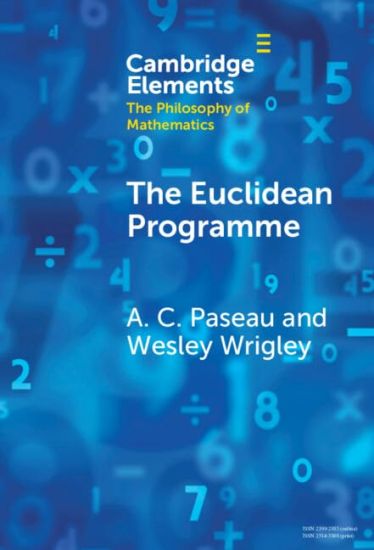
The Euclidean Programme

The Euclidean Programme

A. C. Paseau; Wesley Wrigley

Cambridge University Press
2024
sidottu
The Euclidean Programme embodies a traditional sort of epistemological foundationalism, according to which knowledge – especially mathematical knowledge – is obtained by deduction from self-evident axioms or first principles. Epistemologists have examined foundationalism extensively, but neglected its historically dominant Euclidean form. By contrast, this book offers a detailed examination of Euclidean foundationalism, which, following Lakatos, the authors call the Euclidean Programme. The book rationally reconstructs the programme's key principles, showing it to be an epistemological interpretation of the axiomatic method. It then compares the reconstructed programme with select historical sources: Euclid's Elements, Aristotle's Posterior Analytics, Descartes's Discourse on Method, Pascal's On the Geometric Mind and a twentieth-century account of axiomatisation. The second half of the book philosophically assesses the programme, exploring whether various areas of contemporary mathematics conform to it. The book concludes by outlining a replacement for the Euclidean Programme.
The Euclidean Programme

The Euclidean Programme

A. C. Paseau; Wesley Wrigley

Cambridge University Press
2024
pokkari
The Euclidean Programme embodies a traditional sort of epistemological foundationalism, according to which knowledge – especially mathematical knowledge – is obtained by deduction from self-evident axioms or first principles. Epistemologists have examined foundationalism extensively, but neglected its historically dominant Euclidean form. By contrast, this book offers a detailed examination of Euclidean foundationalism, which, following Lakatos, the authors call the Euclidean Programme. The book rationally reconstructs the programme's key principles, showing it to be an epistemological interpretation of the axiomatic method. It then compares the reconstructed programme with select historical sources: Euclid's Elements, Aristotle's Posterior Analytics, Descartes's Discourse on Method, Pascal's On the Geometric Mind and a twentieth-century account of axiomatisation. The second half of the book philosophically assesses the programme, exploring whether various areas of contemporary mathematics conform to it. The book concludes by outlining a replacement for the Euclidean Programme.