Kirjailija
Wilhelm Dilthey
Kirjat ja teokset yhdessä paikassa: 63 kirjaa, julkaisuja vuosilta 1870-2025, suosituimpien joukossa Introduction to the Human Sciences. Vertaile teosten hintoja ja tarkista saatavuus suomalaisista kirjakaupoista.
63 kirjaa
Kirjojen julkaisuhaarukka 1870-2025.

Die Briefsammlung enthält eine Auswahl an Briefen von und an den Philosophen aus dem Zeitraum 1852-1882. Zu den Briefpartnern Diltheys zählten neben Familienmitgliedern viele zeitgenössische Philosophen, Historiker, Germanisten, Altphilologen, Nationalökonomen und Theologen sowie Publizisten, Verleger, Politiker, Schriftsteller und Kënstler.Aufgenommen sind vor allem biographisch, werkgeschichtlich und systematisch wichtige sowie wissenschafts- und universitätsgeschichtlich relevante Briefe. Sie sind zum größten Teil bislang unveröffentlicht und werden aus den Nachlässen Diltheys und seiner Briefpartner ediert, wobei die originale Orthographie und Zeichensetzung gewahrt bleiben. Aufgenommen sind darëber hinaus auch die Briefe, die bereits in verschiedenen - zumeist älteren und schwer beschaffbaren - Publikationen vorliegen.

Der Aufbau der geschichtlichen Welt in den Geisteswissenschaften
Wilhelm Dilthey
Contumax
2011
pokkari

This volume provides Dilthey's most mature and best formulation of his Critique of Historical Reason. It begins with three "Studies Toward the Foundation of the Human Sciences," in which Dilthey refashions Husserlian concepts to describe the basic structures of consciousness relevant to historical understanding. The volume next presents the major 1910 work The Formation of the Historical World in the Human Sciences. Here Dilthey considers the degree to which carriers of history--individuals, cultures, institutions, and communities--can be articulated as productive systems capable of generating value and meaning and of realizing purposes. Hegel's idea of objective spirit is reconceived in a more empirical form to designate the medium of commonality in which historical beings are immersed. Any universal claims about history need to be framed within the specific productive systems analyzed by the various human sciences. Dilthey's drafts for the Continuation of the Formation contain extensive discussions of the categories most important for our knowledge of historical life: meaning, value, purpose, time, and development. He also examines the contributions of autobiography to historical understanding and of biography to scientific history. The finest summary of Dilthey's views on hermeneutics can be found in "The Understanding of Other Persons and Their Manifestations of Life." Here, Dilthey differentiates understanding relative to three kinds of manifestations of life. After giving his analysis of elementary understanding, he examines the role of induction in higher understanding and interpretation, and the relevance of transposition and re-experiencing for grasping individuality.
The philosopher and historian of culture Wilhelm Dilthey (1833-1911) has had a significant and continuing influence on twentieth-century Continental philosophy and in a broad range of scholarly disciplines. This volume is the third to be published in Princeton University Press's projected six-volume series of his most important works. Part One makes available three of his works on hermeneutics and its history: "Schleiermacher's Hermeneutical System in Relation to Earlier Protestant Hermeneutics" (The Prize Essay of 1860); "On Understanding and Hermeneutics" (1867-68), based on student lecture notes, and the "The Rise of Hermeneutics" (1900), which traces the history of hermeneutics back to Hellenistic Greece. All the addenda to this well-known essay are translated here, some for the first time. In them Dilthey articulates three philosophical aporias concerning hermeneutics and projects an ultimate convergence between understanding and explanation. Part Two provides translations of review essays by Dilthey on Buckle's use of statistical history and on Burckhardt's cultural history; an essay "Friedrich Schlosser and the Problem of Universal History;" and a talk recalling his early years as a student of Boeckh, Jakob Grimm, Mommsen, Ranke, and Ritter. It also contains the important historical essay "The Eighteenth Century and the Historical World," in which Dilthey reexamines the Enlightenment to show its significant contributions to the rise of historical consciousness.
This is the second volume in a six-volume translation of the major writings of Wilhelm Dilthey (1833-1911), a philosopher and historian of culture who continues to have a significant influence on Continental philosophy and a broad range of scholarly disciplines. In addition to his landmark works on the theories of history and the human sciences, Dilthey made important contributions to hermeneutics, phenomenology, aesthetics, psychology, and the methodology of the social sciences. This volume presents Dilthey's main theoretical works from the 1890s, the period between the "Introduction to the Human Sciences" and "The Formation of the Historical World". A common thread of the writings included here is an interest in the relation between the self and the world. In "The Origin of Our Belief in the Reality of the External World and Its Justification", Dilthey argues that our engagement with the world is rooted in our practical drives and the resistance they meet. The basic nexus of our beliefs about reality is volitional rather than representational. The next essay, "Life and Cognition", examines the main categories with which we organize our experience of life into an understanding of the human world: selfsameness; doing and undergoing; and, essentiality. These categorial relations are further articulated with the aid of Dilthey's structural psychology in ways that rival some of the insights of phenomenology. This occurs in "The Ideas for a Descriptive and Analytic Psychology". By focusing on how lived experience places everything in a temporal continuum that can be described and analyzed, Dilthey saw the opportunity to establish a structural psychology that could be of great use to the human sciences in general. In the final essay, "Contributions to the Study of Individuality", Dilthey attacks Windelband's thesis that the human sciences are idiographic. Many human sciences have systematic and structural aims that combine the study of uniformities with the examination of individuation. Applying the comparative method, Dilthey argues that living beings share many basic similarities within which typical variations tend to recur. For human individuation, however, the specification of the historical nexus is also essential.

Dilthey, W: Einleitung In Die Geisteswissenschaften V1
Wilhelm Dilthey
KESSINGER PUBLISHING, LLC
2010
nidottu


Wilhelm Dilthey-Gesammelte Schriften: Band 21: Psychologie ALS Erfahrungswissenschaft: Erster Teil: Vorlesungen Zur Psychologie Und Anthropologie (Ca.
Wilhelm Dilthey
Vandenhoeck Ruprecht
1997
sidottu
This is the fifth volume in a six-volume translation of the major writings of Wilhelm Dilthey (1833-1911), a philosopher and historian of culture who has had a significant, and continuing, influence on twentieth-century Continental philosophy and in a broad range of scholarly disciplines. In addition to his landmark works on the theories of history and the human sciences, Dilthey made important contributions to hermeneutics and phenomenology, aesthetics, psychology, and the methodology of the social sciences. This volume presents Dilthey's principal writings on aesthetics and the philosophical understanding of poetry, as well as representative essays of literary criticism. The essay "The Imagination of the Poet" (also known as his Poetics) is his most sustained attempt to examine the philosophical bearings of literature in relation to psychological and historical theory. Also included are "The Three Epochs of Modern Aesthetics and its Present Task," "Fragments for a Poetics," and two final essays discussing Goethe and Holderlin. The latter are drawn from Das Erlebnis und die Dichtung, a volume that was acclaimed on publication as a classic of literary criticism and that continues to be a model for the geistesgeschichtliche approach to literary history.
Wilhelm Dilthey-Gesammelte Schriften: Band 7: Der Aufbau Der Geschichtlichen Welt in Den Geisteswissenschaften
Wilhelm Dilthey
Vandenhoeck Ruprecht
1992
sidottu
Fruhe Texte zur Auseinandersetzung um eine deskriptive PsychologieB.
Wilhelm Dilthey-Gesammelte Schriften: Band 3: Studien Zur Geschichte Des Deutschen Geistes: Leibniz Und Sein Zeitalter. Friedrich Der Groae Und Die De
Wilhelm Dilthey; Paul Ritter
Vandenhoeck Ruprecht
1992
sidottu
Fruhe Texte zur Auseinandersetzung um eine deskriptive PsychologieB.

Wilhelm Dilthey-Gesammelte Schriften: Band 8: Weltanschauungslehre: Abhandlungen Zur Philosophie Der Philosophie
Wilhelm Dilthey
Vandenhoeck Ruprecht
1991
sidottu
Fruhe Texte zur Auseinandersetzung um eine deskriptive PsychologieB.
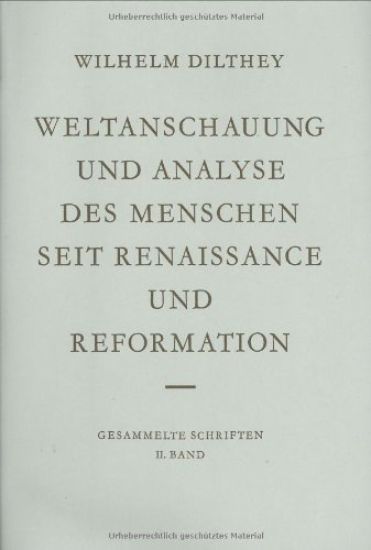
Wilhelm Dilthey-Gesammelte Schriften: Band 2: Weltanschauung Und Analyse Des Menschen Seit Renaissance Und Reformation
Wilhelm Dilthey
Vandenhoeck Ruprecht
1991
sidottu
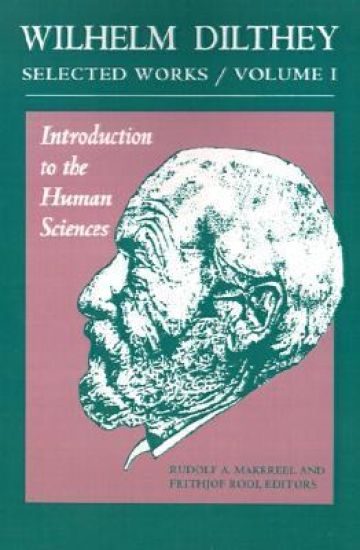
Introduction to the Human Sciences carries forward a projected six-volume translation series of the major writings of Wilhelm Dilthey (1833-1911)--a philosopher and historian of culture who has had a strong and continuing influence on twentieth-century Continental philosophy as well as a broad range of other scholarly disciplines. In addition to his landmark works on the theories of history and the human sciences, Dilthey made important contributions to hermeneutics and phenomenology, aesthetics, psychology, and the methodology of the social sciences. The Selected Works will make accessible to English-speaking readers the full range of Dilthey's thought, including some historical essays and literary criticism. The series provides translations of complete texts, together with editorial notes, and contains manuscript materials that are currently being published for the first time in Germany. This volume brings together the various parts of the Introduction to the Human Sciences published separately in the German edition. Rudolf Makkreel and Frithjof Rodi have underscored the systematic character of Dilthey's theory of the human sciences by translating the bulk of Dilthey's first volume (published in 1883) and his important drafts for the never-completed second volume.