Kirjailija
Willa Cather
Kirjat ja teokset yhdessä paikassa: 609 kirjaa, julkaisuja vuosilta 1927-2026, suosituimpien joukossa Christmas Classics. Vertaile teosten hintoja ja tarkista saatavuus suomalaisista kirjakaupoista.
609 kirjaa
Kirjojen julkaisuhaarukka 1927-2026.
The seven stories in this volume were written during the ascending and perhaps most triumphant years of Willa Cather's career, the period during which she published nine books, including My Ántonia, A Lost Lady, and Death Comes for the Archbishop.For the most part ironic in tone, these stories are, as Bernice Slote observes, bound by the geometrics of urban life-streets and offices, workers and firms, the business world of New York and Pittsburgh, the cities which by 1929 Willa Cather had known well for over thirty years." In her introduction, Slote discusses their biographical elements, connections with earlier and later work, and the intricate patterns that lie below the lucid, shimmering surface of Willa Cather's prose.
'The unity of Miss Cather's design, the clarity and distinction of this book, should put it beside her first great success, My Antonia' TIMES LITERARY SUPPLEMENT 'She is undoubtedly one of the greatest American writers' OBSERVER 'Willa Cather makes a world which is burningly alive, sometimes lovely, often tragic' HELEN DUNMORE It is 1901, and Lucy Gayheart with her 'singular brightness of young beauty' is studying music in the magical smoky city of Chicago. She is courted by handsome Harry Gordon, the most eligible bachelor in Haverford, the Midwestern town she comes from. But Lucy falls in love with middle-aged Clement Sebastien, a famous singer whose talents and tenderness change her life forever. Out of their doomed love affair and Lucy's fatal estrangement from her origins, Willa Cather creates a novel that is as achingly lovely as a Schubert sonata.First published in 1935, this novel of 'achieved simplicity' displays the depth of Willa Cather's sympathy, both for the world of high art and for the reticent decencies of small town life.
Willa Cather's first published novel, set in Boston, London, and Paris, is the story of a man unable to resolve the contradictions in his own nature. The central figures are Bartley Alexander, a world-famous engineer; his wife; Winifred, a Boston society matron; and his former love, Hilda Burgoyne, a London actress. Long considered an uncharacteristic production, in the light of recent scholarship Alexander's Bridge is seen to be closely linked to the body of Cather's work, thematically as well as in its use of myth and symbol. Bernice Slote's introduction considers the circumstances of its composition and its relationship to the later novels, particularly One of Ours, The Professor's House, and Lucy Gayheart. The text has been entirely reset from the first (1912) edition.
Willa Cather's Collected Short Fiction, 1892-1912
Willa Cather
University of Nebraska Press
1971
sidottu
As well as adding another story to the original forty-four, the revised edition updates and expands the chronology and the bibliographies in the light of recent research. It corrects factual and formal errors in the introduction and notes, and emends misprints in the text.
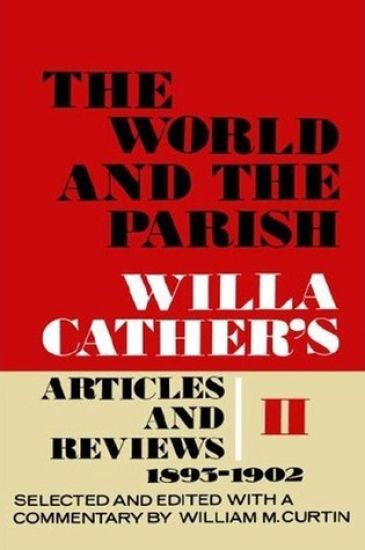
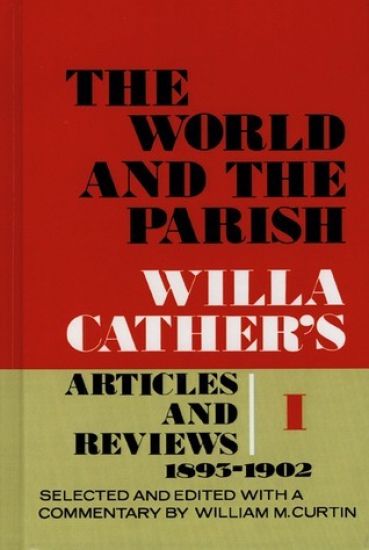
"One of the few really helpful words I ever heard from an older writer," Willa Cather declared in 1922, "I had from Sarah Orne Jewett when she said to me: 'Of course, one day you will write about your own country. In the meantime, get all you can. One must know the world so well before one can know the parish.'" Although Cather's first novel about her own country, O Pioneers!, did not appear until 1913, the process of knowing the world and of mastering her craft, so far as it can be traced in her published writing, already had been going on for some twenty years. The World and the Parish: Willa Cather's Articles and Reviews, 1893-1902, is the fourth in a series collecting the work of these years of experiment and discovery. More specifically, it offers a representative collection of Cather's nonfiction writing for newspapers and periodicals during her first decade as a professional writer.Selected from 520 articles and columns, the text is divided into three parts corresponding to major developments in Cather's career—the period from 1893 to 1896 when she first began to write regularly for Lincoln newspapers; the years in Pittsburgh when she was working for the Home Monthly and the Leader and sending her famous "Passing Show" column back to Nebraska; and the period from the spring of 1900 to 1903, when she freelanced in Pittsburgh and Washington, taught in a Pittsburgh high school, and made her first trip abroad. The text has been edited with three main objectives: 1) to enable the reader to trace Cather's development as a writer; 2) to group the material so that the reader interested in a particular subject—the theatre, or music, or literature, for example—can readily locate pertinent selections; and 3) to provide a context sufficient to relate these pieces to Willa Cather's life and to the times, and to suggest some of their connections with the body of her work. Chronologies have been included for each of the three parts; and the Bibliography is the most complete yet available for the for the nonfiction writing up to 1903.Not the least remarkable feature of this collection is the range and variety of forms and subject matter—reviews (of books, plays, operas, concerts, art exhibits, lectures), feature stories, interviews, straight reportage, columns of miscellaneous comment, and travel letters. Seemingly, with no apparent effort Willa Cather could adjust her sights to any assignment and any audience. And if it is astonishing that she could write so much about so many matters at so many levels, it is perhaps even more astonishing that so much of it was so good. Undeniably, however, the chief interest to the general reader and the peculiar value to the scholar of these journalistic writings reside in their manifold and crucial connections with Cather's later work and in the unparalleled insights they afford into the process by which a gifted writer becomes a great artist.
"One of the few really helpful words I ever heard from an older writer," Willa Cather declared in 1922, "I had from Sarah Orne Jewett when she said to me: 'Of course, one day you will write about your own country. In the meantime, get all you can. One must know the world so well before one can know the parish.'" Although Cather's first novel about her own country, O Pioneers!, did not appear until 1913, the process of knowing the world and of mastering her craft, so far as it can be traced in her published writing, already had been going on for some twenty years. The World and the Parish: Willa Cather's Articles and Reviews, 1893-1902, is the fourth in a series collecting the work of these years of experiment and discovery. More specifically, it offers a representative collection of Cather's nonfiction writing for newspapers and periodicals during her first decade as a professional writer.Selected from 520 articles and columns, the text is divided into three parts corresponding to major developments in Cather's career—the period from 1893 to 1896 when she first began to write regularly for Lincoln newspapers; the years in Pittsburgh when she was working for the Home Monthly and the Leader and sending her famous "Passing Show" column back to Nebraska; and the period from the spring of 1900 to 1903, when she freelanced in Pittsburgh and Washington, taught in a Pittsburgh high school, and made her first trip abroad. The text has been edited with three main objectives: 1) to enable the reader to trace Cather's development as a writer; 2) to group the material so that the reader interested in a particular subject—the theatre, or music, or literature, for example—can readily locate pertinent selections; and 3) to provide a context sufficient to relate these pieces to Willa Cather's life and to the times, and to suggest some of their connections with the body of her work. Chronologies have been included for each of the three parts; and the Bibliography is the most complete yet available for the for the nonfiction writing up to 1903.Not the least remarkable feature of this collection is the range and variety of forms and subject matter—reviews (of books, plays, operas, concerts, art exhibits, lectures), feature stories, interviews, straight reportage, columns of miscellaneous comment, and travel letters. Seemingly, with no apparent effort Willa Cather could adjust her sights to any assignment and any audience. And if it is astonishing that she could write so much about so many matters at so many levels, it is perhaps even more astonishing that so much of it was so good. Undeniably, however, the chief interest to the general reader and the peculiar value to the scholar of these journalistic writings reside in their manifold and crucial connections with Cather's later work and in the unparalleled insights they afford into the process by which a gifted writer becomes a great artist.
More than 100 pieces in this surprising and impressive collection are drawn from a body of Willa Cather’s writing that was not known to exist until its recent discovery by the editor. Previous scholars have assumed that Willa Cather was inactive as a journalist during the year following her graduation from the university in June, 1895; the truth is, she not only continued to contribute drama criticism to Lincoln newspapers, but also, in Miss Slote’s words, had time to “consider thoughtfully and work out some of the guiding principles of fiction, the certain range in the Kingdom of Art which was becoming . . . her own.”Miss Slote has focused on those of the 1893-1896 writings in which Willa Cather formulates and tests her critical attitudes, and on those-even more crucially relevant to her own situation-in which she asks the great questions: What makes an artist? How does one join the two selves of artist and person? Exactly how can one create the creation? Part I presents two essays by the editor: “Writer in Nebraska,” incorporating new biographical material, and “The Kingdom of Art,” a critical reassessment in the light of new findings. Part II consists of some 220 selections accompanied by extensive editorial commentary, grouped as follows: “The Individual Talent”-observations on artists who lives evoked Willa Cather’s sympathy, wonder, or respect, and who success or failure seemed to embody the principles of human endeavor; “The Way of the World”-on art in Philistia, the relations of things (e.g., poetry and football), and history in the arts; “Drama”-pieces on the playwright and his craft and the critic’s responsibilities, as well as lay reviews; “Literature”-major essays on Stevenson, Dumas, Poe, Wilde, Verlaine, Ruskin, and Pierre Loti, and shorter pieces on such writers as Hardy, James, Swinburne, Kipling, Burns, Zola, Tolstoi, and Whitman; and “Improvisations Toward a Credo, 1894-1896”-culminating in two statements in which as last, as the editor notes, “Willa Cather could recognize clearly the emerging form of the artist-self she had been seeking, and with it the individual talent in which all credos must begin.”