Kirjojen hintavertailu. Mukana 12 390 323 kirjaa ja 12 kauppaa.

Kirjailija

Willard Gaylin

Kirjat ja teokset yhdessä paikassa: 9 kirjaa, julkaisuja vuosilta 1984-2012, suosituimpien joukossa Feeling Good and Doing Better. Vertaile teosten hintoja ja tarkista saatavuus suomalaisista kirjakaupoista.

9 kirjaa

Kirjojen julkaisuhaarukka 1984-2012.

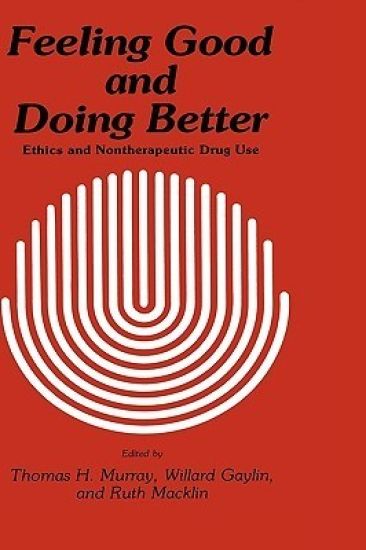
Feeling Good and Doing Better

Feeling Good and Doing Better

Thomas H. Murray; Willard Gaylin; Ruth Macklin

Humana Press Inc.
1984
sidottu
The place of drugs in American society is a problem more apt to evoke diatribe than dialog. With the support of the Na­ tional Science Foundation's program on Ethics and Values in Science and Technology, and the National Endowment for the Humanities' program on Science, Technology, and Human Values, * The Hastings Center was able to sponsor such dialog as part of a major research into the ethics of drug use that spanned two years. We assembled a Research Group from leaders in the scientific, medical, legal, and policy com­ munities, leavened with experts in applied ethics, and brought them together several times a year to discuss the moral, legal and social issues posed by nontherapeutic drug use. At times we also called on other experts when we needed certain issues clarified. We did not try to reach a consensus, yet several broad areas of agreement emerged: That our society's response to nontherapeutic drug use has been irrational and inconsistent; that our attempts at control have been clumsy and ill-informed; that many complex moral values are entwined in the debate and cannot be reduced to a simple conflict between individual liberty and state paternalism. Of course each paper should be read as the statement of that particular author or authors. The views expressed in this book do not necessarily represent the views of The Hastings Center, the National Science Foundation, or the National En­ dowment for the Humanities.
Mental Retardation and Sterilization

Mental Retardation and Sterilization

Ruth Macklin; Willard Gaylin

Springer-Verlag New York Inc.
2012
nidottu
1 This book is the product of a one-year project conducted by the Hastings Center, Institute of Society, Ethics and the Life Sciences, during 1976-1977. The Behavior Control Research Group-an ongoing, interdisciplinary working group com­ posed of philosophers, psychiatrists, psychologists, social sci­ entists, and lawyers-met four times over the course of the year with special consultants with expertise in the field of mental retardation. At those meetings, participants gave in­ formal presentations, which were followed by group discus­ sion. As the project progressed, formal papers were delivered and subjected to further critical commentary. This volume, in two related parts, represents the deliberations of the group as a whole, and then offers individual papers prepared by some scholars in order to give a sense of the kind of specific arguments on which the general conclusions were based. We undertook the project to examine: (1) questions of competence and consent; and (2) the practical implications, lThe project, entitled "Ethical Issues in the Care and Treatment of the Mildly Mentally Retarded," was supported by the EVI5T program of the National Science Foundation under Grant No. 05576-14793. Any Opinions, findings, conclusions, or recommendations expressed herein are those of the authors and do not necessarily reflect the views of the National Science Foundation. ix x PREFACE in terms of care and treatment, that evolve from differing definitions and models applied to mental retardation.
Violence and the Politics of Research

Violence and the Politics of Research

Willard Gaylin; Ruth Macklin; Tabitha M. Powledge

Springer-Verlag New York Inc.
2012
nidottu
This volume is one outcome of a two-year study conducted by the Behavioral Studies Research Group of The Hastings 1 Center. It is divided into three parts to reflect the several facets of the interdisciplinary project from which it stems. In the opening chapter Willard Gaylin and Ruth Macklin, who di­ rected the study, describe its basic conception and structure, which centered around three programs to conduct research into aspects of violence and aggressive behavior, programs aborted in the early 1970s because they were politically and IThis project was supported by the EVIST Program of the National Science Foundation under Grant No. 05577-17072, and by a joint award by the National Endowment for the Humanities. Any opinions, findings, conclu­ sions, or recommendations expressed herein are those of the authors and do not necessarily reflect the views of the National Science Foundation or the National Endowment for the Humanities. Other published outcomes are the edited transcripts of two of the case-study workshops conducted under this project: "Researching Violence: Science, Politics, and Public Contro­ versy," Special Supplement, The Hastings Center Report 9 (April 1979); and "The XYY Controversy: Researching Violence and Genetics," Special Sup­ plement, The Hastings Center Report 10 (August 1980). Copies of these tran­ scripts are available for purchase from The Hastings Center, 360 Broadway, Hastings-on-Hudson, NY 10706. ix PREFACE x socially controversial.
Feeling Good and Doing Better

Feeling Good and Doing Better

Thomas H. Murray; Willard Gaylin; Ruth Macklin

Humana Press Inc.
2011
nidottu
The place of drugs in American society is a problem more apt to evoke diatribe than dialog. With the support of the Na­ tional Science Foundation's program on Ethics and Values in Science and Technology, and the National Endowment for the Humanities' program on Science, Technology, and Human Values, * The Hastings Center was able to sponsor such dialog as part of a major research into the ethics of drug use that spanned two years. We assembled a Research Group from leaders in the scientific, medical, legal, and policy com­ munities, leavened with experts in applied ethics, and brought them together several times a year to discuss the moral, legal and social issues posed by nontherapeutic drug use. At times we also called on other experts when we needed certain issues clarified. We did not try to reach a consensus, yet several broad areas of agreement emerged: That our society's response to nontherapeutic drug use has been irrational and inconsistent; that our attempts at control have been clumsy and ill-informed; that many complex moral values are entwined in the debate and cannot be reduced to a simple conflict between individual liberty and state paternalism. Of course each paper should be read as the statement of that particular author or authors. The views expressed in this book do not necessarily represent the views of The Hastings Center, the National Science Foundation, or the National En­ dowment for the Humanities.
Hatred

Hatred

Willard Gaylin

PublicAffairs,U.S.
2004
pokkari
We all get angry at the built-in frustrations and humiliations of everyday life. But few of us ever experience the intense and perverse hatred that inspires acts of malignant violence such as suicide bombings or ethnic massacres. In Hatred , Dr.Willard Gaylin, one of America's most respected psychiatrists, describes how raw personal passions are transformed into acts of violence and cultures of hatred. Such hatred goes beyond mere emotion. Hatred, Gaylin explains, is a psychological disorder,a form of quasi-delusional thinking. It requires forming "a passionate attachment," an obsessive involvement with the scapegoat population. It is designed to allow the angry and frustrated individual to disavow responsibility for his own failures and misery by directing it towards a convenient victim. Gaylin dissects the mechanisms by which cynical political and religious leaders manipulate frustrated and deprived people, leading to the acts of mass terror that threaten us all. Step-by-step, he leads us into an understanding of the psychological pathway to acts of terrorism,an understanding that is an essential to survival in a world of hatred. Hatred is a masterwork in Willard Gaylin's life-long study of human emotions. Writing for the educated lay audience in the eloquent, accessible language of his bestsellers Feelings and Rediscovering Love , he takes us to the very roots of hatred.
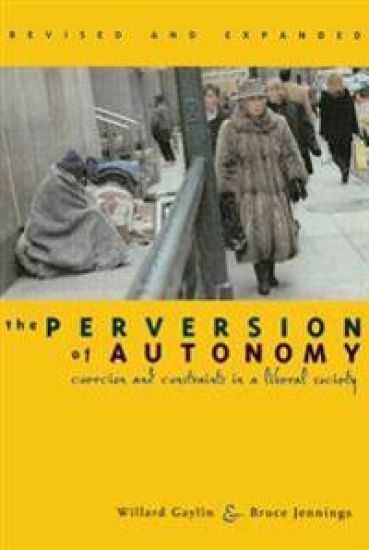
The Perversion of Autonomy

The Perversion of Autonomy

Willard Gaylin; Bruce Jennings

Georgetown University Press
2003
pokkari
Modern psychological and political theory meet head-on in this powerful re-evaluation of America's contradictory and sometimes dangerous addiction to individualism. Best-selling author Gaylin and co-author Jennings investigate the contentious intersections of interdependence and autonomy, rights and public responsibility. They examine the painful abrasion occurring between America's tradition of personal freedom and privacy, as it rubs against the still valuable if almost vanishing ideals of sacrifice and social order. Our current culture of autonomy - championed by both liberals on the left and libertarians on the right - is based on the idea of rationality as the motivation for human conduct. But, as the authors remind us, people are not simply rational creatures - appeals to emotions are always far more effective than logical argument in changing our behavior. This timely edition includes a new preface; updated examples and illustrations throughout; and, new coverage of contemporary social critics and their work since the publication of the first edition. Two essential new chapters, one on the movement to forgo life-sustaining treatment and the other on physician-assisted suicide, particularly clarify the authors' arguments. Drawing on these and numerous other illustrations - with significant emphasis on the state of American health care - Gaylin and Jennings demonstrate that society has not just the right but the duty to occasionally invoke fear, shame, and guilt in order to motivate humane behavior. As cases of AIDS are once again on the upswing, as the dangerously mentally ill are allowed to wander free and untreated, as starvation and poverty still hold too many in its grip in the richest nation on the planet, this controversial book, considerably revised and expanded, is needed more than ever. If we are to indeed preserve and nurture a genuinely free - and liberal - society, the authors suggest that these "coercions" may be essential for the health and the maturity of a nation where we all too often avert our eyes, not seeing that our neighbor is in pain or trouble and needs our help.
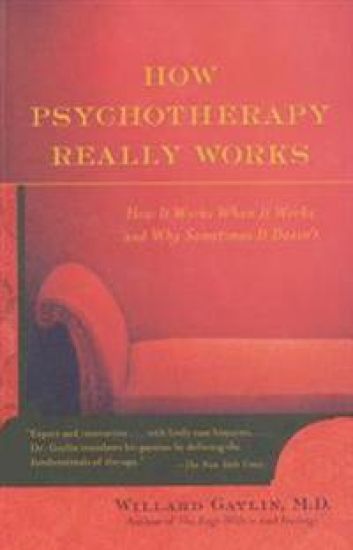
How Psychotherapy Really Works

How Psychotherapy Really Works

Willard Gaylin

CONTEMPORARY BOOKS INC
2001
nidottu
Decodes the mysteries of the therapeutic process How does therapy work? Can "talking" truly precipitate a change in behavior? Why do therapists rely so heavily on childhood experiences? Does the past really affect the present? Drawing on more than 30 years of experience as a psychotherapist, analyst, and teacher, Dr. Gaylin addresses the fundamentals of the therapeutic process in How Psychotherapy Really Works, an enlightening tour through one of the most misunderstood sciences of our times.
Talk Is Not Enough

Talk Is Not Enough

Willard Gaylin

Little, Brown Company
2000
sidottu
Although more people than ever are in psychotherapy, confusion about what it is, who needs it, and who doesn't still exists. Drawing on over thirty years of experience as a psychotherapist, analyst, and teacher, Dr. Gaylin addresses the fundamentals of the therapeutic process: How does therapy work? Can "talking" truly precipitate a change in behavior? Why do therapists rely so heavily on childhood experiences? Does the past really affect the present? Gaylin speaks plainly but profoundly about the art of therapy, what the roles of the patient and therapist should be, and what it takes, on the part of each, for a patient to get better. The result is an enlightening tour through one of the most misunderstood sciences of our time. As insurance companies limit the number of therapy sessions they will cover and people look for quick-fix "cures" for their psychological ailments, Dr. Gaylin explains the importance of long-term therapy. This book has a natural audience of people in therapy. Current estimates put this number at 15 million.
The Killing of Bonnie Garland: A Question of Justice
"A powerful and passionate indictment of the use of psychiatric testimony in criminal cases." --The Cleveland Plain DealerA year after Richard Herrin confessed to killing his girlfriend, Bonnie Garland, he was found not guilty of murder. His crime, he pleaded, was committed "under extreme emotional disturbance," excusing him from maximum responsibility. He was convicted on the reduced charge of manslaughter.In this incisive examination of the murder, the trial, and its aftermath, a distinguished psychiatrist addresses the issue of the insanity defense. He shows how psychiatric testimony can distort court proceedings, and brilliantly analyzes the conflict between the individual rights of the accused and society's right to justice.