Kirjojen hintavertailu. Mukana 12 399 306 kirjaa ja 12 kauppaa.

Kirjailija

Willi Freeden

Kirjat ja teokset yhdessä paikassa: 22 kirjaa, julkaisuja vuosilta 2004-2024, suosituimpien joukossa Spherical Functions of Mathematical Geosciences. Vertaile teosten hintoja ja tarkista saatavuus suomalaisista kirjakaupoista.

22 kirjaa

Kirjojen julkaisuhaarukka 2004-2024.

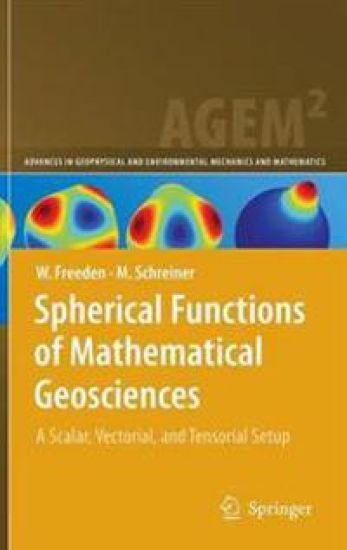
Spherical Functions of Mathematical Geosciences

Spherical Functions of Mathematical Geosciences

Willi Freeden; Michael Schreiner

Springer-Verlag Berlin and Heidelberg GmbH Co. K
2008
sidottu
Duringthelastdecades,geosciencesand-engineeringwerein?uencedbytwo essentialscenarios. First, thetechnologicalprogresshaschangedcompletely the observational and measurement techniques. Modern high speed c- puters and satellite-based techniques are entering more and more all (geo) disciplines. Second, there is a growing public concern about the future of our planet, its climate, its environment, and about an expected shortage of natural resources. Obviously, both aspects, viz. (i) e?cient strategies of protection against threats of a changing Earth and (ii) the exceptional s- uation of getting terrestrial, airborne as well as spaceborne, data of better and better quality explain the strong need for new mathematical structures, tools, and methods. In consequence, mathematics concerned with geosci- ti?c problems, i.e., geomathematics, is becoming more and more important. Nowadays, geomathematics may be regarded as the key technology to build the bridge between real Earth processes and their scienti?c understanding. In fact, it is the intrinsic and indispensable means to handle geoscient- cally relevant data sets of high quality within high accuracy and to improve signi?cantly modeling capabilities in Earth system research.
Multiscale Potential Theory

Multiscale Potential Theory

Willi Freeden; Volker Michel

Birkhauser Boston Inc
2004
sidottu
During the last few decades, the subject of potential theory has not been overly popular in the mathematics community. Neglected in favor of more abstract theories, it has been taught primarily where instructors have ac­ tively engaged in research in this field. This situation has resulted in a scarcity of English language books of standard shape, size, and quality covering potential theory. The current book attempts to fill that gap in the literature. Since the rapid development of high-speed computers, the remarkable progress in highly advanced electronic measurement concepts, and, most of all, the significant impact of satellite technology, the flame of interest in potential theory has burned much brighter. The realization that more and more details of potential functions are adequately visualized by "zooming­ in" procedures of modern approximation theory has added powerful fuel to the flame. It seems as if, all of a sudden, harmonic kernel functions such as splines and/or wavelets provide the impetus to offer appropriate means of assimilating and assessing the readily increasing flow of potential data, reducing it to comprehensible form, and providing an objective basis for scientific interpretation, classification, testing of concepts, and solutions of problems involving the Laplace operator.