Kirjojen hintavertailu. Mukana 12 595 353 kirjaa ja 12 kauppaa.

Kirjailija

William A. Adkins

Kirjat ja teokset yhdessä paikassa: 4 kirjaa, julkaisuja vuosilta 1992-2015, suosituimpien joukossa Ordinary Differential Equations. Vertaile teosten hintoja ja tarkista saatavuus suomalaisista kirjakaupoista.

4 kirjaa

Kirjojen julkaisuhaarukka 1992-2015.

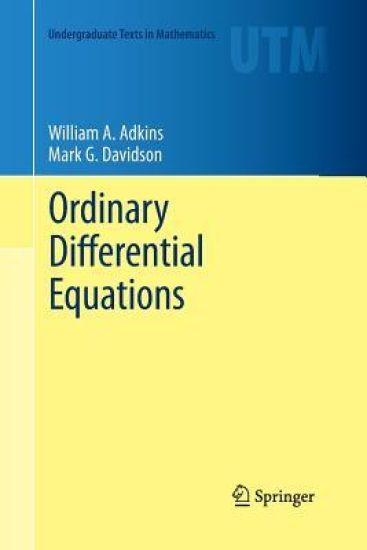
Ordinary Differential Equations

Ordinary Differential Equations

William A. Adkins; Mark G. Davidson

Springer-Verlag New York Inc.
2015
nidottu
Unlike most texts in differential equations, this textbook gives an early presentation of the Laplace transform, which is then used to motivate and develop many of the remaining differential equation concepts for which it is particularly well suited. For example, the standard solution methods for constant coefficient linear differential equations are immediate and simplified, and solution methods for constant coefficient systems are streamlined. By introducing the Laplace transform early in the text, students become proficient in its use while at the same time learning the standard topics in differential equations. The text also includes proofs of several important theorems that are not usually given in introductory texts. These include a proof of the injectivity of the Laplace transform and a proof of the existence and uniqueness theorem for linear constant coefficient differential equations.Along with its unique traits, this text contains all the topics needed for a standard three- or four-hour, sophomore-level differential equations course for students majoring in science or engineering. These topics include: first order differential equations, general linear differential equations with constant coefficients, second order linear differential equations with variable coefficients, power series methods, and linear systems of differential equations. It is assumed that the reader has had the equivalent of a one-year course in college calculus.
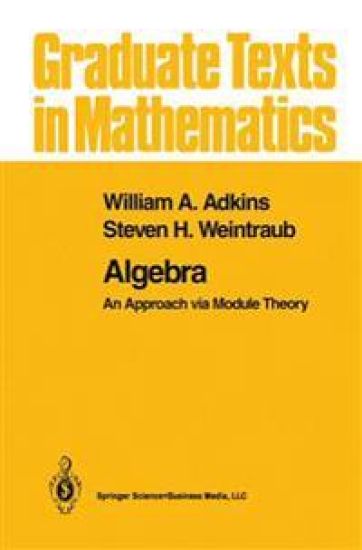
Algebra

Algebra

William A. Adkins; Steven H. Weintraub

Springer-Verlag New York Inc.
2012
nidottu
This book is designed as a text for a first-year graduate algebra course. As necessary background we would consider a good undergraduate linear algebra course. An undergraduate abstract algebra course, while helpful, is not necessary (and so an adventurous undergraduate might learn some algebra from this book). Perhaps the principal distinguishing feature of this book is its point of view. Many textbooks tend to be encyclopedic. We have tried to write one that is thematic, with a consistent point of view. The theme, as indicated by our title, is that of modules (though our intention has not been to write a textbook purely on module theory). We begin with some group and ring theory, to set the stage, and then, in the heart of the book, develop module theory. Having developed it, we present some of its applications: canonical forms for linear transformations, bilinear forms, and group representations. Why modules? The answer is that they are a basic unifying concept in mathematics. The reader is probably already familiar with the basic role that vector spaces play in mathematics, and modules are a generaliza­ tion of vector spaces. (To be precise, modules are to rings as vector spaces are to fields.
Ordinary Differential Equations

Ordinary Differential Equations

William A. Adkins; Mark G. Davidson

Springer-Verlag New York Inc.
2012
sidottu
Unlike most texts in differential equations, this textbook gives an early presentation of the Laplace transform, which is then used to motivate and develop many of the remaining differential equation concepts for which it is particularly well suited. For example, the standard solution methods for constant coefficient linear differential equations are immediate and simplified, and solution methods for constant coefficient systems are streamlined. By introducing the Laplace transform early in the text, students become proficient in its use while at the same time learning the standard topics in differential equations. The text also includes proofs of several important theorems that are not usually given in introductory texts. These include a proof of the injectivity of the Laplace transform and a proof of the existence and uniqueness theorem for linear constant coefficient differential equations.Along with its unique traits, this text contains all the topics needed for a standard three- or four-hour, sophomore-level differential equations course for students majoring in science or engineering. These topics include: first order differential equations, general linear differential equations with constant coefficients, second order linear differential equations with variable coefficients, power series methods, and linear systems of differential equations. It is assumed that the reader has had the equivalent of a one-year course in college calculus.
Algebra

Algebra

William A. Adkins; Steven H. Weintraub

Springer-Verlag New York Inc.
1992
sidottu
This book is designed as a text for a first-year graduate algebra course. As necessary background we would consider a good undergraduate linear algebra course. An undergraduate abstract algebra course, while helpful, is not necessary (and so an adventurous undergraduate might learn some algebra from this book). Perhaps the principal distinguishing feature of this book is its point of view. Many textbooks tend to be encyclopedic. We have tried to write one that is thematic, with a consistent point of view. The theme, as indicated by our title, is that of modules (though our intention has not been to write a textbook purely on module theory). We begin with some group and ring theory, to set the stage, and then, in the heart of the book, develop module theory. Having developed it, we present some of its applications: canonical forms for linear transformations, bilinear forms, and group representations. Why modules? The answer is that they are a basic unifying concept in mathematics. The reader is probably already familiar with the basic role that vector spaces play in mathematics, and modules are a generaliza­ tion of vector spaces. (To be precise, modules are to rings as vector spaces are to fields.