Kirjojen hintavertailu. Mukana 12 390 323 kirjaa ja 12 kauppaa.

Kirjailija

William a Paquette

Kirjat ja teokset yhdessä paikassa: 5 kirjaa, julkaisuja vuosilta 2018-2024, suosituimpien joukossa The Pink House. Vertaile teosten hintoja ja tarkista saatavuus suomalaisista kirjakaupoista.

Mukana myös kirjoitusasut: William a. Paquette

5 kirjaa

Kirjojen julkaisuhaarukka 2018-2024.

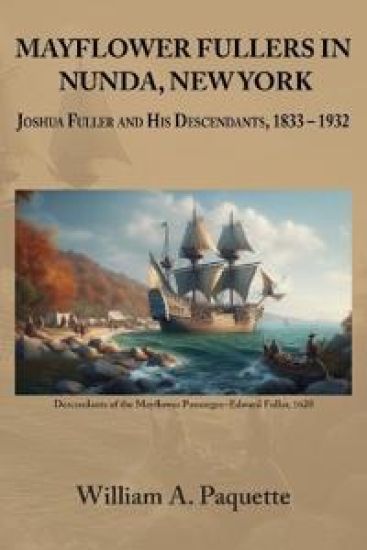
Mayflower Fullers in Nunda, New York

Mayflower Fullers in Nunda, New York

William a Paquette

New Dominion Press
2024
pokkari
The Mayflower Fullers in Nunda, New York, is a historical account of the Fuller family in Nunda, who were direct descendants of Edward Fuller. Edward arrived in the "New World" aboard the Mayflower in the fall of 1620.The Township and Village of Nunda, New York, are in southeastern Livingston County in western New York. Nunda is a Seneca name referring to where a valley meets the hills. Nunda Township was created in 1808 and was opened to settlement as part of the Morris Reserve. The Township originally was a twelve-square-mile tract when it was part of Allegany County, but it was reduced to six square miles when the region along the Genesee River was separated and later designated a State Park. The rest of Nunda became part of Livingston County. Nunda's history records only three families living in the Township in 1808, but the number of residents increased to 1,291 in 1830 and 2,636 by 1840.New England's increasing population and high reproductive period witnessed a population boom. This placed a strain on the resources of New England to provide farmland for each newly married family. Many of the early residents of Nunda came from New England, which is evident by the names of two village streets: Massachusetts and Vermont. Among the families leaving Massachusetts was the Joshua Fuller family. Joshua Fuller purchased land in the Township along what was later named Fuller Road, where Joshua, his son William C., and a grandson, Henry, all farmed. In his advancing years, Joshua Fuller moved from his farm to Massachusetts Street, where he resided until his death.Nunda village was incorporated in 1839 on the site where four Seneca Indian camps were once located. Village life centered around a village square, a newly created post office (1831), and the construction of two commercial blocks: Merchant's Row and Farmer's Exchange. Nunda's population continued to rise due to the new Genesee Valley Canal in 1861, which permitted the shipping of local timber and grains to New York City, Syracuse, and Rochester. Unfortunately, the Canal's value quickly declined with the new railroad lines across New York State. Nunda was not originally included on a railroad route, but a trunk line was later established by 1882. Consequently, Nunda took on the symbols of prosperity with newspapers, manufacturing, banks, and commercial businesses.
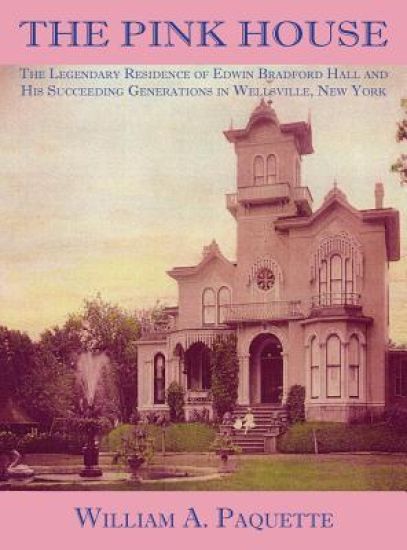
The Pink House

The Pink House

William a Paquette; Julian B Woelfel; Marcile B Woelfel

New Dominion Press
2021
pokkari
The history of The Pink House is unique because it is one of the few Victorian-era residences to remain in the possession of the same family for four generations. Victorian residences are 19th century fantasies created as monuments to their original owner's financial success and their personal tastes and interests. Each residence is an exuberant expression of achieving the American financial dream, the love of family and faith, and the opportunity to explore avocations during an era in United States History when the country was rapidly becoming an urban and industrial nation. Economic success enabled Americans to cast off the simple and austere architecture of houses that were two rooms over two. Multi-storied residences, many with towers and multiple wings, permitted larger and more rooms with specialized functions. The interiors celebrated the latest in technological innovation in plumbing, lighting, and heating. The decorative arts were given full expression in the beautifully carved woodwork that celebrated the varieties of local hard and soft woods and the skills of local immigrant artisans. Victorian homes were dedicated to more than the customary cooking, eating, and sleeping functions. Victorian homes permitted family members to experience beauty and comfort while developing their own talents and skills. But, it was not only the exterior and interior that Victorian houses celebrated. These residences celebrated the landscaped grounds and decorative gardens, which enhanced the beauty of the architecture in their midst. Landscaped grounds with fountains and ornamentals were gathering places for family and friends to celebrate birthdays, christenings, weddings, funerals, and the seasons of spring, summer, fall, and winter. Victorians were social. Both the gardens and grounds along with the residential interiors brought family and friends frequently together to appreciate special moments.The Pink House has always been a private residence. It has never been open to the public. Therefore, this may be the reason for the many unexplained stories that surfaced over 150 years about the home built by Edwin Bradford Hall. Mr. Hall and his descendants remained very private people in both the celebration of life and the sadness of grief over death. Mrs. Fannie Hall Carpenter, the daughter of Edwin B. Hall, lived a more secluded life after the death of her husband, John Milton Carpenter, in 1926 until her own death in 1958. As a result, the house retreated more from the realm of social interaction. Mrs. Carpenter's daughter, Florence Carpenter Woelfel, lived permanently in Columbus, Ohio returning to Wellsville for a few months each year. It was not until the retirement of Dr. Julian Woelfel in 1989, Edwin B. Hall's great-grandson, that The Pink House once again came back to life and was reintegrated into the Wellsville community under Julian's and Marcile's stewardship.On behalf of Dr. Julian and Marcile Woelfel I invite you to The Pink House. This is a ghost free tour. The Pink House never had ghosts. Mary Frances Farnum never haunted The Pink House because it never existed during her short life time. The death of two-year old Beatrice Carpenter was a private family tragedy. As you page through the story of The Pink House enjoy the travel back in time to Wellsville's early days. Rediscover the accomplishments of Edwin Bradford Hall as a successful druggist, a gifted amateur fossil collector, and talented architect. Rediscover the roles played by Antoinette Farnum Hall, her daughter Fannie Hall Carpenter, and Mrs. Hall's sister, Louise Farnum Brown, in the establishment of Wellsville's David A. Howe Public Library. My only regret is that Dr. Julian Woelfel died unexpectedly on September 2, 2017 and could not be with us to celebrate the publication of The Pink House but he remains with us in spirit.
The Pink House

The Pink House

William a Paquette; Julian B Woelfel; Marcile B Woelfel

New Dominion Press
2018
sidottu
The history of The Pink House is unique; it is one of the few Victorian-era residences to remain in the possession of the same family for four generations. Victorian residences are 19th century fantasies created as monuments to the original owner's financial success and their personal interests. Each residence is an expression of achievement.