Kirjojen hintavertailu. Mukana 12 390 323 kirjaa ja 12 kauppaa.

Kirjailija

William a. Tiller

Kirjat ja teokset yhdessä paikassa: 4 kirjaa, julkaisuja vuosilta 1991-2021, suosituimpien joukossa Deep Reality: Why Source Science May Be the Key to Understanding Human Potential. Vertaile teosten hintoja ja tarkista saatavuus suomalaisista kirjakaupoista.

Mukana myös kirjoitusasut: William A Tiller

4 kirjaa

Kirjojen julkaisuhaarukka 1991-2021.

The Powers of Attention, Attraction, and Intention In Field Control Therapy
The Powers of Attention, Attraction, and Intention in Field Control Therapy: My Pathway of Adventure, Discovery, and HealingAs toxins gradually build up in the body, health issues can begin to appear. Healthy tissues showa different field than unhealthy tissue, and Field Control Therapy, or FCT, works with such energyfields. Steven Tonsager, one of the most active practitioners of FCT, shares his work, which ledhim to form theories about the power of energy medicine in treating patients and his own life.Although Steven was influenced by FCT founder Dr. Savely Yurkovsky, Dr. David Hawkins, andDr. William Tiller, he explores new territory in the book, giving FCT practitioners and otherspowerful, practical tools and strategies to uncover insights into the cause and treatments of varioushealth issues. In The Powers of Attention, Attraction, and Intention in Field Control Therapy: MyPathway of Adventure, Discovery, and Healing, Steven offers the following: - New ideas to help patients understand differences between conventional and informationalmedicine by providing clinical examples.- New methods for FCT practitioners to test patients to improve results, as well as new waysto make FCT remedies and administer them to patients.- Additional concepts to connect FCT testing with toxicological principles.- Practical methods to apply MEMON technology for patients with sensitivity toelectromagnetic fields produced by technology.Steven, who hopes his book will inspire others to integrate FCT into their professional and personallives also details his path of discovery during his work with patients in his sometimes irreverentstyle, describing the transformation in his thinking after administering more than 10,000 FCTtests. Those findings led to discoveries explored in the last portion of the book, going beyondcurrent FCT methods and theories.
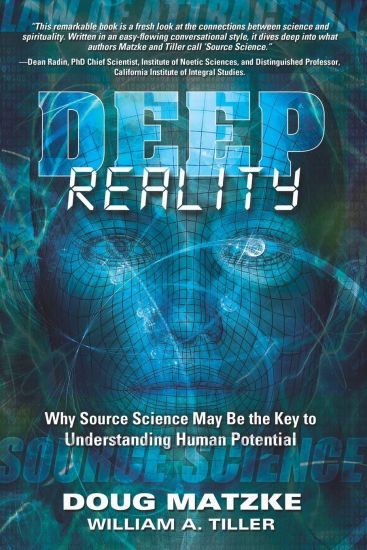
Deep Reality: Why Source Science May Be the Key to Understanding Human Potential
The human species is special because we contain general intelligence. Engineers believe they can build computerized artificial intelligent (AI) versions of human behaviors, because they believe our brains are classical computers. But, humans are Real Intelligent (RI) living systems that exhibit many extraordinary behaviors that are not possible to produce by purely classical mechanisms of any kind. Extraordinary behaviors are also exhibited by advanced quantum computing (QC) machines, thereby creating a technology race and investment boom in both AI and QC technologies. The deep reality explored by this book combines these two ideas (QC + AI) in a conversational style between two world renowned PhD scientists. We propose that our quantum minds exist independently of and interact with our individual brains. We support this model by reviewing the research where people have directly interacted with other quantum and probabilistic systems.Our source science model proposes that thought is intimately connected to the science of informational protophysics, which is the quantum source of our universe and every "thing" in it. This narrative journey recognizes that information, thought, and meaning are primarily dependent on the hyperdimensional states used by both neural and quantum computing. Just like all quantum models, source science leads to extraordinary understanding regarding the space-like entangled nature of thoughts, meaning, emotions, space, and time. After describing our deep, holistic, intimate, and sacred nature, we conclude by making unexpected predictions about our human potential and the future of our human society.
The Science of Crystallization

The Science of Crystallization

William A. Tiller

Cambridge University Press
1992
pokkari
This book, together with its companion volume The Science of Crystallization: Microscopic Interfacial Phenomena, make up a complete course that will teach an advanced student how to understand and analyse scientifically any of the phenomena that are observed during natural or technological crystallization from any medium and via any technique. It is an advanced text that goes into considerable detail concerning the many elements of knowledge needed to understand both quantitatively and qualitatively a crystallization event. Both the present book and its companion volume are sufficiently broad to provide the scientific basis necessary to address any area of application. The book and its companion can be used independently of each other, and together they provide the basis for advanced courses on crystallization in departments of materials science, metallurgy, electrical engineering, geology, chemistry, chemical engineering and physics. In addition the books will be invaluable to scientists and engineers in the solid state electronics, optoelectronics, metallurgical and chemical industries involved in any form of crystallization and thin film formation.
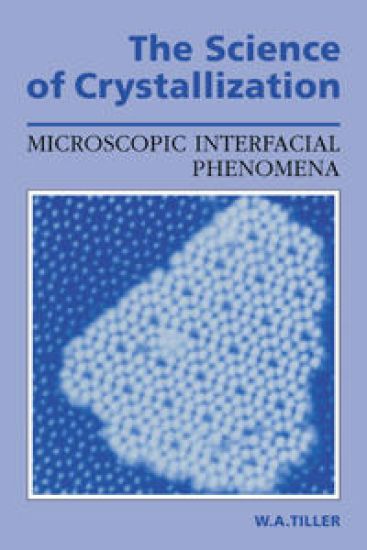
The Science of Crystallization

The Science of Crystallization

William A. Tiller

Cambridge University Press
1991
pokkari
This book, together with its companion volume The Science of Crystallization: Macroscopic Phenomena and Defect Generation, make up a complete course that will teach an advanced student how to understand and analyse scientifically any of the phenomena that are observed during natural or technological crystallization from any medium and via any technique of crystallization. It is an advanced text that goes into considerable detail concerning the many elements of knowledge needed to understand quantitatively a crystallization event. This particular volume deals with the important atomistic-level processes occurring at the interface between a crystal and its nutrient. It also provides the necessary scientific background of both thermodynamics and kinetics needed for the understanding of crystallization for both bulk crystals and thin film formation.