Kirjojen hintavertailu. Mukana 12 657 676 kirjaa ja 12 kauppaa.
Kirjailija
William B. Bonvillian
Kirjat ja teokset yhdessä paikassa: 8 kirjaa, julkaisuja vuosilta 2015-2024, suosituimpien joukossa Global Initiatives and Higher Education in the Fourth Industrial Revolution. Vertaile teosten hintoja ja tarkista saatavuus suomalaisista kirjakaupoista.
The Fourth industrial Revolution (4IR) is forcing higher education (HE) into a new era where it must either actively and positively contribute to innovation, sustainability, and development or become obsolete and redundant. HE must leave its ivory tower and forge links and partnerships with society, industry, and governing bodies by delivering graduates that are holistically educated and trained to bring positive innovation and change and to address the challenges that humanity is facing in the 21st century.
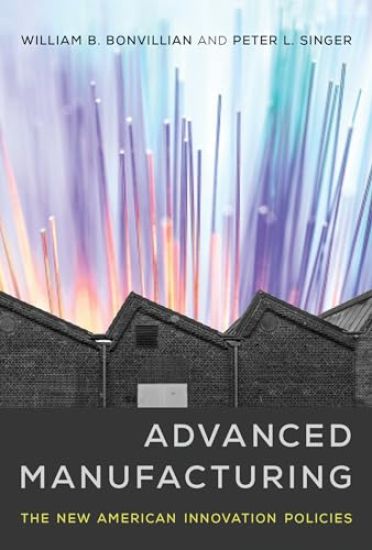
How to rethink innovation and revitalize America's declining manufacturing sector by encouraging advanced manufacturing, bringing innovative technologies into the production process. The United States lost almost one-third of its manufacturing jobs between 2000 and 2010. As higher-paying manufacturing jobs are replaced by lower-paying service jobs, income inequality has been approaching third world levels. In particular, between 1990 and 2013, the median income of men without high school diplomas fell by an astonishing 20% between 1990 and 2013, and that of men with high school diplomas or some college fell by a painful 13%. Innovation has been left largely to software and IT startups, and increasingly U.S. firms operate on a system of "innovate here/produce there," leaving the manufacturing sector behind. In this book, William Bonvillian and Peter Singer explore how to rethink innovation and revitalize America's declining manufacturing sector. They argue that advanced manufacturing, which employs such innovative technologies as 3-D printing, advanced material, photonics, and robotics in the production process, is the key. Bonvillian and Singer discuss transformative new production paradigms that could drive up efficiency and drive down costs, describe the new processes and business models that must accompany them, and explore alternative funding methods for startups that must manufacture. They examine the varied attitudes of mainstream economics toward manufacturing, the post-Great Recession policy focus on advanced manufacturing, and lessons from the new advanced manufacturing institutes. They consider the problem of "startup scaleup," possible new models for training workers, and the role of manufacturing in addressing "secular stagnation" in innovation, growth, the middle classes, productivity rates, and related investment. As recent political turmoil shows, the stakes could not be higher.
The U.S. government is pursuing a series of new industrial policies at a level not seen before. This effort has been driven politically on a bipartisan basis by concern over China’s extensive industrial policy system. Growing concern about climate change has also been a major driver for these new policies as has the Covid-19 pandemic. Industrial Innovation Policy in the United States places these new policy approaches into an historical context, particularly emphasizing industrial policy approaches to the innovation system. It then reviews the definitional and economic debates over industrial policy. Next, it catalogs and summarizes the main thrusts of new U.S. industrial policy efforts and describes the major elements, as well as gaps in these approaches. In particular, it notes the critical gap in the U.S. for scale-up funding for moving new technologies into production as compared to China. The author also notes the types of industrial innovation policies, characterizing “top down” and “bottom up” approaches. Finally, the monograph reviews the new mechanisms and supporting infrastructure needed to make industrial policy approaches operational.
The chapters in this volume focus on the future of law and related disciplines: human rights and access to medical care, corruption and money laundering in state procurement, counterfeit medical products, IPR waiver on COVID-19 vaccines, emergency powers, freedom of expression, prison healthcare, the impact on labour law, access to courts and digital court processes, access to education and the impact on insurance law are but a few possible topics which are addressed.
A roadmap for how we can rebuild America's working class by transforming workforce education and training.The American dream promised that if you worked hard, you could move up, with well-paying working-class jobs providing a gateway to an ever-growing middle class. Today, however, we have increasing inequality, not economic convergence. Technological advances are putting quality jobs out of reach for workers who lack the proper skills and training. In Workforce Education, William Bonvillian and Sanjay Sarma offer a roadmap for rebuilding America's working class. They argue that we need to train more workers more quickly, and they describe innovative methods of workforce education that are being developed across the country.
After a long decline in American manufacturing in the 2000s — manufacturing employment fell by one third, 64,000 factories closed, manufacturing capital investment and output suffered, and the productivity rate dropped during this period. Simultaneously, the U.S. had been systematically shifting production abroad, and the decline in production capability was starting to affect innovation capacity — which had long been viewed as a core strength of the U.S. economy.This book reviews the origins of the policy response to this dilemma, which came to be called “advanced manufacturing.” It traces the way the foundational concepts were developed in a series of reports from in and out of government. It explores how, for the first time, an innovation system response was considered and developed to strengthen the U.S. production system. It examines the key new policy mechanism created by the Administration and supported by Congress, the manufacturing innovation institutes, a complex public-private collaborative model to develop new production technologies and processes, with supporting workforce education.It reviews how the new institutes are working, lessons learned as they have started up and possible enhancements that could expand their policy reach. While this model may create efficiencies and productivity gains to help put existing U.S. manufacturers back in competition with lower cost and lower wage competitors abroad, there is a second problem — the U.S. innovation system based on venture capital for implementing the IT and biotech innovation waves of the late 20th century now largely shifted to support software firms, abandoning manufacturing startups. This is now driving the next generation of manufacturers to production abroad, which will have significant societal consequences longer term. This monograph reviews new models to tackle this problem, essentially substituting technology and knowhow rich spaces for capital.
The American economy faces two deep problems: expanding innovation and raising the rate of quality job creation. Both have roots in a neglected problem: the resistance of Legacy economic sectors to innovation. While the U.S. has focused its polices on breakthrough innovations to create new economic frontiers like information technology and biotechnology, most of its economy is locked into Legacy sectors defended by technological/economic/political/social paradigms that block competition from disruptive innovations that could challenge their models. Americans like to build technology "covered wagons " and take them "out west " to open new innovation frontiers; we don't head our wagons "back east " to bring innovation to our Legacy sectors. By failing to do so, the economy misses a major opportunity for innovation, which is the bedrock of U.S. competitiveness and its standard of living. Technological Innovation in Legacy Sectors uses a new, unifying conceptual framework to identify the shared features underlying structural obstacles to innovation in major Legacy sectors: energy, air and auto transport, the electric power grid, buildings, manufacturing, agriculture, health care delivery and higher education, and develops approaches to understand and transform them. It finds both strengths and obstacles to innovation in the national innovation environments - a new concept that combines the innovation system and the broader innovation context - for a group of Asian and European economies. Manufacturing is a major Legacy sector that presents a particular challenge because it is a critical stage in the innovation process. By increasingly offshoring production, the U.S. is offshoring important parts of its innovation capacity. "Innovate here, produce here, " where the U.S. took all the gains of its strong innovation system at every stage, is being replaced by "innovate here, produce there, " which threatens to lead to "produce there, innovate there. " To bring innovation to Legacy sectors, authors William Bonvillian and Charles Weiss recommend that policymakers focus on all stages of innovation from research through implementation. They should fill institutional gaps in the innovation system and take measures to address structural obstacles to needed disruptive innovations. In the specific case of advanced manufacturing, the production ecosystem can be recreated to reverse "jobless innovation " and add manufacturing-led innovation to the U.S.'s still-strong, research-oriented innovation system.