Kirjojen hintavertailu. Mukana 12 390 323 kirjaa ja 12 kauppaa.
Kirjailija
William B. Langdon
Kirjat ja teokset yhdessä paikassa: 14 kirjaa, julkaisuja vuosilta 1998-2025, suosituimpien joukossa Ten Thousand Things Relating to China and the Chinese. Vertaile teosten hintoja ja tarkista saatavuus suomalaisista kirjakaupoista.
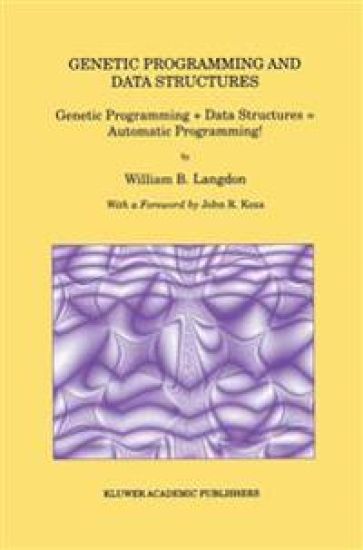
Computers that `program themselves' has long been an aim of computer scientists. Recently genetic programming (GP) has started to show its promise by automatically evolving programs. Indeed in a small number of problems GP has evolved programs whose performance is similar to or even slightly better than that of programs written by people. The main thrust of GP has been to automatically create functions. While these can be of great use they contain no memory and relatively little work has addressed automatic creation of program code including stored data. This issue is the main focus of Genetic Programming, and Data Structures: Genetic Programming + Data Structures = Automatic Programming!. This book is motivated by the observation from software engineering that data abstraction (e.g., via abstract data types) is essential in programs created by human programmers. This book shows that abstract data types can be similarly beneficial to the automatic production of programs using GP. Genetic Programming and Data Structures: Genetic Programming + Data Structures = Automatic Programming! shows how abstract data types (stacks, queues and lists) can be evolved using genetic programming, demonstrates how GP can evolve general programs which solve the nested brackets problem, recognises a Dyck context free language, and implements a simple four function calculator. In these cases, an appropriate data structure is beneficial compared to simple indexed memory. This book also includes a survey of GP, with a critical review of experiments with evolving memory, and reports investigations of real world electrical network maintenance scheduling problems that demonstrate that Genetic Algorithms can find low cost viable solutions to such problems. Genetic Programming and Data Structures: Genetic Programming + Data Structures = Automatic Programming! should be of direct interest to computer scientists doing research on genetic programming, genetic algorithms, data structures, and artificial intelligence. In addition, this book will be of interest to practitioners working in all of these areas and to those interested in automatic programming.
Title: Ten thousand Chinese Things.] Ten thousand Things relating to China and the Chinese: an epitome of the genius, government, history ... of the Celestial Empire, together with a Sinopsis of the Chinese Collection. By William B. Langdon.Publisher: British Library, Historical Print EditionsThe British Library is the national library of the United Kingdom. It is one of the world's largest research libraries holding over 150 million items in all known languages and formats: books, journals, newspapers, sound recordings, patents, maps, stamps, prints and much more. Its collections include around 14 million books, along with substantial additional collections of manuscripts and historical items dating back as far as 300 BC.The GENERAL HISTORICAL collection includes books from the British Library digitised by Microsoft. This varied collection includes material that gives readers a 19th century view of the world. Topics include health, education, economics, agriculture, environment, technology, culture, politics, labour and industry, mining, penal policy, and social order. ++++The below data was compiled from various identification fields in the bibliographic record of this title. This data is provided as an additional tool in helping to insure edition identification: ++++ British Library Dunn, Nathan; Langdon, William B.; 1842. 273 p.; 8 . 1298.l.5.
Genetic programming (GP), one of the most advanced forms of evolutionary computation, has been highly successful as a technique for getting computers to automatically solve problems without having to tell them explicitly how. Since its inceptions more than ten years ago, GP has been used to solve practical problems in a variety of application fields. Along with this ad-hoc engineering approaches interest increased in how and why GP works. This book provides a coherent consolidation of recent work on the theoretical foundations of GP. A concise introduction to GP and genetic algorithms (GA) is followed by a discussion of fitness landscapes and other theoretical approaches to natural and artificial evolution. Having surveyed early approaches to GP theory it presents new exact schema analysis, showing that it applies to GP as well as to the simpler GAs. New results on the potentially infinite number of possible programs are followed by two chapters applying these new techniques.
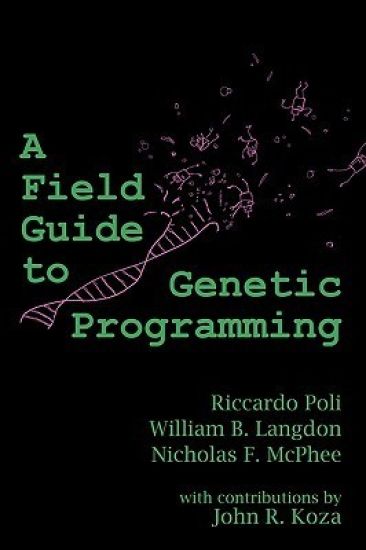
Genetic programming (GP) is a systematic, domain-independent method for getting computers to solve problems automatically starting from a high-level statement of what needs to be done. Using ideas from natural evolution, GP starts from an ooze of random computer programs, and progressively refines them through processes of mutation and sexual recombination, until high-fitness solutions emerge. All this without the user having to know or specify the form or structure of solutions in advance. GP has generated a plethora of human-competitive results and applications, including novel scientific discoveries and patentable inventions. This unique overview of this exciting technique is written by three of the most active scientists in GP. See www.gp-field-guide.org.uk for more information on the book.
Genetic programming (GP), one of the most advanced forms of evolutionary computation, has been highly successful as a technique for getting computers to automatically solve problems without having to tell them explicitly how. Since its inceptions more than ten years ago, GP has been used to solve practical problems in a variety of application fields. Along with this ad-hoc engineering approaches interest increased in how and why GP works. This book provides a coherent consolidation of recent work on the theoretical foundations of GP. A concise introduction to GP and genetic algorithms (GA) is followed by a discussion of fitness landscapes and other theoretical approaches to natural and artificial evolution. Having surveyed early approaches to GP theory it presents new exact schema analysis, showing that it applies to GP as well as to the simpler GAs. New results on the potentially infinite number of possible programs are followed by two chapters applying these new techniques.
Computers that `program themselves' has long been an aim of computer scientists. Recently genetic programming (GP) has started to show its promise by automatically evolving programs. Indeed in a small number of problems GP has evolved programs whose performance is similar to or even slightly better than that of programs written by people. The main thrust of GP has been to automatically create functions. While these can be of great use they contain no memory and relatively little work has addressed automatic creation of program code including stored data. This issue is the main focus of Genetic Programming, and Data Structures: Genetic Programming + Data Structures = Automatic Programming!. This book is motivated by the observation from software engineering that data abstraction (e.g., via abstract data types) is essential in programs created by human programmers. This book shows that abstract data types can be similarly beneficial to the automatic production of programs using GP. Genetic Programming and Data Structures: Genetic Programming + Data Structures = Automatic Programming! shows how abstract data types (stacks, queues and lists) can be evolved using genetic programming, demonstrates how GP can evolve general programs which solve the nested brackets problem, recognises a Dyck context free language, and implements a simple four function calculator. In these cases, an appropriate data structure is beneficial compared to simple indexed memory. This book also includes a survey of GP, with a critical review of experiments with evolving memory, and reports investigations of real world electrical network maintenance scheduling problems that demonstrate that Genetic Algorithms can find low cost viable solutions to such problems. Genetic Programming and Data Structures: Genetic Programming + Data Structures = Automatic Programming! should be of direct interest to computer scientists doing research on genetic programming, genetic algorithms, data structures, and artificial intelligence. In addition, this book will be of interest to practitioners working in all of these areas and to those interested in automatic programming.





![Ten Thousand Chinese Things.] Ten Thousand Things Relating to China and the Chinese](/covers/9781241527655.jpg)
!["Ten Thousand Chinese Things." a Descriptive Catalogue of the Chinese Collection [Owned by N. Dunn], Now Exhibiting at St. George's Place, Hyde Park Corner, London ... by Wm. B. Langdon ... First English Edition. [With Plates.]](/covers/9781241093389.jpg)