
Kirjailija
William F. Buckley
Kirjat ja teokset yhdessä paikassa: 33 kirjaa, julkaisuja vuosilta 1998-2024, suosituimpien joukossa Buckley vs. Vidal. Vertaile teosten hintoja ja tarkista saatavuus suomalaisista kirjakaupoista.
Mukana myös kirjoitusasut: William F Buckley
33 kirjaa
Kirjojen julkaisuhaarukka 1998-2024.

Up from Liberalism
William F. Buckley; John Dos Passos; Barry Morris Goldwater
Literary Licensing, LLC
2011
nidottu
Up from Liberalism
William F. Buckley; John Dos Passos; Barry Morris Goldwater
Literary Licensing, LLC
2011
sidottu
Up From Liberalism is a political treatise written by conservative commentator William F. Buckley Jr. The book is a collection of essays and speeches that detail Buckley's journey from a young liberal in the 1950s to a prominent conservative voice in American politics. In the book, Buckley critiques the liberal ideology and argues for a return to conservative principles, such as limited government, free markets, and individual liberty. He also discusses his experiences founding the National Review magazine and his involvement in the conservative movement. Up From Liberalism is considered a seminal work in the conservative movement and has been praised for its intellectual rigor and persuasive arguments.This scarce antiquarian book is a facsimile reprint of the old original and may contain some imperfections such as library marks and notations. Because we believe this work is culturally important, we have made it available as part of our commitment for protecting, preserving, and promoting the world's literature in affordable, high quality, modern editions, that are true to their original work.

Racing Through Paradise is the third entry in Bill Buckley's now classic sailing trilogy. Here the irresponsible, eloquent, enjoyable Buckley guides us through his beloved Azores, and through the Galapagos ("the Bronx Zoo at the Equator"), about which he inclines more to Melville's view than to Darwin's, and through places such as Johnston Atoll, where mysteries and hostilities await. On a hilarious side adventure, we have a memorable encounter with "The Angel of Craig's Point." Along the way, Buckley navigates among pleasant diversions as well as unforeseen navigational and philosophical shoals. He adroitly excerpts the candid journals of his shipmates, notably that of his son, Christopher, himself a best-selling novelist. The fine photographs by Christopher Little illustrate throughout. When Buckley's Sealestial sails, finally, into New Guinea, we have shared a unique experience with a special breed of sailor, skipper, host, friend, and human being.
All the virtues of Bill Buckley's earlier books are here--but this one is profoundly different. 1990 was a very good year, producing vintage Buckley. He celebrated deeply meaningful anniversaries: the fortieth year of his marriage; the fortieth since his graduation from Yale; the thirty-fifth from National Review, the magazine he founded, and then decided--to considerable shock--to retire from editing. In the year in which he became a senior citizen, he appeared, daringly, as a harpsichordist with two symphony orchestras; wrote a controversial book advocating voluntary national service, a proposal not calculated to endear him to his fellow conservatives; and endured the death of a close friend. Thus is completed (perhaps) the end of several affairs--and the capstone volume of a diarist-journal keeper-journalist, who has proved to be, over books at sea and on land (Cruising Speed, The Unmaking of a Mayor, Airborne, Atlantic High, Overdrive, Racing Through Paradise), both his own Boswell and Johnson.
God and Man at Yale: The Superstitions of 'Academic Freedom'
William F. Buckley
Regnery Publishing
2021
nidottu
Celebrate 70 years of the classic "For God, for country, and for Yale... in that order," William F. Buckley Jr. wrote as the dedication of his monumental work--a compendium of knowledge that still resonates within the halls of the Ivy League university that tried to cover up its political and religious bias. In 1951, a twenty-five-year-old Yale graduate published his first book, which exposed the "extraordinarily irresponsible educational attitude" that prevailed at his alma mater. The book, God and Man at Yale, rocked the academic world and catapulted its young author, William F. Buckley Jr. into the public spotlight. Now, half a century later, read the extraordinary work that began the modern conservative movement. Buckley's harsh assessment of his alma mater divulged the reality behind the institution's wholly secular education, even within the religion department and divinity school. Unabashed, one former Yale student details the importance of Christianity and heralds the modern conservative movement in his preeminent tell-all, God and Man at Yale: The Superstitions of "Academic Freedom."
This work has been selected by scholars as being culturally important and is part of the knowledge base of civilization as we know it.This work is in the public domain in the United States of America, and possibly other nations. Within the United States, you may freely copy and distribute this work, as no entity (individual or corporate) has a copyright on the body of the work.Scholars believe, and we concur, that this work is important enough to be preserved, reproduced, and made generally available to the public. To ensure a quality reading experience, this work has been proofread and republished using a format that seamlessly blends the original graphical elements with text in an easy-to-read typeface.We appreciate your support of the preservation process, and thank you for being an important part of keeping this knowledge alive and relevant.
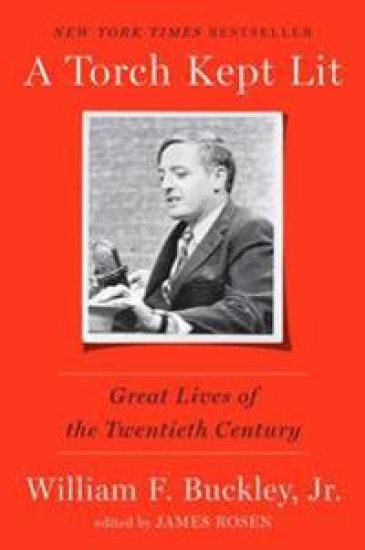
A Torch Kept Lit
William F. Buckley
Crown Publishing Group, Division of Random House Inc
2016
sidottu
The New York Times Bestseller William F. Buckley, Jr. remembers--as only he could--the towering figures of the twentieth century in a brilliant and emotionally powerful collection, compiled by acclaimed Fox News correspondent James Rosen. In a half century on the national stage, William F. Buckley, Jr. achieved unique stature as a writer, a celebrity, and the undisputed godfather of modern American conservatism. He kept company with the best and brightest, the sultry and powerful. Ronald Reagan pronounced WFB "perhaps the most influential journalist and intellectual in our era," and his jet-setting life was a who's who of high society, fame, and fortune. Among all his distinctions, which include founding the conservative magazine National Review and hosting the long-running talk show Firing Line, Buckley was also a master of that most elusive art form: the eulogy. He drew on his unrivaled gifts to mourn, celebrate, or seek mercy for the men and women who touched his life and the nation. Now, for the first time, WFB's sweeping judgments of the great figures of his time--presidents and prime ministers, celebrities and scoundrels, intellectuals and guitar gods--are collected in one place. A Torch Kept Lit presents more than fifty of Buckley's best eulogies, drawing on his personal memories and private correspondences and using a novelist's touch to conjure his subjects as he knew them. We are reintroduced, through Buckley's eyes, to the likes of Winston Churchill and Ronald Reagan, Elvis Presley and John Lennon, Truman Capote and Martin Luther King, Jr. Curated by Fox News chief Washington correspondent James Rosen, a Buckley prot g and frequent contributor to National Review, this volumes sheds light on a tumultuous period in American history--from World War II to Watergate, the "death" of God to the Grateful Dead--as told in the inimitable voice of one of our most elegant literary stylists.William F. Buckley, Jr. is back--just when we need him most.

Blackford Oakes launches a wild attempt to kill Castro on behalf of the CIA. Ever since the botched invasion at the Bay of Pigs, Fidel Castro has run amok. He has executed thousands of his enemies, driven his countrymen to emigrate, and done everything possible to run Cuba into the ground--all in a deliberate attempt to humiliate the White House. At least, that's how the situation looks from 1600 Pennsylvania Avenue, where hatred of Castro has grown into an obsession. Under orders from John and Bobby Kennedy, the CIA will do anything necessary to kill Castro--no matter how ridiculous. Even-tempered CIA agent Blackford Oakes is dismayed at the agency's wild schemes, which include everything from poisoned wet suits to Mafia hit men. But the evil of Castro's regime is not a joke, and Oakes won't be laughing when he tries to knock the dictator off his throne.

A Very Private Plot: A Blackford Oakes Novel
William F. Buckley
Blackstone Publishing
2016
Paperback
The year is 1995, and an energetic senator wants to disarm, perhaps even eliminate, the CIA. To accumulate the evidence necessary to persuade the Senate, he needs the cooperation of Blackford Oakes, now retired. He wants an account from Oakes of his covert activity ten years earlier, when he served as chief of covert activities for the CIA. What will the frustrated senator do to compel cooperation from Blackford Oakes? With the detailed knowledge and savoir faire characteristic of the author, A Very Private Plot takes the listener inside the Kremlin, the Reagan White House, and the Clinton White House. The forces unleashed in 1985 threaten any resolution between the United States and the Soviet Union, and threaten the lives of a very small unit of young Russians who remain in the memory as the tale reaches its climax.
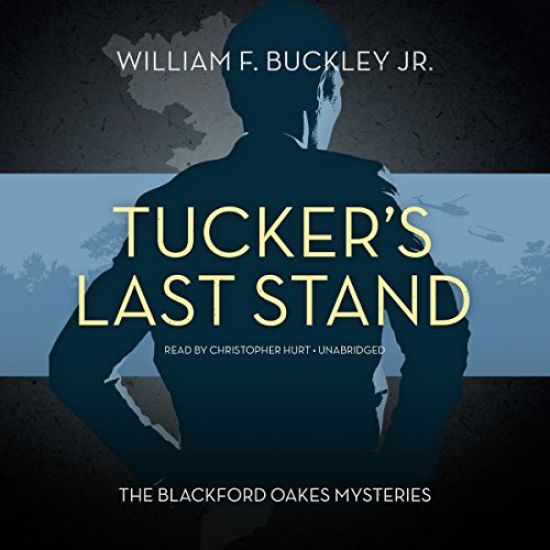
William F. Buckley's bestselling Blackford Oakes novels have set a new standard for stylish espionage entertainment. Now Buckley sends Oakes on his most thrilling adventure yet. The year is 1964. Faced with a hard-hitting presidential campaign and a deteriorating situation in Vietnam, Lyndon Johnson dispatches Oakes and a swashbuckling soldier of fortune named Tucker on secret missions to Southeast Asia. Tucker is to figure out how to interdict military traffic along the Ho Chi Minh Trail. Oakes is to supervise a secret operation in the Gulf of Tonkin, an operation that will give Johnson the excuse he needs for a greater US military role in Vietnam. Filled with the intrigue, wit, and historical detail that have distinguished the previous novels of the series, Tucker's Last Stand is William F. Buckley Jr. at his inimitable best.

As Anatole Broyard of the New York Times has so aptly said, "If le Carr├(R) is the Henry James of suspense fiction, Buckley, if he chose, might be the Waugh." Bill Buckley has created a handsome American hero, Blackford Oakes, who happens to be an irreverent Yale-and-CIA-trained superspy. The year is 1954. Stalin has died in Moscow and a deadly earnest power play nears its conclusion. Meanwhile, British and American commandos on a mission to liberate a Soviet satellite country have met a disastrous end. Jinxed. The communications system between English and American intelligence has been penetrated. Jinxed. There is a spook in their midst. High Jinx--higher still when the risk becomes one which Blacky alone must take.

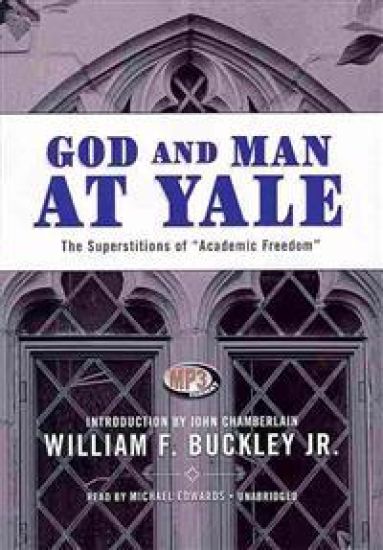
God and Man at Yale: The Superstitions of Academic Freedom
William F. Buckley
Blackstone Publishing
2012
Paperback
This is the book that launched Buckley's career--and a movement. As a young recent graduate, Buckley took on Yale's professional and administrative staffs, citing their hypocritical withdrawal from the tenets upon which the institution was built. Yale was founded on the belief that God exists, and thus virtue and individualism represent immutable cornerstones of education. But when Buckley wrote this scathing expos├(R), the institution had made an about-face: Yale was expounding collectivism and agnosticism. This classic work shows Buckley as he ever was: dauntless, venturesome, bold, and valiant. More than half a century later, experience the extraordinary work that began the modern conservative movement.

CIA superspy Blackford Oakes, fresh from his daring exploits at Windsor Castle, has been entrusted with a matter of some delicacy: finding the perfect blue to restore the war-damaged windows of a thirteenth-century German chapel. The owner of the chapel, Axel Wintergrin, is not only an old friend but a charismatic hero who is rising to power in Germany. He is rallying his countrymen toward reunification, an idea that creates panic on both sides of the Iron Curtain. As the Cold War turns hot, Oakes is thrown into the arms of a beautiful KGB agent--and onto the horns of a dilemma. He must either betray her or pull the switch on his friend.
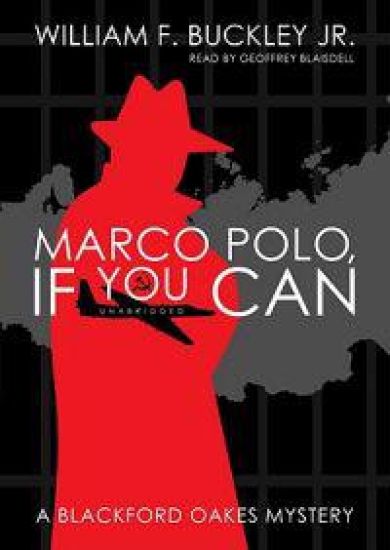
Marco Polo, If You Can: A Blackford Oakes Mystery
William F. Buckley
Blackstone Publishing
2010
Paperback
Master of espionage fiction and National Book Award winner William F. Buckley Jr. brings us another in his bestselling series starring the intrepid CIA agent Blackford Oakes. When a shadowy Russian mole threatens to undermine the free world's defenses by infiltrating President Eisenhower's National Security Counsel, CIA super-secret agent Blackford Oakes is called in to unmask the imposter. Then, Oakes turns the tables on the Communists by piloting a U-2 spy plane on a Gary Powers-style one-way mission behind the Iron Curtain. Sentenced to death and trapped in the depths of the Lubyanka prison, Oakes may have turned his last trick. Or has he?

Eloquent . . . immensely readable . . . the saga of the victory of capitalism over the brutal and irrational fraud that was state socialism. --The Baltimore Sun""Buckley's lucid account celebrates the tenacity of the human spirit and the will to achieve freedom."" --Publishers Weekly""This is a small masterpiece of the narrative tradition. The Fall of the Berlin Wall keep s] readers turning the page."" --National Review"" A] great narrative of democratic survival and democratic victory."" --The Washington TimesThe fall of the Berlin Wall in November 1989 was the turning point in the struggle against Communism in Eastern Europe. In The Fall of the Berlin Wall, renowned author and conservative pioneer William F. Buckley Jr. explains why the wall was built, reveals its devastating impact on the lives of people on both sides, and provides a riveting account of the events that led to the wall's destruction and the end of the Cold War.