Kirjojen hintavertailu. Mukana 12 595 353 kirjaa ja 12 kauppaa.

Kirjailija

William Franke

Kirjat ja teokset yhdessä paikassa: 30 kirjaa, julkaisuja vuosilta 1996-2026, suosituimpien joukossa The Sign of the Swan. Vertaile teosten hintoja ja tarkista saatavuus suomalaisista kirjakaupoista.

30 kirjaa

Kirjojen julkaisuhaarukka 1996-2026.

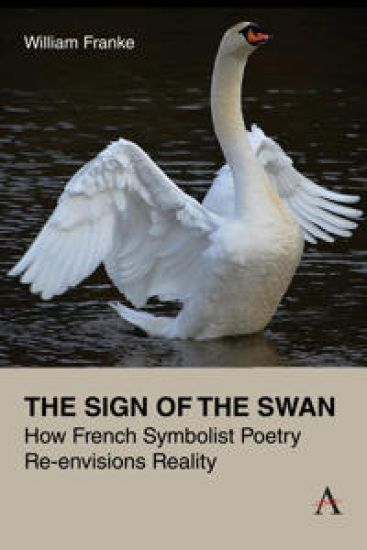
The Sign of the Swan

The Sign of the Swan

William Franke

ANTHEM PRESS
2026
nidottu
Offers a fresh interpretation of French Symbolist poetics, showing how Mallarmé, Baudelaire, and Rimbaud used visionary, transformative language to challenge modern secular perceptions of reality and reveal the enduring power of poetry. Despite intensive scholarly activity around its various protagonists, there is surprisingly little comprehensive attempt at critical interpretation in English of the French symbolist movement and its far-reaching purport. Most contemporary works on the topic take the form of anthologies of poetry and theory. The turn to religion, moreover, in recent decades (“post-secular” times) has opened new perspectives developed especially by Bertrand Marchal and his satellites in France, but to date without much echo in the English-speaking world. The Sign of the Swan stands out as an ambitious attempt to interpret the profound spiritual revolution wrought by this poetry in a religiously visionary key rather than as simply consonant with the general secularizing trend of art in modern times. Historically, symbolism presents itself when a need to open up other channels of meaning besides those recognized by scientific positivism comes to be strongly felt at various stages of the industrial revolution. Thus, symbolist meaning defines itself against denotative, scientific, pragmatic meaning in language. And yet an indescribable, literal rootedness of language in physiological fact is acknowledged by Mallarmé as a disappearing source of poetic creation. This irrecoverable origin can be compensated for and reconstructed by the productions of fantasy. Paradoxically, Mallarmé’s poetry exalts the pure idea and at the same time the concrete materiality of language. This book explains how this coincidence of opposites is possible. The emptiness of language resulting from its merely representing an absent object, what we may term its objective emptiness, makes it open to every sort of subjective in-pouring of contents to fill it out. What is missing on the objective side constitutes an opportunity for investment on the subjective side. It is not surprising that the symbolists discovered one of their richest symbols in the “cygne”—which not only means “swan,” but also homophonically says “sign” (“signe”). This word in French symbolist poetry, starting with Baudelaire and Mallarmé, intimates the transfiguration of the pure, blank linguistic sign, “white” like the swan, into an inexhaustible plethora of associations to be made by individuals and their subjective fantasies. The “symbol” thus becomes itself a source of perceptions, a verbal unity containing a universe.
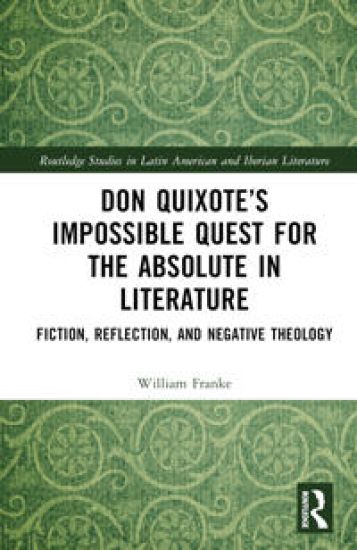
Don Quixote’s Impossible Quest for the Absolute in Literature
This book offers a reading particularly of Part II of Don Quixote, a reading that is embedded in a philosophical reflection on the revelation of religious truth in and through literature. Part II of Don Quixote is the far richer part for its meta-literary reflection on the novel itself as a genre and on life as such seen through the lens of self-reflection. The author has treated the phenomenon of modern self-reflexivity as originally theological in nature in previous publications (notably Dante’s Paradiso and the Theological Origins of Modern Thought: Toward a Speculative Philosophy of Self-Reflection, Routledge, 2021). The present endeavor expands this overall intellectual project, extending it into detailed consideration of what is recognizably another nodal great work inaugurating unprecedented forms of self-reflection in the early modern period. Reading the founding texts of literary and cultural tradition in this negative-theological key proves crucial to allowing them to release the full force of their religious vision in the present age, despite its sometimes obstinate secularity. This reading absorbs and reconciles the religious and secular readings of Miguel de Unamuno and José Ortega y Gasset, two of Spain’s outstanding philosophical luminaries. Both thinkers based their entire philosophies and their analyses of the Spanish national character and destiny on their interpretations of the Quixote. Negative theology deploys critical reason that critiques the limits of reason itself and opens toward an unfathomable (un)ground of All. Such speculative interpretation performs a synthesis of the secularizing and sacralizing tendencies that are both sublimely operative in the text of the Quixote. It thereby enables the work to emerge in the fully parodic and paradoxical vitality that other interpretations, governed by one paradigm or the other, access only partially. Rather than falling into one camp or the other, the proposed approach combines and resources both heritages, sacred and secular, in their deepest synergisms. Spanish baroque mysticism and contemporary post-secular thought are made to converge in highlighting the blessed, even sacred, donation that literature like Don Quixote preserves and transmits as our most precious and saving cultural heritage.
Social Identities and Social Justice

Social Identities and Social Justice

William Franke

ACADEMICA PRESS
2025
sidottu
The revolutionary upheaval currently sweeping across Western democracies on parade under the banner term "wokeism" calls for rethinking the foundations of ethics and politics. The social justice movement challenges us fundamentally to reconceive our being with one another in society and to reassess our profoundest traditions. There is something unmistakably right in the demand for justice for all regardless of class, race, gender, or whatever other characteristic. However, "social justice" is being brandished as a weapon today against certain categories judged by partial perspectives and prejudice to be the guilty parties in history and society. Certain identities are scapegoated to allow those wielding woke ideology to posture as avenging angels charged with the mission of canceling an unjust past and culture. Like every historical religion, wokeism has its grip on a transcendent truth shining with sacred splendor and beauty—the imperative of freedom and justice for all without exclusions—but it takes this truth over in ways that make it serve as a means of consolidating power for those who make themselves its priests and executors. In Social Identities and Social Justice, William Franke indicates a way to exit from the current impasse poisoning politics in Western democracies by thinking the concept of identity through to its grounds in the non-identity (or undelimited human potential) that all share and that unites rather than divides us. The traditions of negative theology (admission of ignorance of God) and apophasis (self-critical unsaying of one's own certainties) are leveraged for outlining a truly relational approach to public discourse. We must open our concepts of mutually exclusive identities towards their infinite truth rooted in our unlimited interconnectedness. By doing so, we open our ideas beyond their finite content and open ourselves to building a world together.
Social Identities and Social Justice: Reconceiving Ethics and Politics in the Wake of Wokeism
The revolutionary upheaval currently sweeping across Western democracies on parade under the banner term "woke" calls for rethinking the foundations of ethics and politics. The social justice movement challenges us to fundamentally reconceive our being with one another in society and to re-embrace our profoundest traditions. Focus on identities, however, has become divisive and vexatious. In Social Identities and Social Justice, William Franke indicates a way to exit from the current impasse empoisoning politics in Western democracies by thinking the concept of identity through to its grounds in the non-identity (or undelimited human potential) that all share and that unites rather than divides us. The traditions of negative theology (admission of ignorance of God) and apophasis (self-critical unsaying of one's own certainties) are leveraged for outlining a truly relational approach to public discourse. We must open our concepts of mutually exclusive identities towards their infinite truth rooted in our unlimited interconnectedness. Doing so, we open our ideas beyond their finite content and open ourselves to building a world together.
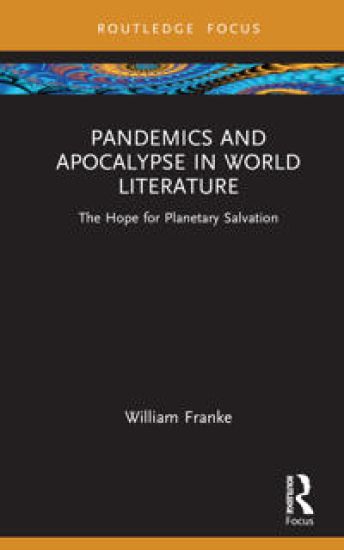
Pandemics and Apocalypse in World Literature

Pandemics and Apocalypse in World Literature

William Franke

TAYLOR FRANCIS LTD
2025
sidottu
Pandemics and Apocalypse rereads classical narratives of plague from the Bible (Exodus) and classical antiquity, both Greek (Homer, Thucydides, Sophocles) and Roman (Lucretius, Virgil, Ovid), through the Middle Ages (Dante, Boccaccio) and Modernity (Defoe, Manzoni, Artaud, Camus) as a basis for contemplating the significance of the recent Covid-19 pandemic. It concerns how we are to confront future pandemics and other inextricably related crises, notably those of an ecological nature. Responses to Covid-19 typically set everything on defeating this “enemy,” but actually we cannot eliminate viruses without eliminating ourselves. We need to see the pandemic as revealing us to ourselves in our inherently vulnerable condition as a first step to admitting the infinite openness to one another and to our Ground—physical and metaphysical—that alone can save our world by engendering a different attitude, open and engaged, to one another and to the Earth as sources of our collective life.
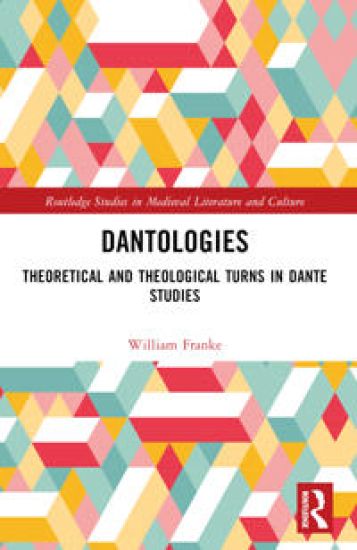
Dantologies

Dantologies

William Franke

TAYLOR FRANCIS LTD
2024
nidottu
This book comprises a searching philosophical meditation on the evolution of the humanities in recent decades, taking Dante studies as an exemplary specimen. The contemporary currents of theory have decisively impacted this field, but Dante also has a strong relationship with theology. The idea that theology, teleology, and logocentric rationalities are simply overcome and swept away by new theoretical approaches proves much more complex as the theory revolution is exposed in its crypto-theological motives and origins. The revolutionary agendas and methodologies of theoretical currents have ushered in all manner of minorities and postcolonial and gender studies. But the exciting adventure they inaugurate shows up in quite a surprising light when brought to focus through the scholarly discipline of Dante studies as a terrain of dispute between traditional philology and postmodern theory. On this terrain, negative theology can play a peculiarly destabilizing, but also a conciliatory, role: it is equally critical of all languages for a theological transcendence to which it nevertheless remains infinitely open.
Don Quixote’s Impossible Quest for the Absolute in Literature
This book offers a reading particularly of Part II of Don Quixote, a reading that is embedded in a philosophical reflection on the revelation of religious truth in and through literature. Part II of Don Quixote is the far richer part for its meta-literary reflection on the novel itself as a genre and on life as such seen through the lens of self-reflection. The author has treated the phenomenon of modern self-reflexivity as originally theological in nature in previous publications (notably Dante’s Paradiso and the Theological Origins of Modern Thought: Toward a Speculative Philosophy of Self-Reflection, Routledge, 2021). The present endeavor expands this overall intellectual project, extending it into detailed consideration of what is recognizably another nodal great work inaugurating unprecedented forms of self-reflection in the early modern period. Reading the founding texts of literary and cultural tradition in this negative-theological key proves crucial to allowing them to release the full force of their religious vision in the present age, despite its sometimes obstinate secularity. This reading absorbs and reconciles the religious and secular readings of Miguel de Unamuno and José Ortega y Gasset, two of Spain’s outstanding philosophical luminaries. Both thinkers based their entire philosophies and their analyses of the Spanish national character and destiny on their interpretations of the Quixote. Negative theology deploys critical reason that critiques the limits of reason itself and opens toward an unfathomable (un)ground of All. Such speculative interpretation performs a synthesis of the secularizing and sacralizing tendencies that are both sublimely operative in the text of the Quixote. It thereby enables the work to emerge in the fully parodic and paradoxical vitality that other interpretations, governed by one paradigm or the other, access only partially. Rather than falling into one camp or the other, the proposed approach combines and resources both heritages, sacred and secular, in their deepest synergisms. Spanish baroque mysticism and contemporary post-secular thought are made to converge in highlighting the blessed, even sacred, donation that literature like Don Quixote preserves and transmits as our most precious and saving cultural heritage.
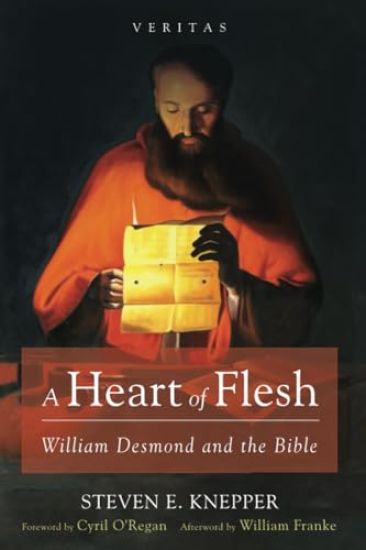
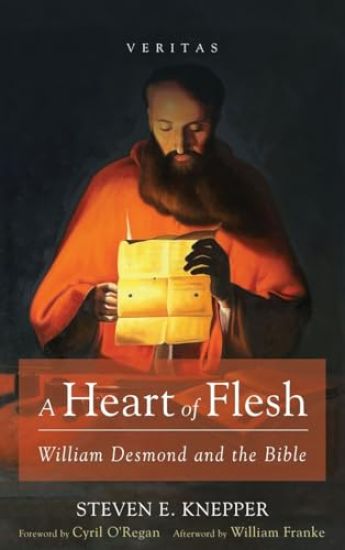
A Heart of Flesh

A Heart of Flesh

Cyril O'Regan; William Franke

Cascade Books
2023
pokkari
The Irish philosopher William Desmond is one of the most compelling and adventurous Christian thinkers of our time. The essays gathered here undertake a journey through the Bible with Desmond that ranges across biblical theology, philosophy of religion, metaphysics, ethics, aesthetics, political theory, and literary studies. Some of the essays examine the place of the Bible in Desmond's thought, considering his readings of the creation, the Abraham cycle, and the Beatitudes. Other essays bring Desmond's ideas to bear on broad questions that emerge from the Bible about philosophy and revelation, exegesis, theopoetics, eschatology, and tyranny. Still others bring Desmond into conversation with influential philosophers who engage (or conspicuously do not engage) the Bible, such as Hegel, Schopenhauer, Kierkegaard, Heidegger, and Tillich. Together, these essays show the rich possibilities of approaching the Bible with Desmond. All take their bearings from Desmond's "metaxological" approach, which does not seek to claim the final word, which attends to the text rather than simply imposing on it, and which allows for an ongoing dialogue. / Contributors: Ryan G. Duns, SJ / Caitlin Smith Gilson / Joseph K. Gordon / William Christian Hackett / Steven E. Knepper / Renee Kohler-Ryan / Andrew Kuiper / Brendan Thomas Sammon / Terence Sweeney / Ethan Vanderleek / Erik van Versendaal / Robert Wyllie
A Heart of Flesh

A Heart of Flesh

Cyril O'Regan; William Franke

Cascade Books
2023
sidottu
The Irish philosopher William Desmond is one of the most compelling and adventurous Christian thinkers of our time. The essays gathered here undertake a journey through the Bible with Desmond that ranges across biblical theology, philosophy of religion, metaphysics, ethics, aesthetics, political theory, and literary studies. Some of the essays examine the place of the Bible in Desmond's thought, considering his readings of the creation, the Abraham cycle, and the Beatitudes. Other essays bring Desmond's ideas to bear on broad questions that emerge from the Bible about philosophy and revelation, exegesis, theopoetics, eschatology, and tyranny. Still others bring Desmond into conversation with influential philosophers who engage (or conspicuously do not engage) the Bible, such as Hegel, Schopenhauer, Kierkegaard, Heidegger, and Tillich. Together, these essays show the rich possibilities of approaching the Bible with Desmond. All take their bearings from Desmond's "metaxological" approach, which does not seek to claim the final word, which attends to the text rather than simply imposing on it, and which allows for an ongoing dialogue. / Contributors: Ryan G. Duns, SJ / Caitlin Smith Gilson / Joseph K. Gordon / William Christian Hackett / Steven E. Knepper / Renee Kohler-Ryan / Andrew Kuiper / Brendan Thomas Sammon / Terence Sweeney / Ethan Vanderleek / Erik van Versendaal / Robert Wyllie
Dantologies

Dantologies

William Franke

TAYLOR FRANCIS LTD
2023
sidottu
This book comprises a searching philosophical meditation on the evolution of the humanities in recent decades, taking Dante studies as an exemplary specimen. The contemporary currents of theory have decisively impacted this field, but Dante also has a strong relationship with theology. The idea that theology, teleology, and logocentric rationalities are simply overcome and swept away by new theoretical approaches proves much more complex as the theory revolution is exposed in its crypto-theological motives and origins. The revolutionary agendas and methodologies of theoretical currents have ushered in all manner of minorities and postcolonial and gender studies. But the exciting adventure they inaugurate shows up in quite a surprising light when brought to focus through the scholarly discipline of Dante studies as a terrain of dispute between traditional philology and postmodern theory. On this terrain, negative theology can play a peculiarly destabilizing, but also a conciliatory, role: it is equally critical of all languages for a theological transcendence to which it nevertheless remains infinitely open.
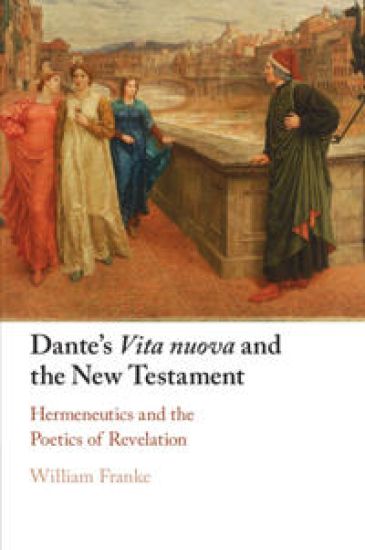
Dante's Vita Nuova and the New Testament

Dante's Vita Nuova and the New Testament

William Franke

Cambridge University Press
2023
pokkari
Modelling knowledge as revelation and theology as poetry, this powerful new reading of the Vita nuova not only challenges Dante scholars to reconsider the book's speculative emphases but also offers the general reader an accessible yet penetrating exploration of some of the Western tradition's most far-reaching ideas surrounding love and knowledge. Dante's 'little book', included in full here in an original parallel translation, captures in its first emergence the same revolutionary ferment that would later become manifest both in the larger oeuvre of this great European writer and in the literature of the entire Western canon. William Franke demonstrates how Dante's youthful poetic autobiography disrupts sectarian thinking and reconciles the seeming contraries of divine revelation and human invention, while also providing the means for understanding religious revelation in the Bible. Ultimately, this revolutionary unification of Scripture and poetry shows the intimate working of love at the source of inspired knowing.
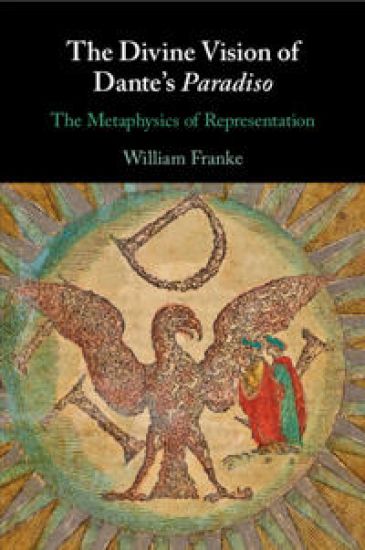
The Divine Vision of Dante's Paradiso

The Divine Vision of Dante's Paradiso

William Franke

Cambridge University Press
2023
pokkari
In Canto XVIII of Paradiso, Dante sees thirty-five letters of Scripture - LOVE JUSTICE, YOU WHO RULE THE EARTH - 'painted' one after the other in the sky. It is an epiphany that encapsulates the Paradiso, staging its ultimate goal - the divine vision. This book offers a fresh, intensive reading of this extraordinary passage at the heart of the third canticle of the Divine Comedy. While adapting in novel ways the methods of the traditional lectura Dantis, William Franke meditates independently on the philosophical, theological, political, ethical, and aesthetic ideas that Dante's text so provocatively projects into a multiplicity of disciplinary contexts. This book demands that we question not only what Dante may have meant by his representations, but also what they mean for us today in the broad horizon of our intellectual traditions and cultural heritage.
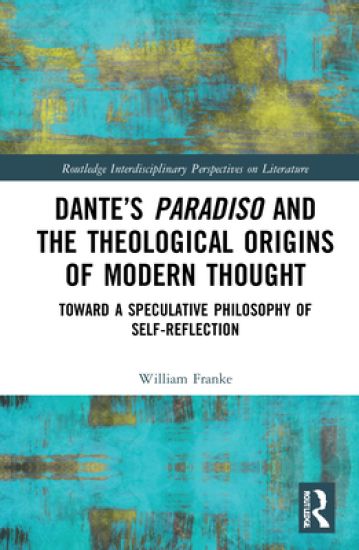
Dante’s Paradiso and the Theological Origins of Modern Thought
Self-reflection, as the hallmark of the modern age, originates more profoundly with Dante than with Descartes. This book rewrites modern intellectual history, taking Dante’s lyrical language in Paradiso as enacting a Trinitarian self-reflexivity that gives a theological spin to the birth of the modern subject already with the Troubadours. The ever more intense self-reflexivity that has led to our contemporary secular world and its technological apocalypse can lead also to the poetic vision of other worlds such as those experienced by Dante. Facing the same nominalist crisis as Duns Scotus, his exact contemporary and the precursor of scientific method, Dante’s thought and work indicate an alternative modernity along the path not taken. This other way shows up in Nicholas of Cusa’s conjectural science and in Giambattista Vico’s new science of imagination as alternatives to the exclusive reign of positive empirical science. In continuity with Dante’s vision, they contribute to a reappropriation of self-reflection for the humanities.
A Philosophy of the Unsayable

A Philosophy of the Unsayable

William Franke

UNIVERSITY OF NOTRE DAME PRESS
2021
sidottu
In A Philosophy of the Unsayable, William Franke argues that the encounter with what exceeds speech has become the crucial philosophical issue of our time. He proposes an original philosophy pivoting on analysis of the limits of language. The book also offers readings of literary texts as poetically performing the philosophical principles it expounds. Franke engages with philosophical theologies and philosophies of religion in the debate over negative theology and shows how apophaticism infiltrates the thinking even of those who attempt to deny or delimit it. In six cohesive essays, Franke explores fundamental aspects of unsayability. In the first and third essays, his philosophical argument is carried through with acute attention to modes of unsayability that are revealed best by literary works, particularly by negativities of poetic language in the oeuvres of Paul Celan and Edmond Jabès. Franke engages in critical discussion of apophatic currents of philosophy both ancient and modern, focusing on Hegel and French post-Hegelianism in his second essay and on Neoplatonism in his fourth essay. He treats Neoplatonic apophatics especially as found in Damascius and as illuminated by postmodern thought, particularly Jean-Luc Nancy's deconstruction of Christianity. In the last two essays, Franke treats the tension between two contemporary approaches to philosophy of religion—Radical Orthodoxy and radically secular or Death-of-God theologies. A Philosophy of the Unsayable will interest scholars and students of philosophy, literature, religion, and the humanities. This book develops Franke's explicit theory of unsayability, which is informed by his long-standing engagement with major representatives of apophatic thought in the Western tradition.
Dante's Vita Nuova and the New Testament

Dante's Vita Nuova and the New Testament

William Franke

Cambridge University Press
2021
sidottu
Modelling knowledge as revelation and theology as poetry, this powerful new reading of the Vita nuova not only challenges Dante scholars to reconsider the book's speculative emphases but also offers the general reader an accessible yet penetrating exploration of some of the Western tradition's most far-reaching ideas surrounding love and knowledge. Dante's 'little book', included in full here in an original parallel translation, captures in its first emergence the same revolutionary ferment that would later become manifest both in the larger oeuvre of this great European writer and in the literature of the entire Western canon. William Franke demonstrates how Dante's youthful poetic autobiography disrupts sectarian thinking and reconciles the seeming contraries of divine revelation and human invention, while also providing the means for understanding religious revelation in the Bible. Ultimately, this revolutionary unification of Scripture and poetry shows the intimate working of love at the source of inspired knowing.
The Divine Vision of Dante's Paradiso

The Divine Vision of Dante's Paradiso

William Franke

Cambridge University Press
2021
sidottu
In Canto XVIII of Paradiso, Dante sees thirty-five letters of Scripture - LOVE JUSTICE, YOU WHO RULE THE EARTH - 'painted' one after the other in the sky. It is an epiphany that encapsulates the Paradiso, staging its ultimate goal - the divine vision. This book offers a fresh, intensive reading of this extraordinary passage at the heart of the third canticle of the Divine Comedy. While adapting in novel ways the methods of the traditional lectura Dantis, William Franke meditates independently on the philosophical, theological, political, ethical, and aesthetic ideas that Dante's text so provocatively projects into a multiplicity of disciplinary contexts. This book demands that we question not only what Dante may have meant by his representations, but also what they mean for us today in the broad horizon of our intellectual traditions and cultural heritage.
Dante’s Paradiso and the Theological Origins of Modern Thought
Self-reflection, as the hallmark of the modern age, originates more profoundly with Dante than with Descartes. This book rewrites modern intellectual history, taking Dante’s lyrical language in Paradiso as enacting a Trinitarian self-reflexivity that gives a theological spin to the birth of the modern subject already with the Troubadours. The ever more intense self-reflexivity that has led to our contemporary secular world and its technological apocalypse can lead also to the poetic vision of other worlds such as those experienced by Dante. Facing the same nominalist crisis as Duns Scotus, his exact contemporary and the precursor of scientific method, Dante’s thought and work indicate an alternative modernity along the path not taken. This other way shows up in Nicholas of Cusa’s conjectural science and in Giambattista Vico’s new science of imagination as alternatives to the exclusive reign of positive empirical science. In continuity with Dante’s vision, they contribute to a reappropriation of self-reflection for the humanities.
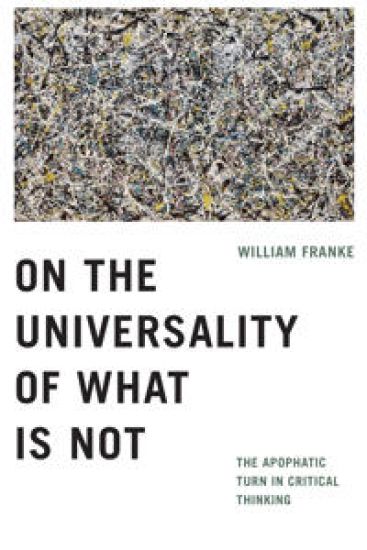
On the Universality of What Is not

On the Universality of What Is not

William Franke

University of Notre Dame Press
2020
sidottu
Branching out from his earlier works providing a history and a theory of apophatic thinking, William Franke's newest book pursues applications across a variety of communicative media, historical periods, geographical regions, and academic disciplines—moving from the literary humanities and cultural theory and politics to more empirical fields such as historical anthropology, evolutionary biology, and cognitive science. On the Universality of What Is Not: The Apophatic Turn in Critical Thinking is an original philosophical reflection that shows how intransigent deadlocks debated in each of these arenas can be broken through thanks to the uncanny insights of apophatic vision. Leveraging Franke's distinctive method of philosophical, religious, and literary thinking and practice, On the Universality of What Is Not proposes a radically unsettling approach to answering (or suspending) perennial questions of philosophy and religion, as well as to dealing with some of our most pressing dilemmas at present at the university and in the socio-political sphere. In a style of exposition that is as lucid as it is poetic, deep-rooted tensions between alterity and equality in all these areas are exposed and transcended.
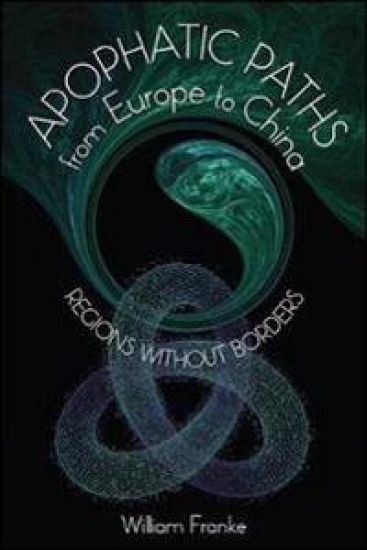
Apophatic Paths from Europe to China

Apophatic Paths from Europe to China

William Franke

State University of New York Press
2019
pokkari
An encounter between Franke's philosophy of the unsayable and Eastern apophatic wisdom in the domains of poetry, thought, and culture.In Apophatic Paths from Europe to China, William Franke brings his original philosophy of the unsayable, previously developed from Western sources such as ancient Neoplatonism, medieval mysticism, and postmodern negative theology, into dialogue with Eastern traditions of thought. In particular, he compares the Daoist Way of Chinese wisdom with Western apophatic thought that likewise pivots on recognizing the nonexistent, the unthinkable, and the unsayable. Leveraging François Jullien's exegesis of the Chinese classics' challenge to rethink the very basis of life and consciousness, Franke proposes negative theology as an analogue to the Chinese model of thought, which has long been recognized for its special attunement to silence at the limits of language. Crucial to Franke's agenda is the endeavor to discern and renew the claim of universality, rethought and reconfigured within the predicament of philosophy today considered specifically as a cultural or, more exactly, intercultural predicament.