Kirjojen hintavertailu. Mukana 12 595 353 kirjaa ja 12 kauppaa.

Kirjailija

William Fulton

Kirjat ja teokset yhdessä paikassa: 19 kirjaa, julkaisuja vuosilta 1984-2025, suosituimpien joukossa Schubert Varieties and Degeneracy Loci. Vertaile teosten hintoja ja tarkista saatavuus suomalaisista kirjakaupoista.

19 kirjaa

Kirjojen julkaisuhaarukka 1984-2025.

Equivariant Cohomology in Algebraic Geometry

Equivariant Cohomology in Algebraic Geometry

David Anderson; William Fulton

Cambridge University Press
2025
pokkari
Equivariant cohomology has become an indispensable tool in algebraic geometry and in related areas including representation theory, combinatorial and enumerative geometry, and algebraic combinatorics. This text introduces the main ideas of the subject for first- or second-year graduate students in mathematics, as well as researchers working in algebraic geometry or combinatorics. The first six chapters cover the basics: definitions via finite-dimensional approximation spaces, computations in projective space, and the localization theorem. The rest of the text focuses on examples – toric varieties, Grassmannians, and homogeneous spaces – along with applications to Schubert calculus and degeneracy loci. Prerequisites are kept to a minimum, so that one-semester graduate-level courses in algebraic geometry and topology should be sufficient preparation. Featuring numerous exercises, examples, and material that has not previously appeared in textbook form, this book will be a must-have reference and resource for both students and researchers for years to come.
Equivariant Cohomology in Algebraic Geometry

Equivariant Cohomology in Algebraic Geometry

David Anderson; William Fulton

Cambridge University Press
2023
sidottu
Equivariant cohomology has become an indispensable tool in algebraic geometry and in related areas including representation theory, combinatorial and enumerative geometry, and algebraic combinatorics. This text introduces the main ideas of the subject for first- or second-year graduate students in mathematics, as well as researchers working in algebraic geometry or combinatorics. The first six chapters cover the basics: definitions via finite-dimensional approximation spaces, computations in projective space, and the localization theorem. The rest of the text focuses on examples – toric varieties, Grassmannians, and homogeneous spaces – along with applications to Schubert calculus and degeneracy loci. Prerequisites are kept to a minimum, so that one-semester graduate-level courses in algebraic geometry and topology should be sufficient preparation. Featuring numerous exercises, examples, and material that has not previously appeared in textbook form, this book will be a must-have reference and resource for both students and researchers for years to come.
Place and Prosperity

Place and Prosperity

William Fulton

ISLAND PRESS
2022
pokkari
There are few more powerful questions than, “Where are you from” or “Where do you live?” People feel intensely connected to cities as places and to other people who feel that same connection. In order to understand place – and understand human settlements generally – it is important to understand that places are not created by accident. They are created in order to further a political or economic agenda. Better cities emerge when the people who shape them think more broadly and consciously about the places they are creating. In Place and Prosperity: How Cities Help Us to Connect and Innovate, urban planning expert William Fulton takes an engaging look at the process by which these decisions about places are made, how cities are engines of prosperity, and how place and prosperity are deeply intertwined. Fulton has been writing about cities over his forty-year career that includes working as a journalist, professor, mayor, planning director, and the director of an urban think tank in one of America’s great cities. Place and Prosperity is a curated collection of his writings with new and updated selections and framing material. Though the essays in Place and Prosperity are in some ways personal, drawing on Fulton’s experience in learning and writing about cities, their primary purpose is to show how these two ideas – place and prosperity – lie at the heart of what a city is and, by extension, what our society is all about. Fulton shows how, over time, a successful place creates enduring economic assets that don’t go away and lay the groundwork for prosperity in the future. But for urbanism to succeed, all of us have to participate in making cities great places for everybody. Because cities, imposing though they may be as physical environments, don’t work without us. Cities are resilient. They’ve been buffeted over the decades by White flight, decay, urban renewal, unequal investment, increasingly extreme weather events, and now the worst pandemic in a century, and they’re still going strong. Fulton shows that at their best, cities not only inspire and uplift us, but they make our daily life more convenient, more fulfilling – and more prosperous.
Talk City

Talk City

William Fulton

Lulu.com
2017
pokkari
Talk City is a collection of the remarkable blogs the distinguished urban planner Bill Fulton wrote while serving as a member of the City Council in the California beach town of Ventura. The blog started out as a way to explain what had happened at the weekly council meetings. Before long, however, it turned into an evocative, real-time chronicle of what it was like to serve as an underpaid, overstressed, part-time local elected official during hard times. If you like local government and politics, you'll love how Talk City reveals the stresses and strains of serving as an elected official in a typical American city.
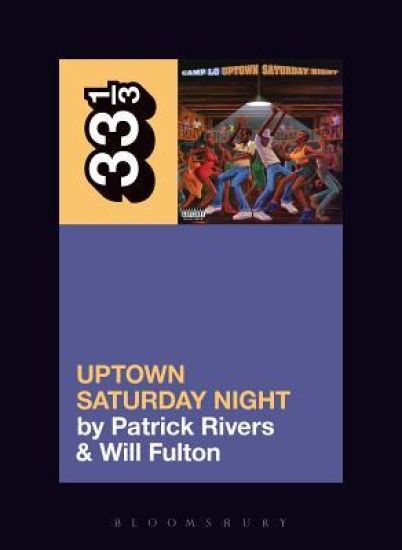
Camp Lo's Uptown Saturday Night

Camp Lo's Uptown Saturday Night

Patrick Rivers; William Fulton

Bloomsbury Academic USA
2017
nidottu
Geechi Suede and Sonny Cheeba are Camp Lo. These two emcees from the Bronx, NY entered the American hip hop scene with an insider slang that bewildered listeners as they radiated the look of a bygone era of black culture. In 1996, they collaborated with producer Ski and a host of other contributors to create Uptown Saturday Night, featuring the seminal single “Luchini (a.k.a. This is It).” While other 1990s rappers referred to 1970s Blaxploitation culture, Camp Lo were self-described “time travelers” who weaved the slang and style of a soulful past into state-of-the-art lyrical flows. Uptown Saturday Night is a tapestry of 1970s black popular culture and 1990s New York City hip hop. This volume will detail how the album’s fantastic world of “Coolie High” reflected classic films like Cooley High and the Sidney Poitier film from which the album’s title is derived, and promoted vintage slang and fashion. The book features new interviews with Camp Lo, producer Ski, Trugoy the Dove from De La Soul, Ish from Digable Planets, and others, and offers musical and cultural analyses that detail the development of the album and its essential contributions to a post-soul aesthetic.
Riemann-Roch Algebra

Riemann-Roch Algebra

William Fulton; Serge Lang

Springer-Verlag New York Inc.
2010
nidottu
In various contexts of topology, algebraic geometry, and algebra (e.g. group representations), one meets the following situation. One has two contravariant functors K and A from a certain category to the category of rings, and a natural transformation p:K--+A of contravariant functors. The Chern character being the central exam- ple, we call the homomorphisms Px: K(X)--+ A(X) characters. Given f: X--+ Y, we denote the pull-back homomorphisms by and fA: A(Y)--+ A(X). As functors to abelian groups, K and A may also be covariant, with push-forward homomorphisms and fA: A( X)--+ A(Y). Usually these maps do not commute with the character, but there is an element r f E A(X) such that the following diagram is commutative: K(X)~A(X) fK j J~A K( Y) ------p;-+ A( Y) The map in the top line is p x multiplied by r f. When such commutativity holds, we say that Riemann-Roch holds for f. This type of formulation was first given by Grothendieck, extending the work of Hirzebruch to such a relative, functorial setting. Since then viii INTRODUCTION several other theorems of this Riemann-Roch type have appeared. Un- derlying most of these there is a basic structure having to do only with elementary algebra, independent of the geometry. One purpose of this monograph is to describe this algebra independently of any context, so that it can serve axiomatically as the need arises.
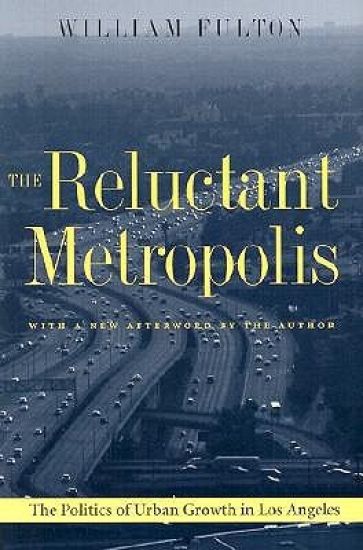
The Reluctant Metropolis

The Reluctant Metropolis

William Fulton

Johns Hopkins University Press
2002
pokkari
In twelve engaging essays, William Fulton chronicles the history of urban planning in the Los Angeles metropolitan area, tracing the legacy of short-sighted political and financial gains that has resulted in a vast urban region on the brink of disaster. Looking at such diverse topics as shady real estate speculations, the construction of the Los Angeles subway, the battle over the future of South Central L.A. after the 1992 riots, and the emergence of Las Vegas as "the new Los Angeles," Fulton offers a fresh perspective on the city's epic sprawl. The only way to reverse the historical trends that have made Los Angeles increasingly unliveable, Fulton concludes, is to confront the prevailing "cocoon citizenship," the mind-set that prevents the city's inhabitants and leaders from recognizing Los Angeles's patchwork of communities as a single metropolis.
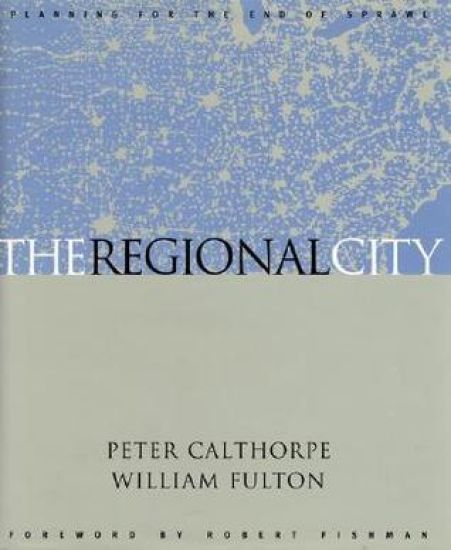
The Regional City

The Regional City

Peter Calthorpe; William Fulton

Island Press
2001
nidottu
Most Americans today do not live in discrete cities and towns, but rather in an aggregation of cities and suburbs that forms one basic economic, multi-cultural, environmental and civic entity. These "regional cities" have the potential to significantly improve the quality of our lives-to provide interconnected and diverse economic centres, transportation choices, and a variety of human-scale communities. In The Regional City, two of the most innovative thinkers in the field of land use planning and design offer a detailed look at this new metropolitan form and explain how regional-scale planning and design can help direct growth wisely and reverse current trends in land use. The authors: - discuss the nature and underpinnings of this new metropolitan form - present their view of the policies and physical design principles required for metropolitan areas to transform themselves into regional cities - document the combination of physical design and social and economic policies that are being used across the country - consider the main factors that are shaping metropolitan regions today, including the maturation of sprawling suburbs and the renewal of urban neighbourhoods Featuring full-colour graphics and in-depth case studies, The Regional City offers a thorough examination of the concept of regional planning along with examples of successful initiatives from around the country. It will be must reading for planners, architects, landscape architects, local officials, real estate developers, community development professionals, and for students in architecture, urban planning, and policy.
Schubert Varieties and Degeneracy Loci

Schubert Varieties and Degeneracy Loci

William Fulton; Piotr Pragacz

Springer-Verlag Berlin and Heidelberg GmbH Co. K
1998
nidottu
Schubert varieties and degeneracy loci have a long history in mathematics, starting from questions about loci of matrices with given ranks. These notes, from a summer school in Thurnau, aim to give an introduction to these topics, and to describe recent progress on these problems. There are interesting interactions with the algebra of symmetric functions and combinatorics, as well as the geometry of flag manifolds and intersection theory and algebraic geometry.
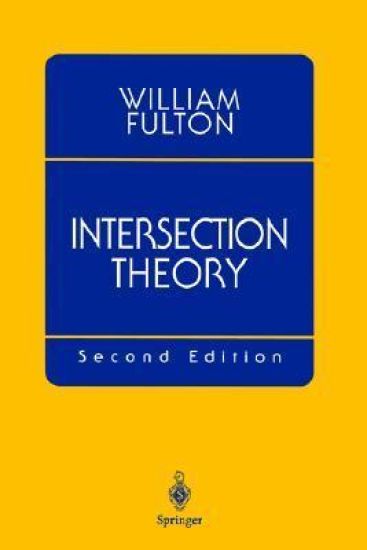
Intersection Theory

Intersection Theory

William Fulton

Springer-Verlag New York Inc.
1998
nidottu
From the ancient origins of algebraic geometry in the solutions of polynomial equations, through the triumphs of algebraic geometry during the last two centuries, intersection theory has played a central role. The aim of this book is to develop the foundations of this theory, and to indicate the range of classical and modern applications. Although a comprehensive history of this vast subject is not attempted, the author points out some of the striking early appearances of the ideas of intersection theory. A suggested prerequisite for the reading of this book is a first course in algebraic geometry. Fulton's introduction to intersection theory has been well used for more than 10 years. It is still the only existing complete modern treatise of the subject and received the Steele Prize for best exposition in August 1996.
Young Tableaux

Young Tableaux

William Fulton

Cambridge University Press
1997
sidottu
The aim of this book is to develop the combinatorics of Young tableaux and to show them in action in the algebra of symmetric functions, representations of the symmetric and general linear groups, and the geometry of flag varieties. The first part of the book is a self-contained presentation of the basic combinatorics of Young tableaux, including the remarkable constructions of 'bumping' and 'sliding', and several interesting correspondences. In Part II these results are used to study representations with geometry on Grassmannians and flag manifolds, including their Schubert subvarieties, and the related Schubert polynomials. Much of this material has never appeared in book form.There are numerous exercises throughout, with hints or answers provided. Researchers in representation theory and algebraic geometry as well as in combinatorics will find Young Tableaux interesting and useful; students will find the intuitive presentation easy to follow.
Young Tableaux

Young Tableaux

William Fulton

Cambridge University Press
1996
pokkari
The aim of this book is to develop the combinatorics of Young tableaux and to show them in action in the algebra of symmetric functions, representations of the symmetric and general linear groups, and the geometry of flag varieties. The first part of the book is a self-contained presentation of the basic combinatorics of Young tableaux, including the remarkable constructions of ‘bumping’ and ‘sliding’, and several interesting correspondences. In Part II these results are used to study representations with geometry on Grassmannians and flag manifolds, including their Schubert subvarieties, and the related Schubert polynomials. Much of this material has never appeared in book form.There are numerous exercises throughout, with hints or answers provided. Researchers in representation theory and algebraic geometry as well as in combinatorics will find Young Tableaux interesting and useful; students will find the intuitive presentation easy to follow.
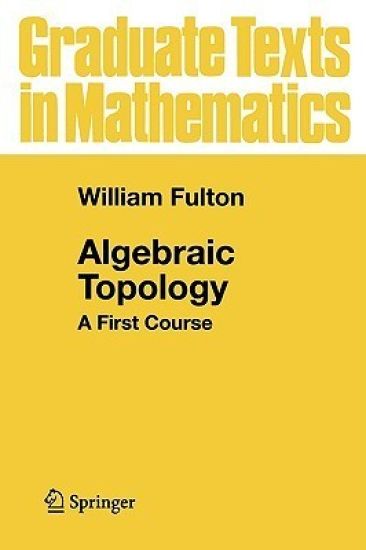
Algebraic Topology

Algebraic Topology

William Fulton

Springer-Verlag New York Inc.
1995
nidottu
To the Teacher. This book is designed to introduce a student to some of the important ideas of algebraic topology by emphasizing the re­ lations of these ideas with other areas of mathematics. Rather than choosing one point of view of modem topology (homotopy theory, simplicial complexes, singular theory, axiomatic homology, differ­ ential topology, etc.), we concentrate our attention on concrete prob­ lems in low dimensions, introducing only as much algebraic machin­ ery as necessary for the problems we meet. This makes it possible to see a wider variety of important features of the subject than is usual in a beginning text. The book is designed for students of mathematics or science who are not aiming to become practicing algebraic topol­ ogists-without, we hope, discouraging budding topologists. We also feel that this approach is in better harmony with the historical devel­ opment of the subject. What would we like a student to know after a first course in to­ pology (assuming we reject the answer: half of what one would like the student to know after a second course in topology)? Our answers to this have guided the choice of material, which includes: under­ standing the relation between homology and integration, first on plane domains, later on Riemann surfaces and in higher dimensions; wind­ ing numbers and degrees of mappings, fixed-point theorems; appli­ cations such as the Jordan curve theorem, invariance of domain; in­ dices of vector fields and Euler characteristics; fundamental groups
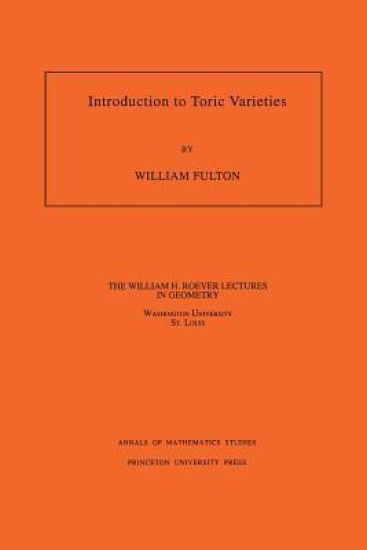
Introduction to Toric Varieties

Introduction to Toric Varieties

William Fulton

Princeton University Press
1993
pokkari
Toric varieties are algebraic varieties arising from elementary geometric and combinatorial objects such as convex polytopes in Euclidean space with vertices on lattice points. Since many algebraic geometry notions such as singularities, birational maps, cycles, homology, intersection theory, and Riemann-Roch translate into simple facts about polytopes, toric varieties provide a marvelous source of examples in algebraic geometry. In the other direction, general facts from algebraic geometry have implications for such polytopes, such as to the problem of the number of lattice points they contain. In spite of the fact that toric varieties are very special in the spectrum of all algebraic varieties, they provide a remarkably useful testing ground for general theories. The aim of this mini-course is to develop the foundations of the study of toric varieties, with examples, and describe some of these relations and applications. The text concludes with Stanley's theorem characterizing the numbers of simplicies in each dimension in a convex simplicial polytope. Although some general theorems are quoted without proof, the concrete interpretations via simplicial geometry should make the text accessible to beginners in algebraic geometry.
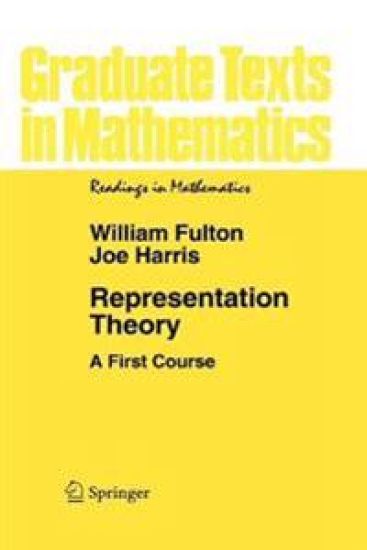
Representation Theory

Representation Theory

William Fulton; Joe Harris

Springer-Verlag New York Inc.
1991
nidottu
The main goal of these lectures is to introduce the beginner to the finite-dimensional representations of Lie groups and Lie algebras. Intended to serve non-specialists, the concentration of the text is on examples. The general theory is developed mainly as a useful and unifying language to describe phenomena already encountered in concrete cases.
Representation Theory

Representation Theory

William Fulton; Joe Harris

Springer-Verlag New York Inc.
1991
sidottu
The primary goal of these lectures is to introduce a beginner to the finite­ dimensional representations of Lie groups and Lie algebras. Since this goal is shared by quite a few other books, we should explain in this Preface how our approach differs, although the potential reader can probably see this better by a quick browse through the book. Representation theory is simple to define: it is the study of the ways in which a given group may act on vector spaces. It is almost certainly unique, however, among such clearly delineated subjects, in the breadth of its interest to mathematicians. This is not surprising: group actions are ubiquitous in 20th century mathematics, and where the object on which a group acts is not a vector space, we have learned to replace it by one that is {e. g. , a cohomology group, tangent space, etc. }. As a consequence, many mathematicians other than specialists in the field {or even those who think they might want to be} come in contact with the subject in various ways. It is for such people that this text is designed. To put it another way, we intend this as a book for beginners to learn from and not as a reference. This idea essentially determines the choice of material covered here. As simple as is the definition of representation theory given above, it fragments considerably when we try to get more specific.
Introduction to Intersection Theory in Algebraic Geometry

Introduction to Intersection Theory in Algebraic Geometry

William Fulton

Amer Mathematical Society
1984
pokkari
This book introduces some of the main ideas of modern intersection theory, traces their origins in classical geometry and sketches a few typical applications. It requires little technical background: much of the material is accessible to graduate students in mathematics. A broad survey, the book touches on many topics, most importantly introducing a powerful new approach developed by the author and R. MacPherson. It was written from the expository lectures delivered at the NSF-supported CBMS conference at George Mason University, held June 27-July 1, 1983.The author describes the construction and computation of intersection products by means of the geometry of normal cones. In the case of properly intersecting varieties, this yields Samuel's intersection multiplicity; at the other extreme it gives the self-intersection formula in terms of a Chern class of the normal bundle; in general it produces the excess intersection formula of the author and R. MacPherson.Among the applications presented are formulas for degeneracy loci, residual intersections, and multiple point loci; dynamic interpretations of intersection products; Schubert calculus and solutions to enumerative geometry problems; and Riemann-Roch theorems.