Kirjojen hintavertailu. Mukana 12 152 606 kirjaa ja 12 kauppaa.

Kirjailija

William G. Bowen

Kirjat ja teokset yhdessä paikassa: 30 kirjaa, julkaisuja vuosilta 1973-2019, suosituimpien joukossa Equity and Excellence in American Higher Education. Vertaile teosten hintoja ja tarkista saatavuus suomalaisista kirjakaupoista.

30 kirjaa

Kirjojen julkaisuhaarukka 1973-2019.

The Shape of the River

The Shape of the River

William G. Bowen; Derek Bok; Nicholas Lemann

Princeton University Press
2019
pokkari
The landmark New York Times bestseller that demonstrates the benefits of race-conscious admissions in higher education First published in 1998, William Bowen and Derek Bok’s The Shape of the River became an immediate landmark in the debate over affirmative action in America. It grounded a contentious subject in concrete data at a time when arguments surrounding it were characterized more by emotion than evidence—and it made a forceful case that race-conscious admissions were successfully helping to promote equal opportunity. Today, the issue of affirmative action remains unsettled. Much has changed, but The Shape of the River continues to present the most compelling data available about the effects of affirmative action. Now with a new foreword by Nicholas Lemann and an afterword by Derek Bok, The Shape of the River is an essential text for anyone seeking to understand race-conscious admissions in higher education.
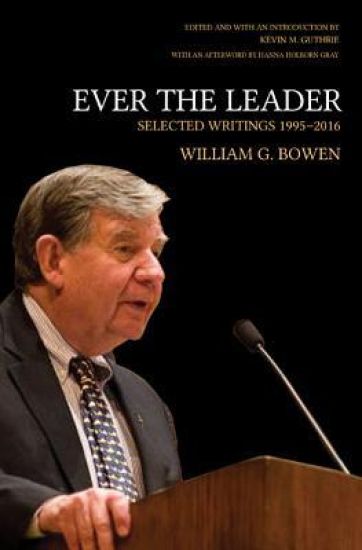
Ever the Leader

Ever the Leader

William G. Bowen; Hanna Holborn Gray

Princeton University Press
2017
sidottu
Ever the Leader gathers together selected speeches and writings from one of the great scholars and commentators of higher education. William G. Bowen's career at Princeton University--from economics professor to provost to a sixteen-year tenure as president--was marked by extraordinary accomplishments during times of great change, both at the university and in the country. But it was in Bowen's second act, as president of the Andrew W. Mellon Foundation and founding chairman of ITHAKA, that he took the lessons he learned as a highly productive leader of one of the nation's most esteemed universities and applied them to a broader set of problems in higher education. This volume of work from Bowen's later career captures this expansion of his thought and influence. Comprising remarks and articles on the subjects of university values, educational opportunity, college sports, technology, and Bowen's own colleagues and friends, Ever the Leader is more than just a concise distillation of Bowen's research and thinking on some of the most urgent issues of the day--it is a portrait of leadership in action. The selected papers, talks, and articles exemplify Bowen's commitment and singular ability to communicate strong, persuasive arguments for change, and to motivate others to engage with the truly hard questions facing higher education leaders. Filled with formidable insights, Ever the Leader will be required reading for university presidents, policymakers, and all those who carry on the struggle for equity and excellence in higher education.
Lesson Plan

Lesson Plan

William G. Bowen; Michael McPherson

Princeton University Press
2017
pokkari
American higher education faces some serious problems--but they are not the ones most people think. In this brief and accessible book, two leading experts show that many so-called crises--from the idea that typical students are drowning in debt to the belief that tuition increases are being driven by administrative bloat--are exaggerated or simply false. At the same time, many real problems--from the high dropout rate to inefficient faculty staffing--have received far too little attention. In response, William G. Bowen and Michael S. McPherson provide a frank assessment of the biggest challenges confronting higher education and propose a bold agenda for reengineering essential elements of the system to meet them. The result promises to help shape the debate about higher education for years to come. Lesson Plan shows that, for all of its accomplishments, higher education today is falling short when it comes to vital national needs. Too many undergraduates are dropping out or taking too long to graduate; minorities and the poor fare worse than their peers, reinforcing inequality; and college is unaffordable for too many. But these problems could be greatly reduced by making significant changes, including targeting federal and state funding more efficiently; allocating less money for "merit aid" and more to match financial need; creating a respected "teaching corps" that would include nontenure faculty; improving basic courses in fields such as math by combining adaptive learning and face-to-face teaching; strengthening leadership; and encouraging more risk taking. It won't be easy for faculty, administrators, trustees, and legislators to make such sweeping changes, but only by doing so will they make it possible for our colleges and universities to meet the nation's demands tomorrow and into the future.
Locus of Authority

Locus of Authority

William G. Bowen; Eugene M. Tobin

Princeton University Press
2017
pokkari
Do higher education institutions have what it takes to reform effectively from within? Locus of Authority argues that every issue facing today's colleges and universities, from stagnant degree completion rates to worrisome cost increases, is exacerbated by a century-old system of governance that desperately requires change. While prior studies have focused on boards of trustees and presidents, few have looked at the place of faculty within the governance system. Bowen and Tobin explore whether departments remain the best ways through which to organize decision making and if the concepts of academic freedom and shared governance need to be sharpened and redefined. Using case studies of four very different institutions, the authors demonstrate that college and university governance has capably adjusted to the necessities of the moment and governance norms and policies should be assessed in the context of historical events. They also demonstrate that successful reform depends on the artful consideration of technological, financial, and cultural developments. Locus of Authority shows that the consequences of not addressing college and university governance are more than the nation can afford.
The Economics of Labor Force Participation

The Economics of Labor Force Participation

William G. Bowen; T. Aldrich Finegan

Princeton University Press
2016
sidottu
This comprehensive and detailed analysis of the factors that determine who is in the labor force in the United States is equally interesting for the light it sheds on what people are not working or seeking work-and why they are not. The effects on labor force participation rates of both individual characteristics (e.g. age, marital status, color, educational attainment) and labor market conditions (unemployment, earnings, industry mix) are analyzed for specific population groups: prime-age males, single women, married women, older persons, and younger persons. The book concludes with a discussion of the sensitivity of participation rates to the tightness of labor markets as revealed by both time-series and cross-sectional analyses. Originally published in 1969. The Princeton Legacy Library uses the latest print-on-demand technology to again make available previously out-of-print books from the distinguished backlist of Princeton University Press. These editions preserve the original texts of these important books while presenting them in durable paperback and hardcover editions. The goal of the Princeton Legacy Library is to vastly increase access to the rich scholarly heritage found in the thousands of books published by Princeton University Press since its founding in 1905.
Ever the Teacher

Ever the Teacher

William G. Bowen

Princeton University Press
2016
sidottu
In one of his commencement talks as President of Princeton University, William G. Bowen called upon the assembled graduates to find ways, in their lives, to blend "the powers of the mind and the promptings of the heart." This collection of his presidential writings--drawn from annual reports, opening exercises addresses, commencement remarks, and other speeches and essays--reflects a blend of analysis and advocacy that speaks both to public policy issues affecting all of American higher education and to the deeper meanings and values of Princeton. The writings selected for inclusion here represent roughly half of the total archive annotated in Appendix B. They range from brief extracts to complete documents, and they are organized under such topics as the university in society; purposes of education/liberal education; graduate education, scholarship, and research; faculty; diversity, opportunity, and financial aid; the economics of the private research university; and a final chapter titled simply "Reflections." Throughout his fifteen-year tenure, President Bowen remained a teacher in the introductory economics course at Princeton, and his principal identification was always as a member of the faculty. His writings, as he saw them, were an extension of his teaching: an opportunity to communicate important ideas in ways that would sharpen his own understanding at the same time that they provoked others to think hard about the questions being raised. As such, his writings were a source of insight and illumination for many "students," of various descriptions, who listened, and read, and learned from what he had to say. Originally published in 1988. The Princeton Legacy Library uses the latest print-on-demand technology to again make available previously out-of-print books from the distinguished backlist of Princeton University Press. These editions preserve the original texts of these important books while presenting them in durable paperback and hardcover editions. The goal of the Princeton Legacy Library is to vastly increase access to the rich scholarly heritage found in the thousands of books published by Princeton University Press since its founding in 1905.
Prospects for Faculty in the Arts and Sciences

Prospects for Faculty in the Arts and Sciences

William G. Bowen; Julie Ann Sosa

Princeton University Press
2016
sidottu
This thought-provoking study of academic job markets over the next quarter century uses rigorous analysis to project substantial excess demand for faculty starting in the 1997-2002 period. Particularly severe imbalances are projected in the humanities and social sciences. Contrary to popular impressions, however, these projected shortages are not caused by any unusual "bunching" of retirements. The authors' discussion of factors affecting the outlook for academic employment includes information on changes in the age distributions of faculties, trends in enrollment, shifts in the popularity of fields of study, changes in the faculty-student ratio, and the continuing increase in the time spent by the typical graduate student in obtaining a doctorate. This work will appeal to a broad audience. It will be essential reading for those who are responsible for determining the size and character of graduate programs in universities, for aspiring academics who are looking for a sense of their job prospects, for college and university faculty members and administrators who must recruit new colleagues, and for those interested in the federal role in higher education. Originally published in 1989. The Princeton Legacy Library uses the latest print-on-demand technology to again make available previously out-of-print books from the distinguished backlist of Princeton University Press. These editions preserve the original texts of these important books while presenting them in durable paperback and hardcover editions. The goal of the Princeton Legacy Library is to vastly increase access to the rich scholarly heritage found in the thousands of books published by Princeton University Press since its founding in 1905.
In Pursuit of the PhD

In Pursuit of the PhD

William G. Bowen; Neil L. Rudenstine

Princeton University Press
2016
sidottu
What percentage of graduate students entering PhD programs in the arts and sciences at leading universities actually complete their studies? How do completion rates vary by field of study, scale of graduate program, and type of financial support provided to students? Has the increasing reliance on Teaching Assistantships affected completion rates and time-to-degree? How successful have national fellowship programs been in encouraging students to finish their studies in reasonably short periods of time? What have been the effects of curricular developments and shifts in the state of the job market? How has the overall "system" of graduate education been affected by the expansion of the 1960s and the subsequent contraction in enrollments and degrees conferred? Is there "excess capacity" in the system at the present time? This major study seeks to answer fundamental questions of this kind. It is based on an exhaustive analysis of an unparalleled data set consisting of the experiences in graduate school of more than 35,000 students who entered programs in English, history, political science, economics, mathematics, and physics at ten leading universities between 1962 and 1986. In addition, new information has been obtained on the graduate student careers of more than 13,000 winners of prestigious national fellowships such as the Woodrow Wilson and the Danforth. It is the combination of these original data sets with other sources of national data that permits fresh insights into the processes and outcomes of graduate education. The authors conclude that opportunities to achieve significant improvements in the organization and functioning of graduate programs exist--especially in the humanities and related social sciences--and the final part of the book contains their policy recommendations. This will be the standard reference on graduate education for years to come, and it should be read and studied by everyone concerned with the future of graduate education in the United States. Originally published in 1992. The Princeton Legacy Library uses the latest print-on-demand technology to again make available previously out-of-print books from the distinguished backlist of Princeton University Press. These editions preserve the original texts of these important books while presenting them in durable paperback and hardcover editions. The goal of the Princeton Legacy Library is to vastly increase access to the rich scholarly heritage found in the thousands of books published by Princeton University Press since its founding in 1905.
What's Happened to the Humanities?

What's Happened to the Humanities?

William G. Bowen; Harold T. Shapiro

Princeton University Press
2016
sidottu
This volume of specially commissioned original essays presents the thoughts of some of the most distinguished commentators within the American academy on the fundamental changes that have taken place in the humanities in the latter part of the twentieth century. In the transformation of American higher education from the university to the "demoversity," the humanities have become a less and less important part of education, a matter established by a statistical appendix and elaborated on in several of the essays. The individual essays offer close observations into how the humanities have been affected by declining academic status, by demographic shifts, by reductions in financial support, and by changing communication technology. They also explore the effect of these forces on books, libraries, and the phenomenology of reading in the age of images. When basic conditions change, theory follows, and several essays trace the appearance and effect of new relativistic epistemologies in the humanities. Social institutions change as well in such circumstances, and the volume concludes with studies of the new social arrangements that have developed in the humanities in recent years: the attack on professionalism and the effort to transform the humanities into the social conscience of academia and even of the nation as a whole. Cause and effect? Who can say? What the essays make clear, however, is that as the humanities have become less significant in American higher education, they have also been the scene of unusually energetic pedagogical, social, and intellectual changes. The contributors to the volume are David Bromwich, John D'Arms, Denis Donoghue, Carla Hesse, Gertrude Himmelfarb, Lynn Hunt, Frank Kermode, Louis Menand, Francis Oakley, Christopher Ricks, and Margery Sabin. Included is a substantial introduction by Alvin Kernan and an appendix of tables and figures showing baccalaureate and doctoral degrees over the years in various types of schools. Originally published in 1997. The Princeton Legacy Library uses the latest print-on-demand technology to again make available previously out-of-print books from the distinguished backlist of Princeton University Press. These editions preserve the original texts of these important books while presenting them in durable paperback and hardcover editions. The goal of the Princeton Legacy Library is to vastly increase access to the rich scholarly heritage found in the thousands of books published by Princeton University Press since its founding in 1905.
Lesson Plan

Lesson Plan

William G. Bowen; Michael McPherson

Princeton University Press
2016
sidottu
American higher education faces some serious problems--but they are not the ones most people think. In this brief and accessible book, two leading experts show that many so-called crises--from the idea that typical students are drowning in debt to the belief that tuition increases are being driven by administrative bloat--are exaggerated or simply false. At the same time, many real problems--from the high dropout rate to inefficient faculty staffing--have received far too little attention. In response, William G. Bowen and Michael S. McPherson provide a frank assessment of the biggest challenges confronting higher education and propose a bold agenda for reengineering essential elements of the system to meet them. The result promises to help shape the debate about higher education for years to come. Lesson Plan shows that, for all of its accomplishments, higher education today is falling short when it comes to vital national needs. Too many undergraduates are dropping out or taking too long to graduate; minorities and the poor fare worse than their peers, reinforcing inequality; and college is unaffordable for too many. But these problems could be greatly reduced by making significant changes, including targeting federal and state funding more efficiently; allocating less money for "merit aid" and more to match financial need; creating a respected "teaching corps" that would include nontenure faculty; improving basic courses in fields such as math by combining adaptive learning and face-to-face teaching; strengthening leadership; and encouraging more risk taking. It won't be easy for faculty, administrators, trustees, and legislators to make such sweeping changes, but only by doing so will they make it possible for our colleges and universities to meet the nation's demands tomorrow and into the future.
The Economics of Labor Force Participation

The Economics of Labor Force Participation

William G. Bowen; T. Aldrich Finegan

Princeton University Press
2015
pokkari
This comprehensive and detailed analysis of the factors that determine who is in the labor force in the United States is equally interesting for the light it sheds on what people are not working or seeking work-and why they are not. The effects on labor force participation rates of both individual characteristics (e.g. age, marital status, color, educational attainment) and labor market conditions (unemployment, earnings, industry mix) are analyzed for specific population groups: prime-age males, single women, married women, older persons, and younger persons. The book concludes with a discussion of the sensitivity of participation rates to the tightness of labor markets as revealed by both time-series and cross-sectional analyses. Originally published in 1969. The Princeton Legacy Library uses the latest print-on-demand technology to again make available previously out-of-print books from the distinguished backlist of Princeton University Press. These editions preserve the original texts of these important books while presenting them in durable paperback and hardcover editions. The goal of the Princeton Legacy Library is to vastly increase access to the rich scholarly heritage found in the thousands of books published by Princeton University Press since its founding in 1905.
Locus of Authority

Locus of Authority

William G. Bowen; Eugene M. Tobin

Princeton University Press
2015
sidottu
Do higher education institutions have what it takes to reform effectively from within? Locus of Authority argues that every issue facing today's colleges and universities, from stagnant degree completion rates to worrisome cost increases, is exacerbated by a century-old system of governance that desperately requires change. While prior studies have focused on boards of trustees and presidents, few have looked at the place of faculty within the governance system. Bowen and Tobin explore whether departments remain the best ways through which to organize decision making and if the concepts of academic freedom and shared governance need to be sharpened and redefined. Using case studies of four very different institutions, the authors demonstrate that college and university governance has capably adjusted to the necessities of the moment and governance norms and policies should be assessed in the context of historical events. They also demonstrate that successful reform depends on the artful consideration of technological, financial, and cultural developments. Locus of Authority shows that the consequences of not addressing college and university governance are more than the nation can afford.
Higher Education in the Digital Age

Higher Education in the Digital Age

William G. Bowen; Kevin M. Guthrie

Princeton University Press
2015
pokkari
Two of the most visible and important trends in higher education today are its exploding costs and the rapid expansion of online learning. Could the growth in online courses slow the rising cost of college and help solve the crisis of affordability? In this short and incisive book, William G. Bowen, one of the foremost experts on the intersection of education and economics, explains why, despite his earlier skepticism, he now believes technology has the potential to help rein in costs without negatively affecting student learning. As a former president of Princeton University, an economist, and author of many books on education, including the acclaimed bestseller The Shape of the River, Bowen speaks with unique expertise on the subject. Surveying the dizzying array of new technology-based teaching and learning initiatives, including the highly publicized emergence of "massive open online courses" (MOOCs), Bowen argues that such technologies could transform traditional higher education--allowing it at last to curb rising costs by increasing productivity, while preserving quality and protecting core values. But the challenges, which are organizational and philosophical as much as technological, are daunting. They include providing hard evidence of whether online education is cost-effective in various settings, rethinking the governance and decision-making structures of higher education, and developing customizable technological platforms. Yet, Bowen remains optimistic that the potential payoff is great. Based on the 2012 Tanner Lectures on Human Values, delivered at Stanford University, the book includes responses from Stanford president John Hennessy, Harvard University psychologist Howard Gardner, Columbia University literature professor Andrew Delbanco, and Coursera cofounder Daphne Koller.
What's Happened to the Humanities?

What's Happened to the Humanities?

William G. Bowen; Harold T. Shapiro

Princeton University Press
2014
pokkari
This volume of specially commissioned original essays presents the thoughts of some of the most distinguished commentators within the American academy on the fundamental changes that have taken place in the humanities in the latter part of the twentieth century. In the transformation of American higher education from the university to the "demoversity," the humanities have become a less and less important part of education, a matter established by a statistical appendix and elaborated on in several of the essays. The individual essays offer close observations into how the humanities have been affected by declining academic status, by demographic shifts, by reductions in financial support, and by changing communication technology. They also explore the effect of these forces on books, libraries, and the phenomenology of reading in the age of images. When basic conditions change, theory follows, and several essays trace the appearance and effect of new relativistic epistemologies in the humanities. Social institutions change as well in such circumstances, and the volume concludes with studies of the new social arrangements that have developed in the humanities in recent years: the attack on professionalism and the effort to transform the humanities into the social conscience of academia and even of the nation as a whole. Cause and effect? Who can say? What the essays make clear, however, is that as the humanities have become less significant in American higher education, they have also been the scene of unusually energetic pedagogical, social, and intellectual changes. The contributors to the volume are David Bromwich, John D'Arms, Denis Donoghue, Carla Hesse, Gertrude Himmelfarb, Lynn Hunt, Frank Kermode, Louis Menand, Francis Oakley, Christopher Ricks, and Margery Sabin. Included is a substantial introduction by Alvin Kernan and an appendix of tables and figures showing baccalaureate and doctoral degrees over the years in various types of schools. Originally published in 1997. The Princeton Legacy Library uses the latest print-on-demand technology to again make available previously out-of-print books from the distinguished backlist of Princeton University Press. These editions preserve the original texts of these important books while presenting them in durable paperback and hardcover editions. The goal of the Princeton Legacy Library is to vastly increase access to the rich scholarly heritage found in the thousands of books published by Princeton University Press since its founding in 1905.
In Pursuit of the PhD

In Pursuit of the PhD

William G. Bowen; Neil L. Rudenstine

Princeton University Press
2014
pokkari
What percentage of graduate students entering PhD programs in the arts and sciences at leading universities actually complete their studies? How do completion rates vary by field of study, scale of graduate program, and type of financial support provided to students? Has the increasing reliance on Teaching Assistantships affected completion rates and time-to-degree? How successful have national fellowship programs been in encouraging students to finish their studies in reasonably short periods of time? What have been the effects of curricular developments and shifts in the state of the job market? How has the overall "system" of graduate education been affected by the expansion of the 1960s and the subsequent contraction in enrollments and degrees conferred? Is there "excess capacity" in the system at the present time? This major study seeks to answer fundamental questions of this kind. It is based on an exhaustive analysis of an unparalleled data set consisting of the experiences in graduate school of more than 35,000 students who entered programs in English, history, political science, economics, mathematics, and physics at ten leading universities between 1962 and 1986. In addition, new information has been obtained on the graduate student careers of more than 13,000 winners of prestigious national fellowships such as the Woodrow Wilson and the Danforth. It is the combination of these original data sets with other sources of national data that permits fresh insights into the processes and outcomes of graduate education. The authors conclude that opportunities to achieve significant improvements in the organization and functioning of graduate programs exist--especially in the humanities and related social sciences--and the final part of the book contains their policy recommendations. This will be the standard reference on graduate education for years to come, and it should be read and studied by everyone concerned with the future of graduate education in the United States. Originally published in 1992. The Princeton Legacy Library uses the latest print-on-demand technology to again make available previously out-of-print books from the distinguished backlist of Princeton University Press. These editions preserve the original texts of these important books while presenting them in durable paperback and hardcover editions. The goal of the Princeton Legacy Library is to vastly increase access to the rich scholarly heritage found in the thousands of books published by Princeton University Press since its founding in 1905.
Prospects for Faculty in the Arts and Sciences

Prospects for Faculty in the Arts and Sciences

William G. Bowen; Julie Ann Sosa

Princeton University Press
2014
pokkari
This thought-provoking study of academic job markets over the next quarter century uses rigorous analysis to project substantial excess demand for faculty starting in the 1997-2002 period. Particularly severe imbalances are projected in the humanities and social sciences. Contrary to popular impressions, however, these projected shortages are not caused by any unusual "bunching" of retirements. The authors' discussion of factors affecting the outlook for academic employment includes information on changes in the age distributions of faculties, trends in enrollment, shifts in the popularity of fields of study, changes in the faculty-student ratio, and the continuing increase in the time spent by the typical graduate student in obtaining a doctorate. This work will appeal to a broad audience. It will be essential reading for those who are responsible for determining the size and character of graduate programs in universities, for aspiring academics who are looking for a sense of their job prospects, for college and university faculty members and administrators who must recruit new colleagues, and for those interested in the federal role in higher education. Originally published in 1989. The Princeton Legacy Library uses the latest print-on-demand technology to again make available previously out-of-print books from the distinguished backlist of Princeton University Press. These editions preserve the original texts of these important books while presenting them in durable paperback and hardcover editions. The goal of the Princeton Legacy Library is to vastly increase access to the rich scholarly heritage found in the thousands of books published by Princeton University Press since its founding in 1905.
Ever the Teacher

Ever the Teacher

William G. Bowen

Princeton University Press
2014
pokkari
In one of his commencement talks as President of Princeton University, William G. Bowen called upon the assembled graduates to find ways, in their lives, to blend "the powers of the mind and the promptings of the heart." This collection of his presidential writings--drawn from annual reports, opening exercises addresses, commencement remarks, and other speeches and essays--reflects a blend of analysis and advocacy that speaks both to public policy issues affecting all of American higher education and to the deeper meanings and values of Princeton. The writings selected for inclusion here represent roughly half of the total archive annotated in Appendix B. They range from brief extracts to complete documents, and they are organized under such topics as the university in society; purposes of education/liberal education; graduate education, scholarship, and research; faculty; diversity, opportunity, and financial aid; the economics of the private research university; and a final chapter titled simply "Reflections." Throughout his fifteen-year tenure, President Bowen remained a teacher in the introductory economics course at Princeton, and his principal identification was always as a member of the faculty. His writings, as he saw them, were an extension of his teaching: an opportunity to communicate important ideas in ways that would sharpen his own understanding at the same time that they provoked others to think hard about the questions being raised. As such, his writings were a source of insight and illumination for many "students," of various descriptions, who listened, and read, and learned from what he had to say. Originally published in 1988. The Princeton Legacy Library uses the latest print-on-demand technology to again make available previously out-of-print books from the distinguished backlist of Princeton University Press. These editions preserve the original texts of these important books while presenting them in durable paperback and hardcover editions. The goal of the Princeton Legacy Library is to vastly increase access to the rich scholarly heritage found in the thousands of books published by Princeton University Press since its founding in 1905.
Lessons Learned

Lessons Learned

William G. Bowen

Princeton University Press
2013
pokkari
Lessons Learned gives unprecedented access to the university president's office, providing a unique set of reflections on the challenges involved in leading both research universities and liberal arts colleges. In this landmark book, William Bowen, former president of Princeton University and of the Andrew W. Mellon Foundation, and coauthor of the acclaimed best-seller The Shape of the River, takes readers behind closed faculty-room doors to discuss how today's colleges and universities serve their age-old missions. With extraordinary candor, clarity, and good humor, Bowen shares the sometimes-hard lessons he learned about working with trustees, faculty, and campus groups; building an effective administrative team; deciding when to speak out on big issues and when to insist on institutional restraint; managing dissent; cultivating alumni and raising funds; setting academic priorities; fostering inclusiveness; eventually deciding when and how to leave the president's office; and much more. Drawing on more than four decades of experience, Bowen demonstrates how his greatest lessons often arose from the missteps he made along the way, and how, when it comes to university governance, there are important general principles but often no single right answer. Full of compelling stories, insights, and practical wisdom, Lessons Learned frames the questions that leaders of higher education will continue to confront at a complex moment in history.
Higher Education in the Digital Age

Higher Education in the Digital Age

William G. Bowen

Princeton University Press
2013
sidottu
Two of the most visible and important trends in higher education today are its exploding costs and the rapid expansion of online learning. Could the growth in online courses slow the rising cost of college and help solve the crisis of affordability? In this short and incisive book, William G. Bowen, one of the foremost experts on the intersection of education and economics, explains why, despite his earlier skepticism, he now believes technology has the potential to help rein in costs without negatively affecting student learning. As a former president of Princeton University, an economist, and author of many books on education, including the acclaimed bestseller The Shape of the River, Bowen speaks with unique expertise on the subject. Surveying the dizzying array of new technology-based teaching and learning initiatives, including the highly publicized emergence of "massive open online courses" (MOOCs), Bowen argues that such technologies could transform traditional higher education--allowing it at last to curb rising costs by increasing productivity, while preserving quality and protecting core values. But the challenges, which are organizational and philosophical as much as technological, are daunting. They include providing hard evidence of whether online education is cost-effective in various settings, rethinking the governance and decision-making structures of higher education, and developing customizable technological platforms. Yet, Bowen remains optimistic that the potential payoff is great. Based on the 2012 Tanner Lectures on Human Values, delivered at Stanford University, the book includes responses from Stanford president John Hennessy, Harvard University psychologist Howard Gardner, Columbia University literature professor Andrew Delbanco, and Coursera cofounder Daphne Koller.
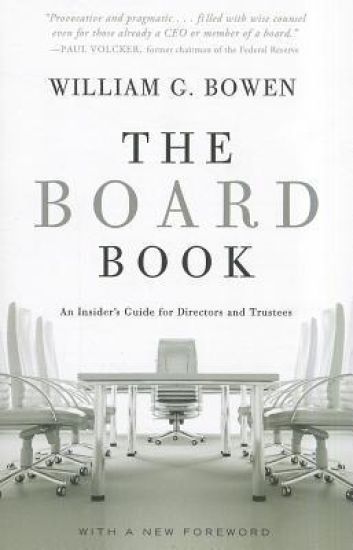
The Board Book

The Board Book

William G. Bowen

WW Norton Co
2012
nidottu
In his new foreword to The Board Book, former Mellon Foundation and Princeton University president William G. Bowen brings his immense experience to bear on the most pressing questions facing boards of directors and trustees today: seeking collaborative relationships and placing a renewed emphasis on sustainable initiatives. The strategies Bowen relates throughout the book foster the collegiality and sense of purpose—more important in today’s turbulent times than ever before—that are integral to any effective board.