Kirjojen hintavertailu. Mukana 12 390 323 kirjaa ja 12 kauppaa.

Kirjailija

William G. Tierney

Kirjat ja teokset yhdessä paikassa: 21 kirjaa, julkaisuja vuosilta 1989-2022, suosituimpien joukossa Trust and the Public Good. Vertaile teosten hintoja ja tarkista saatavuus suomalaisista kirjakaupoista.

Mukana myös kirjoitusasut: William G Tierney

21 kirjaa

Kirjojen julkaisuhaarukka 1989-2022.

Creating a Culture of Mindful Innovation in Higher Education

Creating a Culture of Mindful Innovation in Higher Education

Michael Lanford; William G. Tierney

STATE UNIVERSITY OF NEW YORK PRESS
2022
pokkari
Offers a vision for innovation in higher education focused on societal progress and human development, as well as for higher education's role within a broader culture of innovation.Higher education institutions have traditionally nurtured artistic and scientific development and served as catalysts for innovative ideas and products. However, contemporary discourse too often relegates the concept of innovation to the private sector, where the rhetoric of "disruption" frequently reduces innovation to economic terms. As a result, innovations that could benefit society instead exacerbate existing inequities, and the environmental factors that stimulate long-term innovative progress are neglected. Creating a Culture of Mindful Innovation in Higher Education offers a different vision by identifying the conditions that enable college and university administrators, faculty, and staff to promote an innovative institutional culture. Mindful innovation is defined through six central tenets: societal impact; the necessity of failure; creativity through diversity; respect for autonomy and expertise; thoughtful consideration for the dimensions of time, efficiency, and trust; and the incentivization of intrinsic motivation and progress over scare tactics and disruption. Michael Lanford and William G. Tierney offer a clearheaded analysis of the challenges and opportunities in creating a culture of mindful innovation and argue that the institutions that do so will be poised to lead entrepreneurial endeavors, scientific progress, and greater social equity in the twenty-first century.
Creating a Culture of Mindful Innovation in Higher Education

Creating a Culture of Mindful Innovation in Higher Education

Michael Lanford; William G. Tierney

STATE UNIVERSITY OF NEW YORK PRESS
2022
sidottu
Offers a vision for innovation in higher education focused on societal progress and human development, as well as for higher education's role within a broader culture of innovation.Higher education institutions have traditionally nurtured artistic and scientific development and served as catalysts for innovative ideas and products. However, contemporary discourse too often relegates the concept of innovation to the private sector, where the rhetoric of "disruption" frequently reduces innovation to economic terms. As a result, innovations that could benefit society instead exacerbate existing inequities, and the environmental factors that stimulate long-term innovative progress are neglected. Creating a Culture of Mindful Innovation in Higher Education offers a different vision by identifying the conditions that enable college and university administrators, faculty, and staff to promote an innovative institutional culture. Mindful innovation is defined through six central tenets: societal impact; the necessity of failure; creativity through diversity; respect for autonomy and expertise; thoughtful consideration for the dimensions of time, efficiency, and trust; and the incentivization of intrinsic motivation and progress over scare tactics and disruption. Michael Lanford and William G. Tierney offer a clearheaded analysis of the challenges and opportunities in creating a culture of mindful innovation and argue that the institutions that do so will be poised to lead entrepreneurial endeavors, scientific progress, and greater social equity in the twenty-first century.
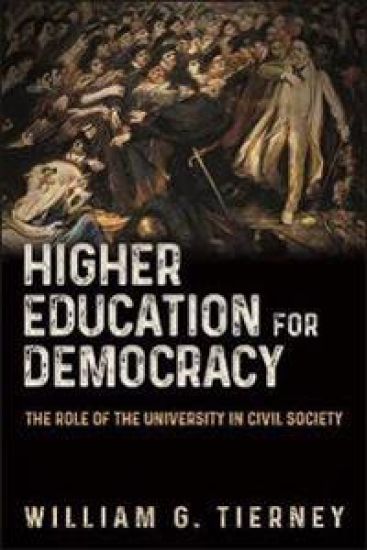
Higher Education for Democracy

Higher Education for Democracy

William G. Tierney

State University of New York Press
2021
pokkari
Uses a cross-national comparison of Los Angeles, New Delhi, and Hong Kong to develop strategies universities should employ to strengthen democracy and resist fascism.Bronze Winner, 2021 Foreword INDIES Book of the Year Award in the Education Category Democracy and higher education are inextricably linked: universities not only have the ability to be key arbiters of how democracy is advanced, but they also need to reflect democratic values in their practices, objectives, and goals. Framed by the COVID-19 pandemic, and the ongoing crisis of structural racism, Higher Education for Democracy explores academe's role in advancing democracy by using a cross-national comparison of Los Angeles, New Delhi, and Hong Kong to develop strategies that universities can employ to strengthen democracy and resist fascism. William G. Tierney argues that if academe is to be a progenitor in the advancement of democracy, then we need to consider five areas of change that have been significant across national contexts amid both globalization and neoliberalism: inequality, privatization, the public good, identity, and academic freedom. Taking a comparative approach and drawing on scholarly literature, archival research, and interviews, Higher Education for Democracy aims to understand these changes and their implications and to position higher education in defense of democracy in a globalized economy framed by fascism.
Higher Education for Democracy

Higher Education for Democracy

William G. Tierney

STATE UNIVERSITY OF NEW YORK PRESS
2021
sidottu
Uses a cross-national comparison of Los Angeles, New Delhi, and Hong Kong to develop strategies universities should employ to strengthen democracy and resist fascism.Bronze Winner, 2021 Foreword INDIES Book of the Year Award in the Education Category Democracy and higher education are inextricably linked: universities not only have the ability to be key arbiters of how democracy is advanced, but they also need to reflect democratic values in their practices, objectives, and goals. Framed by the COVID-19 pandemic, and the ongoing crisis of structural racism, Higher Education for Democracy explores academe's role in advancing democracy by using a cross-national comparison of Los Angeles, New Delhi, and Hong Kong to develop strategies that universities can employ to strengthen democracy and resist fascism. William G. Tierney argues that if academe is to be a progenitor in the advancement of democracy, then we need to consider five areas of change that have been significant across national contexts amid both globalization and neoliberalism: inequality, privatization, the public good, identity, and academic freedom. Taking a comparative approach and drawing on scholarly literature, archival research, and interviews, Higher Education for Democracy aims to understand these changes and their implications and to position higher education in defense of democracy in a globalized economy framed by fascism.
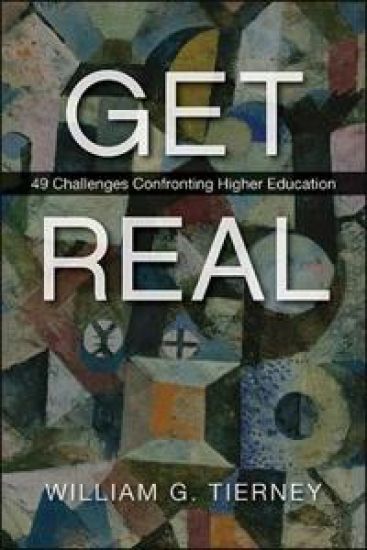
Get Real

Get Real

William G. Tierney

State University of New York Press
2020
pokkari
A thought-provoking overview of the many challenges facing higher education and how to deal with them by a leading thinker in the field.Higher education always seems to be in crisis. Governments, foundations, professional associations, and the occasional scornful professor all tend to lament one or another problem plaguing America's colleges and universities. The more apocalyptic claims state that the United States is a "nation at risk," that our students' minds have been closed, or that radical faculty have run amok and are brainwashing our youth.In Get Real, William G. Tierney, a leading scholar of higher education, cuts through this noise, drawing on his experience and expertise to provide a thought-provoking overview of the many challenges confronting higher education and how to deal with them. In forty-nine short, engaging essays, he aims not to stoke the flames of controversy or promote a particular stance but to provoke creative, forward-looking public discussion about what higher education could and should look like in the twenty-first century. Tierney clearly distills and offers his take on critical issues-from diversity and free speech to the rise of for-profit colleges and student debt-but the goal is always to give readers the background and tools to form their own opinions. Written in a conversational tone and laced with personal anecdotes, Get Real is informed by scholarly literature without being weighed down by it and includes suggestions for further reading.
Get Real

Get Real

William G. Tierney

State University of New York Press
2020
sidottu
A thought-provoking overview of the many challenges facing higher education and how to deal with them by a leading thinker in the field.Higher education always seems to be in crisis. Governments, foundations, professional associations, and the occasional scornful professor all tend to lament one or another problem plaguing America's colleges and universities. The more apocalyptic claims state that the United States is a "nation at risk," that our students' minds have been closed, or that radical faculty have run amok and are brainwashing our youth.In Get Real, William G. Tierney, a leading scholar of higher education, cuts through this noise, drawing on his experience and expertise to provide a thought-provoking overview of the many challenges confronting higher education and how to deal with them. In forty-nine short, engaging essays, he aims not to stoke the flames of controversy or promote a particular stance but to provoke creative, forward-looking public discussion about what higher education could and should look like in the twenty-first century. Tierney clearly distills and offers his take on critical issues-from diversity and free speech to the rise of for-profit colleges and student debt-but the goal is always to give readers the background and tools to form their own opinions. Written in a conversational tone and laced with personal anecdotes, Get Real is informed by scholarly literature without being weighed down by it and includes suggestions for further reading.
Successful Global Collaborations in Higher Education Institutions

Successful Global Collaborations in Higher Education Institutions

William G Tierney; Adnan H M Zahed; Abdulrahman Ai-Youbi

Saint Philip Street Press
2020
sidottu
This open access book presents deep investigation to the manifold topics pertaining to global university collaboration. It outlines the strategies King Abdulaziz University has employed to rise in global rankings, and the reasons chosen to collaborate with other academic and research institutes. The environment in which universities currently exist is considered, and subsequently how an innovative culture might be established and maintained to enable global partnerships to be implemented and to succeed is discussed. The book provides an intense focus on why collaboration is a necessary ingredient for knowledge transfer and explains how to do it. The last part of the book considers how to sustain partnerships. This is because one of the challenges of global partnerships is not just setting them up, but also sustaining them. This work was published by Saint Philip Street Press pursuant to a Creative Commons license permitting commercial use. All rights not granted by the work's license are retained by the author or authors.
Successful Global Collaborations in Higher Education Institutions

Successful Global Collaborations in Higher Education Institutions

William G Tierney; Adnan H M Zahed; Abdulrahman Ai-Youbi

Saint Philip Street Press
2020
pokkari
This open access book presents deep investigation to the manifold topics pertaining to global university collaboration. It outlines the strategies King Abdulaziz University has employed to rise in global rankings, and the reasons chosen to collaborate with other academic and research institutes. The environment in which universities currently exist is considered, and subsequently how an innovative culture might be established and maintained to enable global partnerships to be implemented and to succeed is discussed. The book provides an intense focus on why collaboration is a necessary ingredient for knowledge transfer and explains how to do it. The last part of the book considers how to sustain partnerships. This is because one of the challenges of global partnerships is not just setting them up, but also sustaining them. This work was published by Saint Philip Street Press pursuant to a Creative Commons license permitting commercial use. All rights not granted by the work's license are retained by the author or authors.
The Impact of Culture on Organizational Decision-Making
Colleges and universities are currently undergoing the most significant challenges they have faced since World War II. Rising costs, increased competition from for-profit providers, the impact of technology, and the changing desires and needs of consumers have combined to create a dynamic tension for those who work in, and study, postsecondary education. What worked yesterday is unlikely to work tomorrow. The status quo or bromides such as “stay the course” are insufficient responses in a market that demands creativity and innovation if an organization does not simply wish to survive, but thrive.Managerial responses or top-down linear decisions are antithetical to academic organizations and most likely recipes for disaster. In today’s “flat world”, decision-making for most organizations has become less hierarchical and more decentralized. Understanding this trend is of particular importance for organizations with traditions of shared governance. The message of this book is that understanding organizational culture is critical for those who recognize that academe must change, but are unsure how to make that change happen. Even the most seasoned college and university administrators and professors often ask themselves, “What holds this place together?” The author’s answer is that an organization’s culture is the glue of academic life. Paradoxically, this “glue” does not make things get stuck, but unstuck. An understanding of culture enables an organization’s participants to interpret the institution to themselves and others, and in consequence, to propel the institution forward.An organization’s culture is reflected in what is done, how it is done, and who is involved in doing it. It concerns decisions, actions, and communication on an instrumental and symbolic level. This book considers various facets of academic culture, discusses how to study it, how to analyze it, and how to improve it in order to move colleges and universities aggressively into the future while maintaining core academic values. This book presents updated versions of eight key articles on organizational culture in higher education by William G. Tierney. The new introduction that sets them in the context of current and future challenges will add further value to articles that are already in high demand.
New Players, Different Game

New Players, Different Game

William G. Tierney; Guilbert C. Hentschke

Johns Hopkins University Press
2007
sidottu
As the economic value of education increases, as more students seek to complete college courses while forgoing the "undergraduate experience," and as funding for public higher education decreases, the for-profit higher education sector has exploded. In New Players, Different Game, William G. Tierney and Guilbert C. Hentschke compare for-profit and not-for-profit models of higher education to assess the strengths and weaknesses of both. For-profit institutions offer a fundamentally distinct type of postsecondary education. Some critics argue the institutions are so different they should not be accepted as an integral part of the American higher education system. Here, Tierney and Hentschke explore what traditional and nontraditional colleges and universities can learn from each other, comparing how they recruit students, employ faculty, and organize instructional programs. The authors suggest that, rather than continuing their standoff, the two sectors could mutually benefit from examining each other's culture, practices, and outcomes.
Trust and the Public Good

Trust and the Public Good

William G. Tierney

Peter Lang Publishing Inc
2006
nidottu
Trust and the Public Good considers the role of trust in academic life - as related to social networks, communities, and organizational communication. The text also considers the unique relationship between higher education and the public, noting that trust is essential to fulfillment of the public good. Utilizing a series of institutional case studies, William G. Tierney maintains that the status quo is untenable for higher education. Institutions will be called upon to take risks; innovation and experimentation demand that what is known may be changed or dropped in favor of what is unknown. When individuals take risks in an organization, they need to trust the organization and one another. Trust and the Public Good is essential reading for faculty members, administrators, and preservice teachers.
Building the Responsive Campus

Building the Responsive Campus

William G. Tierney

SAGE Publications Inc
1999
nidottu
As we enter the 21st century, colleges and universities are in great flux. Fiscal shortfalls, a suspicious public, a more consumer-driven market, and a host of other concerns demand that postsecondary institutions restructure themselves. Building the Responsive Campus offers a critique of modern academia, as well as a proposal for making campuses more effective -- that is, better at meeting clients and customers' needs. Author William G. Tierney addresses the problems that many academic institutions have today in clinging to the practices and organization of the past. He argues that institutions of higher learning are in demand of dramatic organizational changes. The chapters look at key critical issues -- faculty roles and rewards, presidential leadership, strategic planning, assessment, and evaluation-utilizing the latest ideas to bring about structural reform and high performance. The timely volume takes a data-driven approach, using research derived from ethnographies, case studies, and interviews carried out over the past 15 years. By outlining many of the organizational problems that colleges and universities face today, Tierney reveals workable solutions.
Academic Outlaws

Academic Outlaws

William G. Tierney

SAGE Publications Inc
1997
sidottu
One of the few portraits of higher education from a postmodern queer analysis that is devoid of painful rhetoric and brutal theorizing. I plan to use it for a course I teach on gay and lesbian issues. A passionately argued and personally revealing postmodern analysis of academia and the queer presence. Rousing, enlightening, and lucid. --James T. Sears, Professor of Curriculum and Higher Education, University of South Carolina "William G. Tierney amply and ably probes the political charge of the specifics of an out gay researcher versus the unmarked person who does research on gay and/or lesbian topics." --Patti Lather, Professor of Education and Women's Studies, The Ohio State University "William G. Tierney is a practicing 'outlaw,' crisscrossing the horizon where cultural studies meets the academy. One of our premier critics of higher education, Tierney reveals how cultural distinctions shape our relation to key dimensions of everyday life: sexuality, ethnicity, gender, and social class. Academic Outlaws works at the intersections of cultural studies and queer theory by forcing us to reflect on how authors/readers reflect and interact with one another in the construction of a text. The book has a theoretical sophistication and elegance of style that is rare in academic writing. A thought-provoking work that is as courageous as it is provocative." --Peter McLaren, Professor of Education and Cultural Studies, UCLA "Academic Outlaws lays the foundation for those in higher education who are honestly interested in creating inclusive environments on our campuses. William G. Tierney's ability to translate theory into strategies for change eliminates the common excuses that scholars do not provide blueprints for transformation. The book is communicated with passion, commitment, and love. A model for all those who have not been full participants in higher education." --Mildred Garcia, Assistant Vice President for Academic Affairs, Montclair State University "Simultaneously autobiographical, fictional, and theoretical, this powerful and accessible exposition is essential reading for all interested in cultural studies and politics." --William F. Pinar, St. Bernard Parish Alumni Endowed Professor, Louisiana State University "William G. Tierney's juxtaposition of critical theory and structural analysis is the most coherent and systematic framework for cultural studies to date. A far-reaching intellectual accomplishment. The bitter, sweet, and loving persona stories inform both sophisticated theory development and superb tactical and strategic planning for faculty and administrators. No other contemporary work connects these epistemological and methodological arenas so deftly and so accessibly. The book sets a new standard for transdisciplinarity in the social sciences." --Yvonna S. Lincoln, Professor, Texas A&M "Every heterosexual person should read this book. It could be one small step in making for a more peaceful, happier world." --Clyde Hendrick, Department of Psychology, Texas Tech University and formerly Dean, Texas Tech University Graduate School "William G. Tierney provides a provocative contemporary look into queer scholarship and queer scholars. There is certainly a need for this book as many academic units are currently struggling with issues on the role of gay and lesbian scholars and scholarship in their respective disciplines. The book should definitely make a significant contribution to the field of gay and lesbian studies." --Larry D. Icard, School of Social Work, University of Washington, Seattle Scholarly yet provocatively written, Academic Outlaws presents a comprehensive discussion of how life in academe is experienced by gay men and lesbian women. Using a narrative style that mixes autobiography, case study data, and fiction, author William G. Tierney provides timely insight into how homosexuals are treated in higher education and proposes an alternative process for redefining long-established cultural norms. He works at the intersection of "hot points" in intellectual, university life, exploring the theoretical and practical implications of cultural studies, queer theory, and critical theory among others. Drawing readers into a comfortable conversation about some of society's most difficult topics, this book demonstrates the need to reframe concepts such as oppression, difference, language, and culture as they affect the social culture of our learning institutions. Of broad and contemporary appeal, this book should be read by researchers, academics, students, and lay readers as well. Academic Outlaws will also appeal to those interested in knowledge production and how we might reconfigure the academy as we approach the 21st century. The policy-related implications will be stimulating to those who are concerned with issues of equity.
Academic Outlaws

Academic Outlaws

William G. Tierney

SAGE Publications Inc
1997
nidottu
One of the few portraits of higher education from a postmodern queer analysis that is devoid of painful rhetoric and brutal theorizing. I plan to use it for a course I teach on gay and lesbian issues. A passionately argued and personally revealing postmodern analysis of academia and the queer presence. Rousing, enlightening, and lucid. --James T. Sears, Professor of Curriculum and Higher Education, University of South Carolina "William G. Tierney amply and ably probes the political charge of the specifics of an out gay researcher versus the unmarked person who does research on gay and/or lesbian topics." --Patti Lather, Professor of Education and Women's Studies, The Ohio State University "William G. Tierney is a practicing 'outlaw,' crisscrossing the horizon where cultural studies meets the academy. One of our premier critics of higher education, Tierney reveals how cultural distinctions shape our relation to key dimensions of everyday life: sexuality, ethnicity, gender, and social class. Academic Outlaws works at the intersections of cultural studies and queer theory by forcing us to reflect on how authors/readers reflect and interact with one another in the construction of a text. The book has a theoretical sophistication and elegance of style that is rare in academic writing. A thought-provoking work that is as courageous as it is provocative." --Peter McLaren, Professor of Education and Cultural Studies, UCLA "Academic Outlaws lays the foundation for those in higher education who are honestly interested in creating inclusive environments on our campuses. William G. Tierney's ability to translate theory into strategies for change eliminates the common excuses that scholars do not provide blueprints for transformation. The book is communicated with passion, commitment, and love. A model for all those who have not been full participants in higher education." --Mildred Garcia, Assistant Vice President for Academic Affairs, Montclair State University "Simultaneously autobiographical, fictional, and theoretical, this powerful and accessible exposition is essential reading for all interested in cultural studies and politics." --William F. Pinar, St. Bernard Parish Alumni Endowed Professor, Louisiana State University "William G. Tierney's juxtaposition of critical theory and structural analysis is the most coherent and systematic framework for cultural studies to date. A far-reaching intellectual accomplishment. The bitter, sweet, and loving persona stories inform both sophisticated theory development and superb tactical and strategic planning for faculty and administrators. No other contemporary work connects these epistemological and methodological arenas so deftly and so accessibly. The book sets a new standard for transdisciplinarity in the social sciences." --Yvonna S. Lincoln, Professor, Texas A&M "Every heterosexual person should read this book. It could be one small step in making for a more peaceful, happier world." --Clyde Hendrick, Department of Psychology, Texas Tech University and formerly Dean, Texas Tech University Graduate School "William G. Tierney provides a provocative contemporary look into queer scholarship and queer scholars. There is certainly a need for this book as many academic units are currently struggling with issues on the role of gay and lesbian scholars and scholarship in their respective disciplines. The book should definitely make a significant contribution to the field of gay and lesbian studies." --Larry D. Icard, School of Social Work, University of Washington, Seattle Scholarly yet provocatively written, Academic Outlaws presents a comprehensive discussion of how life in academe is experienced by gay men and lesbian women. Using a narrative style that mixes autobiography, case study data, and fiction, author William G. Tierney provides timely insight into how homosexuals are treated in higher education and proposes an alternative process for redefining long-established cultural norms. He works at the intersection of "hot points" in intellectual, university life, exploring the theoretical and practical implications of cultural studies, queer theory, and critical theory among others. Drawing readers into a comfortable conversation about some of society's most difficult topics, this book demonstrates the need to reframe concepts such as oppression, difference, language, and culture as they affect the social culture of our learning institutions. Of broad and contemporary appeal, this book should be read by researchers, academics, students, and lay readers as well. Academic Outlaws will also appeal to those interested in knowledge production and how we might reconfigure the academy as we approach the 21st century. The policy-related implications will be stimulating to those who are concerned with issues of equity.
Promotion and Tenure

Promotion and Tenure

William G. Tierney; Estela Mara Bensimon

State University of New York Press
1996
pokkari
Articulates salient problems of tenure-track faculty, especially women and faculty of color. Offers a new paradigm to delineate ways in which the academic community can help socialize younger faculty, and honor differences more readily.Research on the organizational culture in higher education affirms that congruent cultures are better than fragmented ones, and that managing culture is an oxymoron. Such analyses often lead to the assumptions that unity of purpose is essential and leadership is impossible. This book reframes rather than suppresses these notions, and by respecting the differences, builds a commonality between them.Using data on faculty socialization in academe, the authors consider how the work of cultural leadership becomes interpretation and facilitation rather than management. Through a series of interviews using experimental forms of ethnographic presentation, Tierney and Bensimon articulate salient problems of tenure-track faculty, especially women and faculty of color, and address the issue of individuals voluntarily leaving the tenure-track. They offer a new paradigm to delineate ways in which the academic community can help socialize younger faculty, and honor differences more readily.
Building Communities of Difference

Building Communities of Difference

William G. Tierney

Praeger Publishers Inc
1993
nidottu
Higher education is in a time of crisis--diminishing funds, rising costs, lack of student preparation for college work, low morale among students and faculty, strained relations between faculty and administration, and confusion about curriculum and educational goals. Tierney believes that the problems are moral. He suggests that by following principles used by Gandhi and Martin Luther King, institutions of higher learning can model themselves on communities of brotherly love and service to humanity. Tierney presents several case studies of postsecondary institutions and shows how academic structures give privilege to some ideas and constituencies, and silence others. He weds critical theory to postmodernism to derive a workable orientation toward multiculturalism on campus. Tierney's rare book embraces critical theory and honors postmodernism simultaneously. It is about academe but it is accessible by the layman. Through a series of ethnographic case studies of postsecondary institutions, the author uses critical postmodernism to offer a series of practical solutions to some of the most vexing problems of education. Tierney's goal is to orient college life toward multiculturalism. Tierney takes the essence of critical theory and distills the core ingredients of postmodernism. He makes them work together in order to identify the difficulties in perceiving and reacting to the inner and outer workings of the human psyche. Critical postmodernism addresses five axes of contention: boundaries versus border zones, individual constraints versus pluralist possibility, political versus apolitical, hope versus nihilism, and difference versus agape, or generalized love. Ethnographic studies follow the theory: Deep Springs College in the California desert, a school with 26 students and seven faculty; gay faculty in academe; a private liberal arts college with a student body of 2,000 and a faculty of 150 cast in the traditional mode of higher education; private college engaged in strategic planning in the Northeast; and the creation of the San Marcos campus of California State University. The study concludes with a discussion of cultural citizenship and educational democracy and endorses the methods of ethnography as essential to refining perception and suggesting ways of improving the college experience.
Building Communities of Difference

Building Communities of Difference

William G. Tierney

Praeger Publishers Inc
1993
sidottu
Higher education is in a time of crisis--diminishing funds, rising costs, lack of student preparation for college work, low morale among students and faculty, strained relations between faculty and administration, and confusion about curriculum and educational goals. Tierney believes that the problems are moral. He suggests that by following principles used by Gandhi and Martin Luther King, institutions of higher learning can model themselves on communities of brotherly love and service to humanity. Tierney presents several case studies of postsecondary institutions and shows how academic structures give privilege to some ideas and constituencies, and silence others. He weds critical theory to postmodernism to derive a workable orientation toward multiculturalism on campus.Tierney's rare book embraces critical theory and honors postmodernism simultaneously. It is about academe but it is accessible by the layman. Through a series of ethnographic case studies of postsecondary institutions, the author uses critical postmodernism to offer a series of practical solutions to some of the most vexing problems of education. Tierney's goal is to orient college life toward multiculturalism.Tierney takes the essence of critical theory and distills the core ingredients of postmodernism. He makes them work together in order to identify the difficulties in perceiving and reacting to the inner and outer workings of the human psyche. Critical postmodernism addresses five axes of contention: boundaries versus border zones, individual constraints versus pluralist possibility, political versus apolitical, hope versus nihilism, and difference versus agape, or generalized love. Ethnographic studies follow the theory: Deep Springs College in the California desert, a school with 26 students and seven faculty; gay faculty in academe; a private liberal arts college with a student body of 2,000 and a faculty of 150 cast in the traditional mode of higher education; private college engaged in strategic planning in the Northeast; and the creation of the San Marcos campus of California State University. The study concludes with a discussion of cultural citizenship and educational democracy and endorses the methods of ethnography as essential to refining perception and suggesting ways of improving the college experience.
Official Encouragement, Institutional Discouragement

Official Encouragement, Institutional Discouragement

William G. Tierney

Praeger Publishers Inc
1992
nidottu
The impetus for this book derives from the unusually high percentage of minority students generally, and Native American students specifically, who do not complete a collegiate degree. Of all ethnic groups in the U.S., Indian students experience the most difficulty in obtaining a degree. A host of strategies and policies have been implemented by well-meaning administrators to decrease attrition, yet these ideas have often failed to make any significant difference in whether Indian students graduate. This volume is the result of a two-year study of Native American undergraduate students. It offers suggestions based on longitudinal data for empowering Native American and minority students at the organizational, curricular and classroom levels. By employing a critical framework, the book extends our thinking about minorities in academia, and provides insight into the pitfalls that occur with liberal solutions for retention and recruitment strategies.
Official Encouragement, Institutional Discouragement

Official Encouragement, Institutional Discouragement

William G. Tierney

Praeger Publishers Inc
1992
sidottu
The impetus for this book derives from the unusually high percentage of minority students generally, and Native American students specifically, who do not complete a collegiate degree. Of all ethnic groups in the U.S., Indian students experience the most difficulty in obtaining a degree. A host of strategies and policies have been implemented by well-meaning administrators to decrease attrition, yet these ideas have often failed to make any significant difference in whether Indian students graduate. This volume is the result of a two-year study of Native American undergraduate students. It offers suggestions based on longitudinal data for empowering Native American and minority students at the organizational, curricular and classroom levels. By employing a critical framework, the book extends our thinking about minorities in academia, and provides insight into the pitfalls that occur with liberal solutions for retention and recruitment strategies.
Culture and Ideology in Higher Education

Culture and Ideology in Higher Education

William G. Tierney

Praeger Publishers Inc
1991
sidottu
This book is a unique invitation to rethink some of the most basic assumptions of higher education. The essays demonstrate that researchers have often concentrated on issues of effectiveness and efficiency in academe, rather than on issues of social justice and democracy. Participants in and organizations connected with higher education operate in ongoing patterns of struggle that embody competing conceptions of reality and what counts for knowledge. The essays in this volume make up a chorus of voices shaped by an interaction of dominant and subordinate forms of power. There is a focus on critical theory and the belief that education can be a transformative activity that creates conditions for empowerment.Within the framework of this book, a number of chapters deal with how those in power insert their ideas into academe. Other chapters uncover a politics of hope, and of possibility. The book is not a definitive statement but rather an initial comment to encourage discussion. Those studying curriculum and instruction, as well as all faculty, administrators, and researchers in higher education will find this book a comprehensive resource.