Kirjailija
William Garrott Brown
Kirjat ja teokset yhdessä paikassa: 33 kirjaa, julkaisuja vuosilta 2006-2025, suosituimpien joukossa Andrew Jackson. Vertaile teosten hintoja ja tarkista saatavuus suomalaisista kirjakaupoista.
33 kirjaa
Kirjojen julkaisuhaarukka 2006-2025.

In Lafayette Square, which fronts the White House at Washington, there is an equestrian statue of a very thin, long-headed old man whose most striking physical characteristics are the firm chin and lips and the bristling, upright hair. The piece is not a great work of art, but it gives one a strong impression of determination, if not of pugnacity. Sculptors have not the means to represent the human eye, else this impression might have been made stronger; for Andrew Jackson whose warlike aspect is here reproduced had a glance like a hawk's.
Stephen Arnold Douglas
William Garrott Brown
Createspace Independent Publishing Platform
2016
nidottu
Stephen Arnold Douglas is a classic American history biography by William Garrott Brown. Stephen Arnold Douglas (April 23, 1813 - June 3, 1861) was an American politician from Illinois and the designer of the Kansas-Nebraska Act. He was a member of the House of Representatives, the United States Senate, and the Democratic Party nominee for president in the 1860 election, losing to Republican Abraham Lincoln. Douglas had previously defeated Lincoln in a Senate contest, noted for the famous Lincoln-Douglas debates of 1858. He was nicknamed the "Little Giant" because he was short in physical stature, but a forceful and dominant figure in politics. (His height is given in various sources as being in the range of 5 feet (1.5 m) to 5 feet 4 inches (1.63 m); five feet four is reported most often.) Douglas was well known as a resourceful party leader, and an adroit, ready, skillful tactician in debate and passage of legislation. He was a champion of the Young America movement which sought to modernize politics and replace the agrarian and strict constructionist orthodoxies of the past. Douglas was a leading proponent of democracy, and believed in the principle of popular sovereignty: that the majority of citizens should decide contentious issues such as slavery and territorial expansion. As chairman of the Committee on Territories, Douglas dominated the Senate from 1850 to 1859. He was largely responsible for the Compromise of 1850 that apparently settled slavery issues; however, in 1854 he reopened the slavery question with the Kansas-Nebraska Act, which opened some previously prohibited territories to slavery under popular sovereignty. Opposition to this led to the formation of the Republican Party. Douglas initially endorsed the Dred Scott decision of 1857. But during the 1858 Senate campaign, he argued its effect could be negated by popular sovereignty. He also opposed the efforts of President James Buchanan and his Southern allies to enact a Federal slave code and impose the Lecompton Constitution on Kansas. In 1860, the conflict over slavery led to the split in the Democratic Party in the 1860 Convention. Hardline pro-slavery Southerners rejected Douglas, and nominated their own candidate, Vice President John C. Breckinridge, while the Northern Democrats nominated Douglas. Douglas deeply believed in democracy, arguing the will of the people should always be decisive. When civil war came in April 1861, he rallied his supporters to the Union cause with all his energies, but he died of typhoid fever a few weeks later.

Stephen Arnold Douglas
William Garrott Brown
Createspace Independent Publishing Platform
2015
nidottu
"Stephen Arnold Douglas" from William Garrott Brown. Historian and essayist (1868-1913).
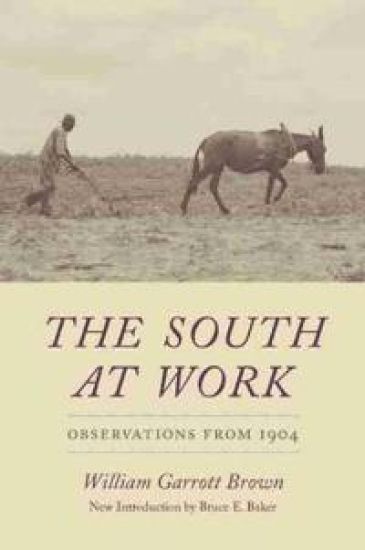
In 1904 William Garrott Brown traveled the American South, investigating the region's political, economic, and social conditions. Using the pen name "Stanton," Brown published twenty epistles in the Boston Evening Transcript detailing his observations. The South at Work is a compilation of these newspaper articles, providing a valuable snapshot of the South as it was simultaneously emerging from post-Civil War economic depression and imposing on African Americans the panoply of Jim Crow laws and customs that sought to exclude them from all but the lowest rungs of southern society. A Harvard-educated historian and journalist originally from Alabama, Brown had been commissioned by the Evening Transcript to visit a wide range of locations and to chronicle the region with a greater depth than that of typical travelers' accounts. Some articles featured familiar topics such as a tobacco warehouse in Durham, North Carolina; a textile mill in Columbia, South Carolina; and the vast steel mills at Birmingham. However, Brown also covered atypical enterprises such as citrus farming in Florida, the King Ranch in Texas, and the New Orleans Cotton Exchange. To add perspective, he talked to businessmen and politicians, as well as everyday workers. In addition to describing the importance of diversifying the South's agricultural economy beyond cotton, Brown addressed race relations and the role of politicians such as James K. Vardaman of Mississippi, the growth of African American communities such as Hayti in Durham, and the role universities played in changing the intellectual climate of the South. The editor, Bruce E. Baker, has written an introduction and provided thorough annotations for each of Brown's letters. Baker demonstrates the value of the collection as it touches on racism, moderate progressivism, and accommodation with the political status quo in the South. Baker and Brown's combined work makes The South at Work one of the most detailed and interesting portraits of the region at the beginning of the twentieth century. Publication in book form makes The South at Work conveniently available to students and scholars of modern southern and American history.

Stephen Arnold Douglas: This Biography of the Man Who Ran Against Lincoln in the 1860 Election
William Garrott Brown
Literary Licensing, LLC
2014
nidottu

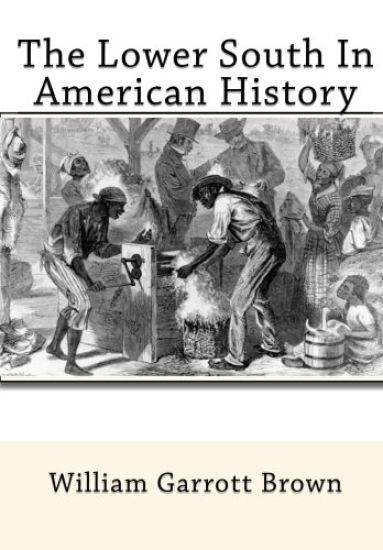
The Lower South In American History
William Garrott Brown
Createspace Independent Publishing Platform
2010
nidottu