Kirjojen hintavertailu. Mukana 12 152 606 kirjaa ja 12 kauppaa.

Kirjailija

William Hirstein

Kirjat ja teokset yhdessä paikassa: 5 kirjaa, julkaisuja vuosilta 2006-2023, suosituimpien joukossa Brain Fiction. Vertaile teosten hintoja ja tarkista saatavuus suomalaisista kirjakaupoista.

5 kirjaa

Kirjojen julkaisuhaarukka 2006-2023.

Responsible Brains

Responsible Brains

William Hirstein; Katrina L. Sifferd; Tyler K. Fagan

MIT PRESS LTD
2023
pokkari
An examination of the relationship between the brain and culpability that offers a comprehensive neuroscientific theory of human responsibility. When we praise, blame, punish, or reward people for their actions, we are holding them responsible for what they have done. Common sense tells us that what makes human beings responsible has to do with their minds and, in particular, the relationship between their minds and their actions. Yet the empirical connection is not necessarily obvious. The "guilty mind" is a core concept of criminal law, but if a defendant on trial for murder were found to have serious brain damage, which brain parts or processes would have to be damaged for him to be considered not responsible, or less responsible, for the crime? What mental illnesses would justify legal pleas of insanity? In Responsible Brains, philosophers William Hirstein, Katrina Sifferd, and Tyler Fagan examine recent developments in neuroscience that point to neural mechanisms of responsibility. Drawing on this research, they argue that evidence from neuroscience and cognitive science can illuminate and inform the nature of responsibility and agency. They go on to offer a novel and comprehensive neuroscientific theory of human responsibility. The authors' core hypothesis is that responsibility is grounded in the brain's prefrontal executive processes, which enable us to make plans, shift attention, inhibit actions, and more. The authors develop the executive theory of responsibility and discuss its implications for criminal law. Their theory neatly bridges the folk-psychological concepts of the law and neuroscientific findings.
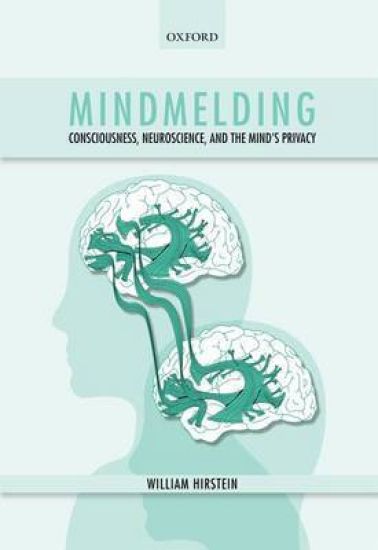
Mindmelding

Mindmelding

William Hirstein

Oxford University Press
2012
sidottu
Can consciousness and the human mind be understood and explained in sheerly physical terms? Materialism is a philosophical/scientific theory, according to which the mind is completely physical. This theory has been around for literally thousands of years, but it was always stymied by its inability to explain how exactly mere matter could do the amazing things the mind can do. Beginning in the 1980s, however, a revolution began quietly boiling away in the neurosciences, yielding increasingly detailed theories about how the brain might accomplish consciousness. Nevertheless, a fundamental obstacle remains. Contemporary research techniques seem to still have the scientific observer of the conscious state locked out of the sort of experience the subjects themselves are having. Science can observe, stimulate, and record events in the brain, but can it ever enter the most sacred citadel, the mind? Can it ever observe the most crucial properties of conscious states, the ones we are aware of? If it can't, this creates a problem. If conscious mental states lack a basic feature possessed by all other known physical states, i.e., the capability to be observed or experienced by many people, this give us reason to believe that they are not entirely physical. In this intriguing book, William Hirstein argues that it is indeed possible for one person to directly experience the conscious states of another, by way of what he calls mindmelding. This would involve making just the right connections in two peoples' brains, which he describes in detail. He then follows up the many other consequences of the possibility that what appeared to be a wall of privacy can actually be breached. Drawing on a range of research from neuroscience and psychology, and looking at executive functioning, mirror neuron work, as well as perceptual phenomena such as blind-sight and filling-in, this book presents a highly original new account of consciousness.
Cognitive Science

Cognitive Science

Daniel Kolak; William Hirstein; Peter Mandik; Jonathan Waskan

Routledge
2006
nidottu
Cognitive Science is a major new guide to the central theories and problems in the study of the mind and brain. The authors clearly explain how and why cognitive science aims to understand the brain as a computational system that manipulates representations. They identify the roots of cognitive science in Descartes - who argued that all knowledge of the external world is filtered through some sort of representation - and examine the present-day role of Artificial Intelligence, computing, psychology, linguistics and neuroscience. Throughout, the key building blocks of cognitive science are clearly illustrated: perception, memory, attention, emotion, language, control of movement, learning, understanding and other important mental phenomena. Cognitive Science:presents a clear, collaborative introduction to the subjectis the first textbook to bring together all the different strands of this new science in a unified approachincludes illustrations and exercises to aid the student
Cognitive Science

Cognitive Science

Daniel Kolak; William Hirstein; Peter Mandik; Jonathan Waskan

Routledge
2006
sidottu
Cognitive Science is a major new guide to the central theories and problems in the study of the mind and brain. The authors clearly explain how and why cognitive science aims to understand the brain as a computational system that manipulates representations. They identify the roots of cognitive science in Descartes - who argued that all knowledge of the external world is filtered through some sort of representation - and examine the present-day role of Artificial Intelligence, computing, psychology, linguistics and neuroscience. Throughout, the key building blocks of cognitive science are clearly illustrated: perception, memory, attention, emotion, language, control of movement, learning, understanding and other important mental phenomena. Cognitive Science:presents a clear, collaborative introduction to the subjectis the first textbook to bring together all the different strands of this new science in a unified approachincludes illustrations and exercises to aid the student
Brain Fiction

Brain Fiction

William Hirstein

Bradford Books
2006
pokkari
Some neurological patients exhibit a striking tendency to confabulate-to construct false answers to a question while genuinely believing that they are telling the truth. A stroke victim, for example, will describe in detail a conference he attended over the weekend when in fact he has not left the hospital. Normal people, too, sometimes have a tendency to confabulate; rather than admitting "I don't know," some people will make up an answer or an explanation and express it with complete conviction. In Brain Fiction, William Hirstein examines confabulation and argues that its causes are not merely technical issues in neurology or cognitive science but deeply revealing about the structure of the human intellect.Hirstein describes confabulation as the failure of a normal checking or censoring process in the brain-the failure to recognize that a false answer is fantasy, not reality. Thus, he argues, the creative ability to construct a plausible-sounding response and some ability to check that response are separate in the human brain. Hirstein sees the dialectic between the creative and checking processes-"the inner dialogue"-as an important part of our mental life. In constructing a theory of confabulation, Hirstein integrates perspectives from different fields, including philosophy, neuroscience, and psychology to achieve a natural mix of conceptual issues usually treated by philosophers with purely empirical issues; information about the distribution of certain blood vessels in the prefrontal lobes of the brain, for example, or the behavior of split-brain patients can shed light on the classic questions of philosophy of mind, including questions about the function of consciousness. This first book-length study of confabulation breaks ground in both philosophy and cognitive science.