Kirjojen hintavertailu. Mukana 12 390 323 kirjaa ja 12 kauppaa.

Kirjailija

William J. Ashworth

Kirjat ja teokset yhdessä paikassa: 4 kirjaa, julkaisuja vuosilta 2003-2021, suosituimpien joukossa The Industrial Revolution. Vertaile teosten hintoja ja tarkista saatavuus suomalaisista kirjakaupoista.

4 kirjaa

Kirjojen julkaisuhaarukka 2003-2021.

The Trinity Circle

The Trinity Circle

William J. Ashworth

University of Pittsburgh Press
2021
sidottu
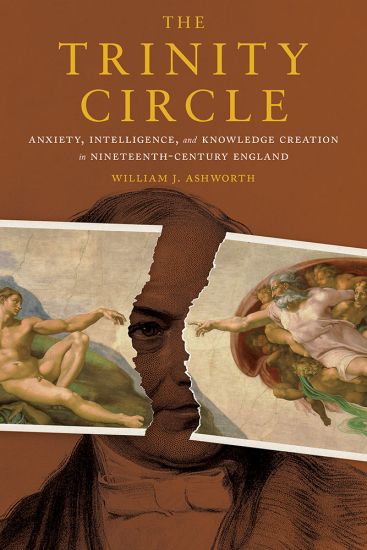
The Trinity Circle explores the creation of knowledge in nineteenth-century England, when any notion of a recognizably modern science was still nearly a century off, religion still infused all ways of elite knowing, and even those who denied its relevance had to work extremely hard to do so. The rise of capitalism during this period—embodied by secular faith, political radicalism, science, commerce, and industry—was, according to Anglican critics, undermining this spiritual world and challenging it with a superficial material one: a human-centric rationalist society hell-bent on measurable betterment via profit, consumption, and a prevalent notion of progress. Here, William J. Ashworth places the politics of science within a far more contested context. By focusing on the Trinity College circle, spearheaded from Cambridge by the polymath William Whewell, he details an ongoing struggle between the Established Church and a quest for change to the prevailing social hierarchy. His study presents a far from unified view toward science and religion at a time when new ways of thinking threatened to divide England and even the Trinity College itself.
The Industrial Revolution

The Industrial Revolution

William J. Ashworth

Bloomsbury Academic
2017
nidottu
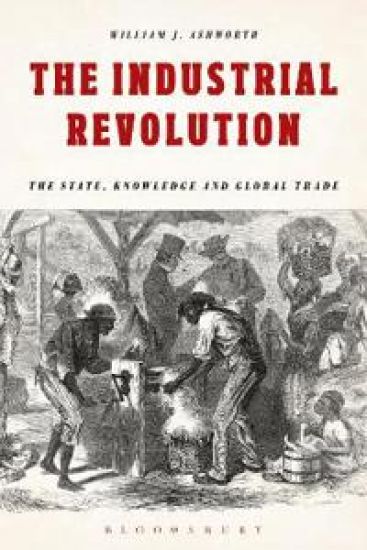
The British Industrial Revolution has long been seen as the spark for modern, global industrialization and sustained economic growth. Indeed the origins of economic history, as a discipline, lie in 19th-century European and North American attempts to understand the foundation of this process.In this book, William J. Ashworth questions some of the orthodoxies concerning the history of the industrial revolution and offers a deep and detailed reassessment of the subject that focuses on the State and its role in the development of key British manufactures. In particular, he explores the role of State regulation and protectionism in nurturing Britain’s negligible early manufacturing base. Taking a long view, from the mid 17th century through to the 19th century, the analysis weaves together a vast range of factors to provide one of the fullest analyses of the industrial revolution, and one that places it firmly within a global context, showing that the Industrial Revolution was merely a short moment within a much larger and longer global trajectory. This book is an important intervention in the debates surrounding modern industrial history will be essential reading for anyone interested in global and comparative economic history and the history of globalization.
The Industrial Revolution

The Industrial Revolution

William J. Ashworth

Bloomsbury Academic
2017
sidottu
The British Industrial Revolution has long been seen as the spark for modern, global industrialization and sustained economic growth. Indeed the origins of economic history, as a discipline, lie in 19th-century European and North American attempts to understand the foundation of this process.In this book, William J. Ashworth questions some of the orthodoxies concerning the history of the industrial revolution and offers a deep and detailed reassessment of the subject that focuses on the State and its role in the development of key British manufactures. In particular, he explores the role of State regulation and protectionism in nurturing Britain’s negligible early manufacturing base. Taking a long view, from the mid 17th century through to the 19th century, the analysis weaves together a vast range of factors to provide one of the fullest analyses of the industrial revolution, and one that places it firmly within a global context, showing that the Industrial Revolution was merely a short moment within a much larger and longer global trajectory. This book is an important intervention in the debates surrounding modern industrial history will be essential reading for anyone interested in global and comparative economic history and the history of globalization.
Customs and Excise

Customs and Excise

William J. Ashworth

Oxford University Press
2003
sidottu
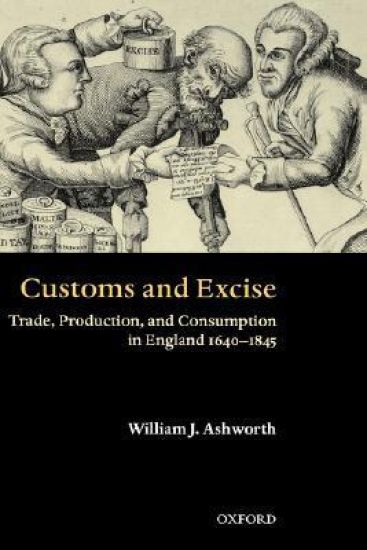
Asis book traces the growth of customs and excise, and their integral role in shaping the framework of industrial England; including state power, technical advance, and the evolution of a consumer society. Central to this structure was the development of two economies - one legal and one illicit. If there was a unique English pathway of industrialization, it was less a distinct entrepreneurial and techno-centric culture, than one predominantly defined within an institutional framework spearheaded by the excise and a wall of tariffs. This process reached its peak by the end of the 1770s. The structure then quickly started to crumble under the weight of the fiscal-military state, and Pitt's calculated policy of concentrating industrial policy around cotton, potteries, and iron - at the expense of other taxed industries. The breakthrough of the new political economy was the erosion of the illicit economy; the smugglers' free trade now became the state's most powerful weapon in the war against non-legal trade. If at the beginning of the period covered by this book state administration was predominantly deregulated and industry regulated, by the close the reverse was the case.