
Kirjojen hintavertailu. Mukana 12 595 353 kirjaa ja 12 kauppaa.

Kirjailija

William L. Benoit

Kirjat ja teokset yhdessä paikassa: 23 kirjaa, julkaisuja vuosilta 1998-2024, suosituimpien joukossa The Rise and Fall of Mass Communication. Vertaile teosten hintoja ja tarkista saatavuus suomalaisista kirjakaupoista.

23 kirjaa

Kirjojen julkaisuhaarukka 1998-2024.

The Clinton Scandals and the Politics of Image Restoration

The Clinton Scandals and the Politics of Image Restoration

Joseph R. Blaney; William L. Benoit

Praeger Publishers Inc
2001
sidottu
President Bill Clinton has been more than generous, Blaney and Benoit point out, in providing fodder for examination of image restoration in politics. His accusers have also done their part in making the public aware of the president's real and perceived shortcomings. As the authors detail, Bill Clinton has been the subject of a tremendous, if not unprecedented, amount of scrutiny by his personal and political enemies.Blaney and Benoit systematically review the background of the various scandals that have marred the Clinton presidency. They concentrate on the techniques used to advance the various accusations and the approaches taken by the president and his supporters to deflect the attacks. All scholars and researchers interested in political communication and rhetoric in contemporary American politics and the presidency will find this to be essential reading.
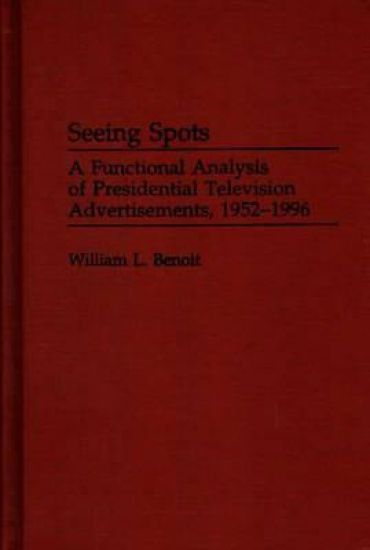
Seeing Spots

Seeing Spots

William L. Benoit

Praeger Publishers Inc
1999
sidottu
Benoit provides a comprehensive analysis of presidential television spots from every campaign that used this important message form, from the 1952 campaign through the last national campaign in 1996. More than 1,600 presidential spots are analyzed, from both primary and general campaigns. Republican, Democratic, and third party candidate advertisements are analyzed. He uses the Functional Theory of Political Campaign Discourse, analyzing themes in spots as acclaims (self-praise), attacks (criticism), and defenses (responses to attacks). Themes are classified according to topic. Each of these topics is broken down further (policy: past deeds, future plans, general goals; character: personal qualities, leadership ability, ideals). Contrasts are made between spots from Republicans and Democrats as well as third parties, incumbents and challengers, and winners and losers. The spots from candidates who led, trailed, or were in close races also are contrasted.Spots are becoming more negative over time, Benoit concludes, in both primary and general campaigns. General campaigns are more negative than primary campaigns, Democrats are more negative than Republicans, and challengers are more negative than incumbents. There are no differences between winners and losers. However, candidates who trailed throughout the campaign were most negative, while candidates in close races were most positive. An important analysis for scholars and researchers in political communication and American presidential politics.
Campaign '96

Campaign '96

William L. Benoit; Joseph R. Blaney; P.M. Pier

Praeger Publishers Inc
1998
sidottu
Benoit, Blaney, and Pier apply the functional theory of political campaign discourse to the 1996 presidential campaign. When a citizen casts a vote, he or she makes a decision about which candidate is preferable. There are only three types of rhetorical strategies for persuading voters to believe a candidate is the better choice: acclaiming or self-praise, attacking or criticizing an opponent, and defending or responding to attacks. As they illustrate, acclaims, if accepted by the audience, make the candidate appear better. Attacks can make the opponent seem worse, improving the source's apparent preferability. If attacked, a candidate can attempt to restore—or prevent—lost credibility by defending against that attack.As Benoit, Blaney, and Pier point out, the functional theory of political communication is relatively new, and their book illustrates it with a detailed analysis of the most recent presidential campaign. One of the major strengths of the study is the variety of message forms examined: television spots, debates, talk radio appearances, keynote speeches, acceptance speeches, speeches by spouses, radio addresses, and free television time remarks. It also examines all three parts of the campaign—primary, nominating conventions, and general campaign. This comprehensive analysis of the '96 presidential campaign will be of considerable use to students, scholars, and other researchers dealing with contemporary American electioneering.