Kirjailija
William L. Miller
Kirjat ja teokset yhdessä paikassa: 13 kirjaa, julkaisuja vuosilta 1977-2026, suosituimpien joukossa Fourth Generation R&D. Vertaile teosten hintoja ja tarkista saatavuus suomalaisista kirjakaupoista.
Mukana myös kirjoitusasut: WILLIAM L MILLER
13 kirjaa
Kirjojen julkaisuhaarukka 1977-2026.
Praise for Fourth Generation R&D "A sweeping and insightfulanalysis of an architecture for innovation in the knowledgeeconomy. Technologists, strategists, and organizational architectswill all find this book worth reading, as will students of themodern organization." --John Seely Brown Chief Scientist, XeroxCorporation "The new realities of competition beg a new approach toinnovation and R Fourth Generation R&D answers that challenge.With lucid arguments and detailed case studies, Fourth GenerationR&D sketches a powerful new paradigm for planning and managinginnovation. Every manager concerned with innovation and its role asa strategic resource--that's to say, every manager--will profitfrom this new understanding." Lawrence Wilkinson President, GlobalBusiness Network "Fourth Generation R&D is a tour de force. Itssweep, depth, and use of graphics are all truly remarkable (not tomention its command of the literature on innovation). Thedistinctions it draws between continuous and discontinuousinnovation--and between tacit and explicit knowledge--arefundamental." --John Yochelson President, The Council onCompetitiveness

Learn to meaningfully converse, relate, and connect with your patients—in a way that benefits both of you. Engagingly written and practically focused, The Primary Care Clinical Encounter: Field Guide to the Generalist’s Craft offers real-word, easy-to-recall tools and models that enable clinicians to connect meaningfully with their patients. Drawing from decades of experience as an educator, clinician, and researcher in the field of primary care, Dr. William L. Miller shares his wisdom and expertise on relationship-centered care and the generalist’s craft with the goal of improved health for patients, better time management for clinicians, improved communication, and, last but certainly not least, (re)discovery of the joy and fulfillment of family medicine practice and interacting with patients on a daily basis. Teaches practical, evidence-based clinical skills to help you connect with your patients, improve their health, reduce burnout, and feel joy and fulfillment in your practice Uses a concise, user-friendly format with tools, tips, tables, figures, and recommendations—designed to quickly and memorably highlight essential content Presents material in five modules to accommodate different learning styles and different stages of your career, whether you’re in training or are an experienced clinician Helps you quickly and intuitively answer everyday questions such as, “How do I create a space where patients can optimize their willingness to share and ability to listen?” “How can I know better what to notice, what to prioritize, what to personalize?” “What are the high value questions, how do I calm an emotional moment, how do I know when to keep it brief and when to dive deeper?” “How can I more fully engage patients in their own care?” An excellent learning tool for residents, fellows, and practitioners in family medicine and primary care, as well as nurse practitioners and physician assistants
Doing Qualitative Research
Benjamin F. Crabtree; William L. Miller
SAGE PUBLICATIONS INC
2022
nidottu
The long-awaited third edition of Doing Qualitative Research by Benjamin F. Crabtree and William L. Miller is out! Co-create your own inspired research stories with this reader-friendly text on qualitative methods, design, and analysis. Written for both students and researchers with little to no qualitative experience, as well as investigators looking to expand and refine their expertise, this clear and concise book will quickly get readers up to speed doing truly excellent qualitative research. The first four chapters of the book set the stage by contextualizing qualitative research within the overall traditions of research, focusing on the history of qualitative research, the importance of collaboration, reflexivity, and finding the appropriate method for your research question. Each part then addresses a different stage of the research process, from data collection, data analysis and interpretation, and refocusing on the bigger picture once your research is complete. Unique chapters cover case study research, intervention studies, and participatory research. The authors use their experiences and knowledge to provide both personal and published research stories to contextualize qualitative concepts. Many of the examples demonstrate the use of qualitative methods within a mixed-methods approach. Each chapter concludes with open-ended questions to further reader contemplation and to spark discussions with classmates and colleagues. With an abundance of clinical research examples featuring a variety of qualitative methods, Doing Qualitative Research encourages researchers to learn by doing and actively experiment with the tools and concepts presented throughout the book.
This authoritative text concerns itself with freedom and `alternatives to freedom', based on original survey research of public attitudes to civil and political rights.It combines and connects explicit and implicit arguments for freedom, with the judgements of public opinion on two levels the general public and politicians encouraging the reader to think about issues both in terms of political theory and public opinion.The issues considered, all of which may be viewed as alternatives to the narrow conception of freedom as the absence of coercion, are: parliamentary sovereignty the national interest responsibility accountability equality the moral communityAlternate chapters present powerful arguments from political figures such as Lord Armstrong, Lord Jenkins and Roy Hattersley, based on practical experience, and then assess public opinion for each issue.
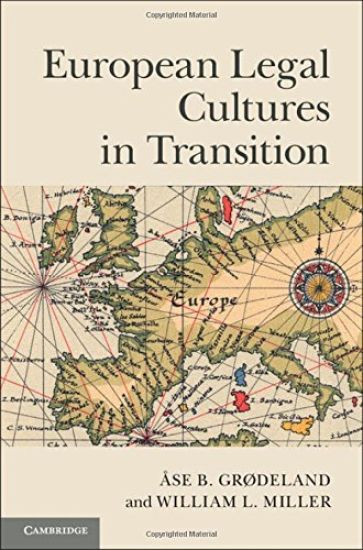
European Legal Cultures in Transition
Åse B. Grødeland; William L. Miller
Cambridge University Press
2015
sidottu
Are national legal cultures in Europe converging or diverging as a result of the pressures of European legal integration? Åse B. Grødeland and William L. Miller address this question by exploring the attitudes and perceptions of the general public and law professionals in five European countries: England, Norway, Bulgaria, Poland and the Ukraine. Presenting new findings, they challenge the established view that ordinary citizens and people working professionally with the law have different legal cultures. Their research in fact reveals that the attitudes of citizens in Eastern and Western Europe towards 'law-in-principle' are remarkably similar, whereas perceptions of 'law-in-practice' differ by country and often correlate with GDP per capita and country ranking in rule of law indices. Grødeland and Miller's innovative methodological approach will appeal to both experts and non-experts with an interest in legal culture, European integration, or European elite and public opinion.
The Open Economy and its Enemies
Jane Duckett; William L. Miller
Cambridge University Press
2006
sidottu
There is a vigorous debate about the merits of globalisation for developing countries. Based on numerous focus-group discussions and over 10,000 interviews, this book studies economic and cultural openness from the perspective of the public in four developing or 'transitional' countries: Vietnam, (South) Korea, the Czech Republic and Ukraine (both before and after the Orange Revolution). It finds many supporters of opening up, but also many who are discontented with its downsides and who expect states to tackle the exploitation and unfairness that accompany it. Among the most fervent enemies of openness there is support not just for peaceful public protest to tackle the problems it brings, but for violence or sabotage. The methodology provides a unique opportunity for the public in developing countries to 'speak with their own voices' about markets and openness - and highlights the subtlety, ambiguity, tensions, conflicts and emotion that statistics alone fail to capture.
The Open Economy and its Enemies
Jane Duckett; William L. Miller
Cambridge University Press
2006
pokkari
There is a vigorous debate about the merits of globalisation for developing countries. Based on numerous focus-group discussions and over 10,000 interviews, this book studies economic and cultural openness from the perspective of the public in four developing or 'transitional' countries: Vietnam, (South) Korea, the Czech Republic and Ukraine (both before and after the Orange Revolution). It finds many supporters of opening up, but also many who are discontented with its downsides and who expect states to tackle the exploitation and unfairness that accompany it. Among the most fervent enemies of openness there is support not just for peaceful public protest to tackle the problems it brings, but for violence or sabotage. The methodology provides a unique opportunity for the public in developing countries to 'speak with their own voices' about markets and openness - and highlights the subtlety, ambiguity, tensions, conflicts and emotion that statistics alone fail to capture.
When the focus is on black or Asian minorities, Britain is frequently described as a multi-cultural state. But when the focus is on Scotland, England and Wales, Britain is also described as a multi-national state. Yet debates about multiculturalism and nationalism have been held in parallel without sharing even a common vocabulary. This book is a pioneering study of how multiculturalism interacts with multinationalism, especially within post-devolution Scotland. It gives equal attention to Scotland's largest 'visible' and 'invisible' minorities: ethnic Pakistanis (almost all of them Muslim) and English immigrants. Rising Scottish self-consciousness could have posed a challenge both these minorities. But in practice, potential problems have proved themselves to be solutions, integrating rather than alienating. In the eyes of the minorities, devolution has made Scots at once more proud and less xenophobic. Even English immigrants feel devolution has defused tensions, calmed frustrations, and forced Scots to blame themselves rather than others for their problems. Pakistanis have suffered increasing harassment - but they attribute that to 9/11 not to devolution. And Muslims adopt Scottish identities, Scottish attitudes, even Scottish nationalism - consciously or unconsciously using these as tools of integration. The book is based in part on large-scale surveys: of Pakistani and English minorities within Scotland, and of the majority populations in Scotland and England. But it is also based on systematic analysis of transcripts of focus-group discussions with minorities revealing the variety of opinion within minorities as well as the contrasts between them. In particular, it presents a unique account of how Scottish Muslims express their feelings in a time of crisis.
The study of elections and voting patterns has been one of the fastest growing fields of political science in the past few decades. It has produced one of the most characteristic artifacts of Western political culture: the public-opinion poll. But what makes people vote the way they do—social class, race, and sex? Or more ephemeral factors, like ideology, party identifications, money and mass-media campaigns? The authors argue that it is futile to ask the question, 'What decides elections?' without first considering another: What do elections decide? Elections and Voters therefore examines competitive electoral systems: how they work, how they are manipulated, and how to interpret the results of elections held under their rules. Ideologies and images, sociological and economic influences, and the effects of the media, money, and opinion polls themselves are discussed, as are noncompetitive elections in four countries commonly omitted from such studies: the Soviet Union, Poland, Mexico, and Kenya. Completely free of jargon, Elections and Voters is indispensable not only to students of politics but also to its practitioners: journalists, politicians, pollsters—and voters themselves.
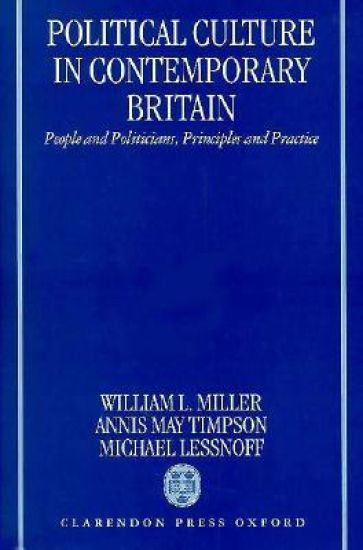
Political Culture in Contemporary Britain
William L. Miller; Annis May Timpson; Michael Lessnoff
Clarendon Press
1996
sidottu
This is the most authoritative picture to date of what the British people and their politicians really think about the fundamentals of politics. Based on new and revealing survey data, it presents a wide-ranging analysis of British attitudes to civil, political, and social rights. The study uncovers two broad `macro-dimensions' of political principle - liberty and equality - which underlie a large number of more specific principles and shape people's responses to many practical issues. Controversially, it claims that commitments to liberty and equality tend to run together - only the least educated treat them as alternatives; left-wingers support both and right-wingers oppose both. It explores the influence of social background, personal experience, and the institutional setting on attitudes towards political principles, highlighting in particular age and the complex influences of education and religion. And it also shows how arguments and propganda combine with political principles and party loyalties to influence opinion on practical issues. The final chapter presents an overall model and quantifies the relative power of all these different influences. The book will be invaluable reading for all those interested in British politics, political sociology, civil liberties, and public opinion as well as those planning their own social science survey research.
This authoritative text concerns itself with freedom and `alternatives to freedom', based on original survey research of public attitudes to civil and political rights.It combines and connects explicit and implicit arguments for freedom, with the judgements of public opinion on two levels the general public and politicians encouraging the reader to think about issues both in terms of political theory and public opinion.The issues considered, all of which may be viewed as alternatives to the narrow conception of freedom as the absence of coercion, are:* parliamentary sovereignty* the national interest* responsibility* accountability* equality* the moral communityAlternate chapters present powerful arguments from political figures such as Lord Armstrong, Lord Jenkins and Roy Hattersley, based on practical experience, and then assess public opinion for each issue.
'...a very superior textbook, avoiding most of the pitfalls of the genre...the wheat-to-chaff ratio is gratifyingly high, in a field with more chaff than most...it must have been a difficult book to write; by any consumer test it rates a range of stars and a 'best buy' recommendation.' - Ivor Crewe, Times Higher Education Supplement '...a lively, readable introductory textbook.' - Talking Politics