
Kirjailija
William Lightfoot Visscher
Kirjat ja teokset yhdessä paikassa: 13 kirjaa, julkaisuja vuosilta 2004-2018, suosituimpien joukossa Stars of Our Country. Vertaile teosten hintoja ja tarkista saatavuus suomalaisista kirjakaupoista.
13 kirjaa
Kirjojen julkaisuhaarukka 2004-2018.

'way Out Yonder, the Romance of a New City
William Lightfoot Visscher
Trieste Publishing
2018
nidottu
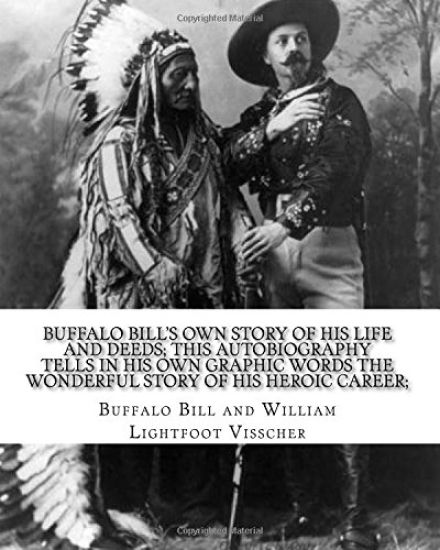
Buffalo Bill's own story of his life and deeds; this autobiography tells in his own graphic words the wonderful story of his heroic career; By: Buffal
William Lightfoot Visscher; Buffalo Bill
Createspace Independent Publishing Platform
2018
nidottu
William Lightfoot Visscher(Visscher, William Lightfoot, 1842-1924)...William Frederick "Buffalo Bill" Cody (February 26, 1846 - January 10, 1917) was an American scout, bison hunter, and showman. He was born in Le Claire, Iowa Territory (now the U.S. state of Iowa), but he lived for several years in his father's hometown in Toronto, Ontario, Canada, before the family returned to the Midwest and settled in the Kansas Territory.Buffalo Bill started working at the age of eleven, after his father's death, and became a rider for the Pony Express at age 14. During the American Civil War, he served the Union from 1863 to the end of the war in 1865. Later he served as a civilian scout for the US Army during the Indian Wars, receiving the Medal of Honor in 1872.One of the most colorful figures of the American Old West, Buffalo Bill's legend began to spread when he was only twenty-three. Shortly thereafter he started performing in shows that displayed cowboy themes and episodes from the frontier and Indian Wars. He founded Buffalo Bill's Wild West in 1883, taking his large company on tours in the United States and, beginning in 1887, in Great Britain and continental Europe.Early life and education edit]Cody was born on February 26, 1846, on a farm just outside Le Claire, Iowa. His father, Isaac Cody, was born on September 5, 1811, in Toronto Township, Upper Canada, now part of Mississauga, Ontario, directly west of Toronto. Mary Ann Bonsell Laycock, Bill's mother, was born about 1817 in New Jersey, near Philadelphia. She moved to Cincinnati to teach school, and there she met and married Isaac. She was a descendant of Josiah Bunting, a Quaker who had settled in Pennsylvania. There is no evidence to indicate Buffalo Bill was raised as a Quaker. In 1847 the couple moved to Ontario, having their son baptized in 1847, as William Cody, at the Dixie Union Chapel in Peel County (present-day Peel Region, of which Mississauga is part), not far from the farm of his father's family. The chapel was built with Cody money, and the land was donated by Philip Cody of Toronto Township.They lived in Ontario for several years.In 1853, Isaac Cody sold his land in rural Scott County, Iowa, for $2000, and the family moved to Fort Leavenworth, Kansas Territory. In the years before the Civil War, Kansas was overtaken by political and physical conflict over the slavery question. Isaac Cody was against slavery. He was invited to speak at Rively's store, a local trading post where pro-slavery men often held meetings. His antislavery speech so angered the crowd that they threatened to kill him if he didn't step down. A man jumped up and stabbed him twice with a Bowie knife. Rively, the store's owner, rushed Cody to get treatment, but he never fully recovered from his injuries.In Kansas, the family was frequently persecuted by pro-slavery supporters. Cody's father spent time away from home for his safety. His enemies learned of a planned visit to his family and plotted to kill him on the way. Bill, despite his youth and being ill at the time, rode 30 miles (48 km) to warn his father. Isaac Cody went to Cleveland, Ohio, to organize a group of thirty families to bring back to Kansas, in order to add to the antislavery population. During his return trip he caught a respiratory infection which, compounded by the lingering effects of his stabbing and complications from kidney disease, led to his death in April 1857.After his death, the family suffered financially. At age 11, Bill took a job with a freight carrier as a "boy extra". On horseback he would ride up and down the length of a wagon train and deliver messages between the drivers and workmen. Next he joined Johnston's Army as an unofficial member of the scouts assigned to guide the United States Army to Utah, to put down a rumored rebellion by the Mormon population of Salt Lake City.............

Pony Express and Stage Coach--icons of the Western FrontierThe opening of the great North American interior during the 19th century has passed into legend. This was the 'Wild West' and its personalities and great events have become familiar to almost everyone. This was a time of lawmen and outlaws, the U. S. cavalrymen in 'dirty shirt blue', the hostile tribes of feathered warriors and the cowboys of the great cattle drives. The lines of the covered wagons took pioneers across plains and deserts to create new towns, ranches and farms. The key to the success of the opening of continent for American settlers was, of course, communication. Before the building of a trans-continental railroad or telegraph lines a solution was required to quickly carry news, freight and people across this often dangerous land. This book contains two essential works on this subject. The first is the exciting life of a great American innovator, Alexander Majors, who was, with his partners, responsible for the creation of the famous Pony Express and an overland stage-coach service. The second focusses on the daredevil riders of the Pony Express who included among their number a young, 'Buffalo Bill' Cody.Leonaur editions are newly typeset and are not facsimiles; each title is available in softcover and hardback with dustjacket; our hardbacks are cloth bound and feature gold foil lettering on their spines and fabric head and tail bands.

Pony Express and Stage Coach--icons of the Western FrontierThe opening of the great North American interior during the 19th century has passed into legend. This was the 'Wild West' and its personalities and great events have become familiar to almost everyone. This was a time of lawmen and outlaws, the U. S. cavalrymen in 'dirty shirt blue', the hostile tribes of feathered warriors and the cowboys of the great cattle drives. The lines of the covered wagons took pioneers across plains and deserts to create new towns, ranches and farms. The key to the success of the opening of continent for American settlers was, of course, communication. Before the building of a trans-continental railroad or telegraph lines a solution was required to quickly carry news, freight and people across this often dangerous land. This book contains two essential works on this subject. The first is the exciting life of a great American innovator, Alexander Majors, who was, with his partners, responsible for the creation of the famous Pony Express and an overland stage-coach service. The second focusses on the daredevil riders of the Pony Express who included among their number a young, 'Buffalo Bill' Cody.Leonaur editions are newly typeset and are not facsimiles; each title is available in softcover and hardback with dustjacket; our hardbacks are cloth bound and feature gold foil lettering on their spines and fabric head and tail bands.

A Thrilling and Truthful History of the Pony Express or Blazing the Westward Way
William Lightfoot Visscher
Literary Licensing, LLC
2014
nidottu

The Stars of Our Country: Poems for Each State of Our Union
William Lightfoot Visscher
Literary Licensing, LLC
2014
nidottu


Poems of the South and Other Verse
William Lightfoot Visscher; Opie Percival (INT) Read
Kessinger Pub
2007
pokkari
A Thrilling And Truthful History of the Pony Express or Blazing the Westward Way
William Lightfoot Visscher
Kessinger Pub
2005
pokkari