Kirjojen hintavertailu. Mukana 12 390 323 kirjaa ja 12 kauppaa.

Kirjailija

William Mishler

Kirjat ja teokset yhdessä paikassa: 3 kirjaa, julkaisuja vuosilta 1998-2006, suosituimpien joukossa Russia Transformed. Vertaile teosten hintoja ja tarkista saatavuus suomalaisista kirjakaupoista.

3 kirjaa

Kirjojen julkaisuhaarukka 1998-2006.

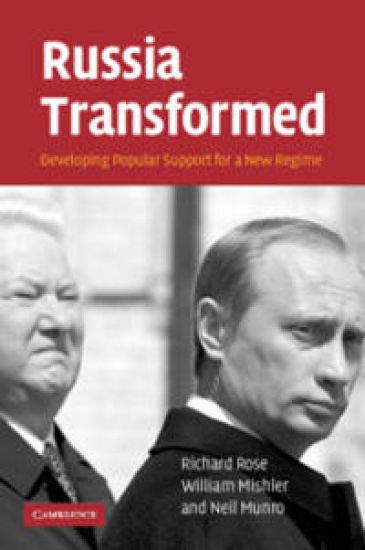
Russia Transformed

Russia Transformed

Richard Rose; William Mishler; Neil Munro

Cambridge University Press
2006
sidottu
Since the fall of communism Russia has undergone a treble transformation of its political, social and economic system. The government is an autocracy in which the Kremlin manages elections and administers the law to suit its own ends. It does not provide the democracy that most citizens desire. Given a contradiction between what Russians want and what they get, do they support their government and, if so, why? Using the New Russia Barometer - a unique set of public opinion surveys from 1992 to 2005 - this book shows that it is the passage of time that has been most important in developing support for the new regime. Although there remains great dissatisfaction with the regime's corruption, it has become accepted as a lesser evil to alternatives. The government appears stable today, but will be challenged by constitutional term limits forcing President Putin to leave office in 2008.
Democracy and its Alternatives

Democracy and its Alternatives

Richard Rose; William Mishler; Christian Haerpfer

Polity Press
1998
sidottu
The collapse of communism has created the opportunity for democracy to spread from Prague to the Baltic and the Black seas. But the alternatives - dictatorship or totalitarian rule - are more in keeping with the traditions of Central and Eastern Europe. Will people put up with new democracies which are associated with inflation, unemployment, crime and corruption? Or will they return to some form of authoritarian regime? Half a century ago, Winston Churchill predicted that people will accept democracy with all its faults - because it is better than anything else that has ever been tried. To find out if Churchill was right, this book analyses a unique source of evidence about public opinion, the New Democracies Barometer, covering the Czech Republic, Hungary, Slovakia, Poland, Slovenia, Bulgaria, Romania, Belarus and Ukraine. The authors find that there is widespread popular support for democracy compared to communism, dictatorship and military rule. People who have been denied democratic freedoms value new political rights more highly. Economic concerns are second in importance. If democracy fails, it will be because political elites have abused their power, not because the public does not want democracy. Looking at post-communist Europe makes us think again about democracy in countries where it is taken for granted. The abrupt transition to democracy in post-communist countries is normal; gradual evolution in the Anglo-American style is the exception to the rule. Complaints in Western countries about democracy being less than ideal reflect confidence that there is no alternative. Post-communist citizens do not have this luxury: they must make the most of what they have. This important book makes an important contribution to current debates about democratization and democratic theory and to the growing literature on the social and political changes taking place in post-communist societies. It will be of particular interest to students and scholars in politics and sociology.
Democracy and its Alternatives

Democracy and its Alternatives

Richard Rose; William Mishler; Christian Haerpfer

Polity Press
1998
nidottu
The collapse of communism has created the opportunity for democracy to spread from Prague to the Baltic and the Black seas. But the alternatives - dictatorship or totalitarian rule - are more in keeping with the traditions of Central and Eastern Europe. Will people put up with new democracies which are associated with inflation, unemployment, crime and corruption? Or will they return to some form of authoritarian regime? Half a century ago, Winston Churchill predicted that people will accept democracy with all its faults - because it is better than anything else that has ever been tried. To find out if Churchill was right, this book analyses a unique source of evidence about public opinion, the New Democracies Barometer, covering the Czech Republic, Hungary, Slovakia, Poland, Slovenia, Bulgaria, Romania, Belarus and Ukraine. The authors find that there is widespread popular support for democracy compared to communism, dictatorship and military rule. People who have been denied democratic freedoms value new political rights more highly. Economic concerns are second in importance. If democracy fails, it will be because political elites have abused their power, not because the public does not want democracy. Looking at post-communist Europe makes us think again about democracy in countries where it is taken for granted. The abrupt transition to democracy in post-communist countries is normal; gradual evolution in the Anglo-American style is the exception to the rule. Complaints in Western countries about democracy being less than ideal reflect confidence that there is no alternative. Post-communist citizens do not have this luxury: they must make the most of what they have. This important book makes an important contribution to current debates about democratization and democratic theory and to the growing literature on the social and political changes taking place in post-communist societies. It will be of particular interest to students and scholars in politics and sociology.