Kirjojen hintavertailu. Mukana 12 595 353 kirjaa ja 12 kauppaa.

Kirjailija

William Q. Meeker

Kirjat ja teokset yhdessä paikassa: 5 kirjaa, julkaisuja vuosilta 2017-2021, suosituimpien joukossa Achieving Product Reliability. Vertaile teosten hintoja ja tarkista saatavuus suomalaisista kirjakaupoista.

5 kirjaa

Kirjojen julkaisuhaarukka 2017-2021.

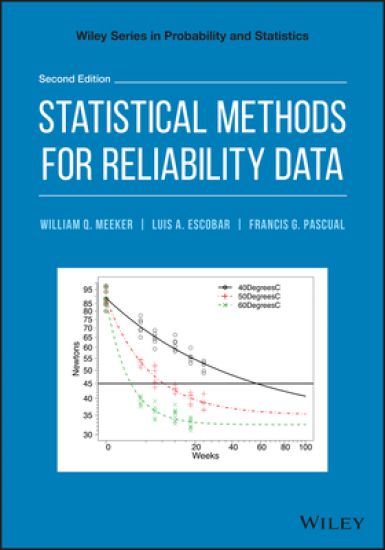
Statistical Methods for Reliability Data

Statistical Methods for Reliability Data

William Q. Meeker; Luis A. Escobar; Francis G. Pascual

John Wiley Sons Inc
2021
sidottu
An authoritative guide to the most recent advances in statistical methods for quantifying reliability Statistical Methods for Reliability Data, Second Edition (SMRD2) is an essential guide to the most widely used and recently developed statistical methods for reliability data analysis and reliability test planning. Written by three experts in the area, SMRD2 updates and extends the long- established statistical techniques and shows how to apply powerful graphical, numerical, and simulation-based methods to a range of applications in reliability. SMRD2 is a comprehensive resource that describes maximum likelihood and Bayesian methods for solving practical problems that arise in product reliability and similar areas of application. SMRD2 illustrates methods with numerous applications and all the data sets are available on the book’s website. Also, SMRD2 contains an extensive collection of exercises that will enhance its use as a course textbook. The SMRD2's website contains valuable resources, including R packages, Stan model codes, presentation slides, technical notes, information about commercial software for reliability data analysis, and csv files for the 93 data sets used in the book's examples and exercises. The importance of statistical methods in the area of engineering reliability continues to grow and SMRD2 offers an updated guide for, exploring, modeling, and drawing conclusions from reliability data. SMRD2 features: Contains a wealth of information on modern methods and techniques for reliability data analysisOffers discussions on the practical problem-solving power of various Bayesian inference methodsProvides examples of Bayesian data analysis performed using the R interface to the Stan system based on Stan models that are available on the book's websiteIncludes helpful technical-problem and data-analysis exercise sets at the end of every chapterPresents illustrative computer graphics that highlight data, results of analyses, and technical concepts Written for engineers and statisticians in industry and academia, Statistical Methods for Reliability Data, Second Edition offers an authoritative guide to this important topic.
Advanced Statistical Methods for Reliability Analysis

Advanced Statistical Methods for Reliability Analysis

William Q. Meeker

John Wiley Sons Inc
2021
sidottu
This book improves Meeker and Escobar (1998, Wiley) not only in terms of organization and presentation, but also in extensions, modifications to the technical material, and advanced topic coverage (such as accelerated degradation and sensor, storage, and communications technology). It presents state-of-the-art, computer-based statistical methods for reliability data analysis, for test planning of industrial products, and for dynamic covariate information found on the Internet. It also improves long time established techniques as it demonstrates how to apply the new graphical, numerical, or simulation-based methods to a broad range of models encountered in reliability data analysis. Bayesian methods in solving practical problems (e.g. models involving random effects or censoring that arises in reliability studies) are now incorporated where appropriate; the computations are done with WinBUGS. Ample exercises that extend and strengthen the concepts in the book are included. The criterion for integrating material in the book is that the authors have in-hand or have seen real applications for the methodology. The book is specifically geared for either a one-semester course on advanced topics in reliability theory in either a statistics or engineering department at the second-year graduate level or for researchers who need access to new and modern methodologies. R functions and subroutines, along with an extensive list of data sets, are included on a massive web site that is meticulously maintained by the authors.
Achieving Product Reliability

Achieving Product Reliability

Necip Doganaksoy; William Q. Meeker; Gerald J. Hahn

CRC Press
2021
nidottu
Are you buying a car or smartphone or dishwasher? We bet long-term, trouble-free operation (i.e., high reliability) is among the top three things you look for. Reliability problems can lead to everything from minor inconveniences to human disasters. Ensuring high reliability in designing and building manufactured products is principally an engineering challenge–but statistics plays a key role. Achieving Product Reliability explains in a non-technical manner how statistics is used in modern product reliability assurance.Features: Describes applications of statistics in reliability assurance in design, development, validation, manufacturing, and field tracking. Uses real-life examples to illustrate key statistical concepts such as the Weibull and lognormal distributions, hazard rate, and censored data. Demonstrates the use of graphical tools in such areas as accelerated testing, degradation data modeling, and repairable systems data analysis. Presents opportunities for profitably applying statistics in the era of Big Data and Industrial Internet of Things (IIoT) utilizing, for example, the instantaneous transmission of large quantities of field data.Whether you are an intellectually curious citizen, student, manager, budding reliability professional, or academician seeking practical applications, Achieving Product Reliability is a great starting point for a big-picture view of statistics in reliability assurance.The authors are world-renowned experts on this topic with extensive experience as company-wide statistical resources for a global conglomerate, consultants to business and government, and researchers of statistical methods for reliability applications.
Achieving Product Reliability

Achieving Product Reliability

Necip Doganaksoy; William Q. Meeker; Gerald J. Hahn

Taylor Francis Ltd
2021
sidottu
Are you buying a car or smartphone or dishwasher? We bet long-term, trouble-free operation (i.e., high reliability) is among the top three things you look for. Reliability problems can lead to everything from minor inconveniences to human disasters. Ensuring high reliability in designing and building manufactured products is principally an engineering challenge–but statistics plays a key role. Achieving Product Reliability explains in a non-technical manner how statistics is used in modern product reliability assurance.Features: Describes applications of statistics in reliability assurance in design, development, validation, manufacturing, and field tracking. Uses real-life examples to illustrate key statistical concepts such as the Weibull and lognormal distributions, hazard rate, and censored data. Demonstrates the use of graphical tools in such areas as accelerated testing, degradation data modeling, and repairable systems data analysis. Presents opportunities for profitably applying statistics in the era of Big Data and Industrial Internet of Things (IIoT) utilizing, for example, the instantaneous transmission of large quantities of field data.Whether you are an intellectually curious citizen, student, manager, budding reliability professional, or academician seeking practical applications, Achieving Product Reliability is a great starting point for a big-picture view of statistics in reliability assurance.The authors are world-renowned experts on this topic with extensive experience as company-wide statistical resources for a global conglomerate, consultants to business and government, and researchers of statistical methods for reliability applications.
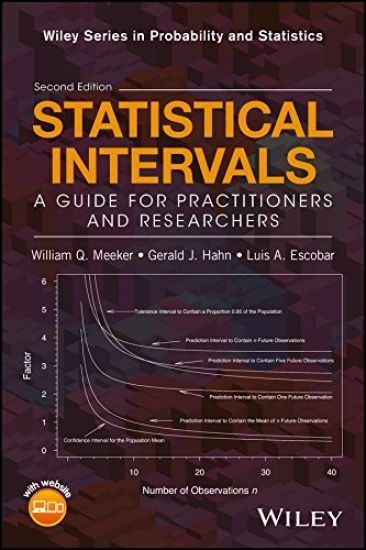
Statistical Intervals

Statistical Intervals

William Q. Meeker; Gerald J. Hahn; Luis A. Escobar

John Wiley Sons Inc
2017
sidottu
Describes statistical intervals to quantify sampling uncertainty,focusing on key application needs and recently developed methodology in an easy-to-apply format Statistical intervals provide invaluable tools for quantifying sampling uncertainty. The widely hailed first edition, published in 1991, described the use and construction of the most important statistical intervals. Particular emphasis was given to intervals—such as prediction intervals, tolerance intervals and confidence intervals on distribution quantiles—frequently needed in practice, but often neglected in introductory courses. Vastly improved computer capabilities over the past 25 years have resulted in an explosion of the tools readily available to analysts. This second edition—more than double the size of the first—adds these new methods in an easy-to-apply format. In addition to extensive updating of the original chapters, the second edition includes new chapters on: Likelihood-based statistical intervalsNonparametric bootstrap intervalsParametric bootstrap and other simulation-based intervalsAn introduction to Bayesian intervalsBayesian intervals for the popular binomial, Poisson and normal distributionsStatistical intervals for Bayesian hierarchical modelsAdvanced case studies, further illustrating the use of the newly described methods New technical appendices provide justification of the methods and pathways to extensions and further applications. A webpage directs readers to current readily accessible computer software and other useful information. Statistical Intervals: A Guide for Practitioners and Researchers, Second Edition is an up-to-date working guide and reference for all who analyze data, allowing them to quantify the uncertainty in their results using statistical intervals.