Kirjailija
William Salmon
Kirjat ja teokset yhdessä paikassa: 41 kirjaa, julkaisuja vuosilta 2004-2025, suosituimpien joukossa Bibliothèque Des Philosophes Chimiques. Tome 1. Vertaile teosten hintoja ja tarkista saatavuus suomalaisista kirjakaupoista.
41 kirjaa
Kirjojen julkaisuhaarukka 2004-2025.

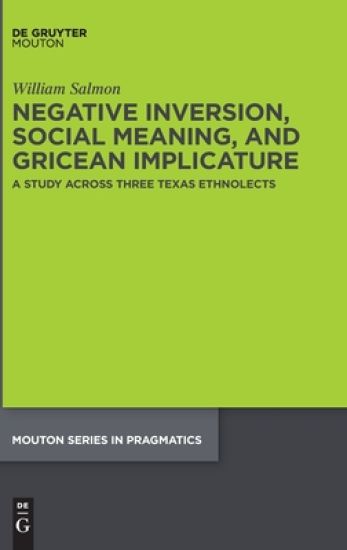
Negative Inversion, Social Meaning, and Gricean Implicature
William Salmon
De Gruyter Mouton
2020
sidottu
Relying on a wealth of new data, this book argues that long-standing puzzles of Negative Inversion (NI) syntax are not puzzles at all when viewed through the lenses of Gricean pragmatics and Labovian sociolinguistics. Focusing on sentences such as "Can't nobody lift that rock" in African American, Anglo, and Chicano Englishes in Texas, the book provides tidy solutions to problems such as: the NI’s relationship to its non-inverted counterpart, its relationship to existential “there” sentences, to modal existential sentences, to the definiteness effects surrounding its NP subject, the emphatic meaning with which it seems to be associated, and more. The book argues that such issues, which have been explored in the syntax and semantics literature since the late 1960s, are handled more fruitfully via Gricean reasoning, demographics of use, and a simple semantics. As such, the book argues that NI can be freed from the “syntactico-semantic straitjacket” into which it has often been forced. It also demonstrates ways in which pragmatic and sociolinguistic thought can be brought together to inform larger linguistic analyses.

The 18th century was a wealth of knowledge, exploration and rapidly growing technology and expanding record-keeping made possible by advances in the printing press. In its determination to preserve the century of revolution, Gale initiated a revolution of its own: digitization of epic proportions to preserve these invaluable works in the largest archive of its kind. Now for the first time these high-quality digital copies of original 18th century manuscripts are available in print, making them highly accessible to libraries, undergraduate students, and independent scholars.The eighteenth-century fascination with Greek and Roman antiquity followed the systematic excavation of the ruins at Pompeii and Herculaneum in southern Italy; and after 1750 a neoclassical style dominated all artistic fields. The titles here trace developments in mostly English-language works on painting, sculpture, architecture, music, theater, and other disciplines. Instructional works on musical instruments, catalogs of art objects, comic operas, and more are also included. ++++The below data was compiled from various identification fields in the bibliographic record of this title. This data is provided as an additional tool in helping to insure edition identification: ++++Harvard University Houghton LibraryN011249London: printed for C. Hitch, L. Haws, J. Rivington, R. Baldwin, W. Johnston, and 7 others in London], 1762. 12],80,77-132, 28]p., plates; 4
Palladio Londinensis; or, the London art of Building. In Three Parts. I. Containing a Demonstration of all the Geometrical Problems III. Copiously Treating of the Several Kinds of Staircases; By William Salmon. The Seventh Edition
William Salmon
Gale Ecco, Print Editions
2018
sidottu
The 18th century was a wealth of knowledge, exploration and rapidly growing technology and expanding record-keeping made possible by advances in the printing press. In its determination to preserve the century of revolution, Gale initiated a revolution of its own: digitization of epic proportions to preserve these invaluable works in the largest archive of its kind. Now for the first time these high-quality digital copies of original 18th century manuscripts are available in print, making them highly accessible to libraries, undergraduate students, and independent scholars.The eighteenth-century fascination with Greek and Roman antiquity followed the systematic excavation of the ruins at Pompeii and Herculaneum in southern Italy; and after 1750 a neoclassical style dominated all artistic fields. The titles here trace developments in mostly English-language works on painting, sculpture, architecture, music, theater, and other disciplines. Instructional works on musical instruments, catalogs of art objects, comic operas, and more are also included. ++++The below data was compiled from various identification fields in the bibliographic record of this title. This data is provided as an additional tool in helping to insure edition identification: ++++British LibraryT138534London: printed for J. Rivington; R. Baldwin; L. Hawes, W. Clarke, and R. Collins; W. Johnston; S. Crowder and 4 others in London], 1767. 12],132, 28]p., plates; 4
Palladio Londinensis; or, the London art of Building. In Three Parts. To Which is Annexed, the Builder's Dictionary The Fifth Edition. With Great Alterations and Improvements, by E. Hoppus,
William Salmon
Gale Ecco, Print Editions
2018
sidottu
The 18th century was a wealth of knowledge, exploration and rapidly growing technology and expanding record-keeping made possible by advances in the printing press. In its determination to preserve the century of revolution, Gale initiated a revolution of its own: digitization of epic proportions to preserve these invaluable works in the largest archive of its kind. Now for the first time these high-quality digital copies of original 18th century manuscripts are available in print, making them highly accessible to libraries, undergraduate students, and independent scholars.The eighteenth-century fascination with Greek and Roman antiquity followed the systematic excavation of the ruins at Pompeii and Herculaneum in southern Italy; and after 1750 a neoclassical style dominated all artistic fields. The titles here trace developments in mostly English-language works on painting, sculpture, architecture, music, theater, and other disciplines. Instructional works on musical instruments, catalogs of art objects, comic operas, and more are also included. ++++The below data was compiled from various identification fields in the bibliographic record of this title. This data is provided as an additional tool in helping to insure edition identification: ++++British LibraryT043564London: printed for S. Birt, C. Hitch and L. Hawes, E. Wicksteed, J. Ward, W. Johnston, T. Longman, and E. Dilly, 1755. 12],132, 28]p., plates(some fold.), fold.tables; 4
The 18th century was a wealth of knowledge, exploration and rapidly growing technology and expanding record-keeping made possible by advances in the printing press. In its determination to preserve the century of revolution, Gale initiated a revolution of its own: digitization of epic proportions to preserve these invaluable works in the largest archive of its kind. Now for the first time these high-quality digital copies of original 18th century manuscripts are available in print, making them highly accessible to libraries, undergraduate students, and independent scholars.Medical theory and practice of the 1700s developed rapidly, as is evidenced by the extensive collection, which includes descriptions of diseases, their conditions, and treatments. Books on science and technology, agriculture, military technology, natural philosophy, even cookbooks, are all contained here.++++The below data was compiled from various identification fields in the bibliographic record of this title. This data is provided as an additional tool in helping to insure edition identification: ++++British LibraryT139013With a final advertisement leaf.London: printed for Mess. Ward and Wicksteed; A. Ward; J. Clarke; and J. Oswald, 1734. 12],128, 28]p., plates: ill.; 4

The Works of Aristotle, in Four Parts. Containing I. His Complete Master-piece; ... To Which is Added, the Family Physician, ... II. His Experienced Midwife; ... III. His Book of Problems; ... IV. His Last Legacy; ... The Best Edition
William Salmon
Gale Ecco, Print Editions
2018
sidottu
The 18th century was a wealth of knowledge, exploration and rapidly growing technology and expanding record-keeping made possible by advances in the printing press. In its determination to preserve the century of revolution, Gale initiated a revolution of its own: digitization of epic proportions to preserve these invaluable works in the largest archive of its kind. Now for the first time these high-quality digital copies of original 18th century manuscripts are available in print, making them highly accessible to libraries, undergraduate students, and independent scholars.Medical theory and practice of the 1700s developed rapidly, as is evidenced by the extensive collection, which includes descriptions of diseases, their conditions, and treatments. Books on science and technology, agriculture, military technology, natural philosophy, even cookbooks, are all contained here.++++The below data was compiled from various identification fields in the bibliographic record of this title. This data is provided as an additional tool in helping to insure edition identification: ++++Bodleian Library (Oxford)T174928Not in fact by Aristotle but by William Salmon.London: printed for, and sold by all the booksellers, 1791. 2],377, 1]p.: ill.; 12

The 18th century was a wealth of knowledge, exploration and rapidly growing technology and expanding record-keeping made possible by advances in the printing press. In its determination to preserve the century of revolution, Gale initiated a revolution of its own: digitization of epic proportions to preserve these invaluable works in the largest archive of its kind. Now for the first time these high-quality digital copies of original 18th century manuscripts are available in print, making them highly accessible to libraries, undergraduate students, and independent scholars.Medical theory and practice of the 1700s developed rapidly, as is evidenced by the extensive collection, which includes descriptions of diseases, their conditions, and treatments. Books on science and technology, agriculture, military technology, natural philosophy, even cookbooks, are all contained here.++++The below data was compiled from various identification fields in the bibliographic record of this title. This data is provided as an additional tool in helping to insure edition identification: ++++British LibraryT083065With a frontispiece to each volume, an additional engraved titlepage to the first volume, and a separate titlepage to the second. The titlepage to the first volume is in red and black.London: printed by I. Dawks, for H. Rhodes; and J. Taylor, 1710. 2v.( 6], xxiv,1296, 44]p.), plates: ill., ports; 2

The 18th century was a wealth of knowledge, exploration and rapidly growing technology and expanding record-keeping made possible by advances in the printing press. In its determination to preserve the century of revolution, Gale initiated a revolution of its own: digitization of epic proportions to preserve these invaluable works in the largest archive of its kind. Now for the first time these high-quality digital copies of original 18th century manuscripts are available in print, making them highly accessible to libraries, undergraduate students, and independent scholars.Medical theory and practice of the 1700s developed rapidly, as is evidenced by the extensive collection, which includes descriptions of diseases, their conditions, and treatments. Books on science and technology, agriculture, military technology, natural philosophy, even cookbooks, are all contained here.++++The below data was compiled from various identification fields in the bibliographic record of this title. This data is provided as an additional tool in helping to insure edition identification: ++++British LibraryT083065With a frontispiece to each volume, an additional engraved titlepage to the first volume, and a separate titlepage to the second. The titlepage to the first volume is in red and black.London: printed by I. Dawks, for H. Rhodes; and J. Taylor, 1710. 2v.( 6], xxiv,1296, 44]p.), plates: ill., ports; 2

The 18th century was a wealth of knowledge, exploration and rapidly growing technology and expanding record-keeping made possible by advances in the printing press. In its determination to preserve the century of revolution, Gale initiated a revolution of its own: digitization of epic proportions to preserve these invaluable works in the largest archive of its kind. Now for the first time these high-quality digital copies of original 18th century manuscripts are available in print, making them highly accessible to libraries, undergraduate students, and independent scholars.Medical theory and practice of the 1700s developed rapidly, as is evidenced by the extensive collection, which includes descriptions of diseases, their conditions, and treatments. Books on science and technology, agriculture, military technology, natural philosophy, even cookbooks, are all contained here.++++The below data was compiled from various identification fields in the bibliographic record of this title. This data is provided as an additional tool in helping to insure edition identification: ++++British LibraryT083064With an additional engraved titlepage to vol.1 and a separate titlepage to vol.II dated 1711. The titlepage to vol.1 is printed in red and black.London: printed by I. Dawks, for H. Rhodes; and J. Taylor, 1710-11. 2v.( 6], xxiv,1296, 44]p.), plate: ill.; 2

The Works of Aristotle, Complete in Four Parts. Containing I. His Complete Master Piece
William Salmon
Gale Ecco, Print Editions
2018
sidottu
The 18th century was a wealth of knowledge, exploration and rapidly growing technology and expanding record-keeping made possible by advances in the printing press. In its determination to preserve the century of revolution, Gale initiated a revolution of its own: digitization of epic proportions to preserve these invaluable works in the largest archive of its kind. Now for the first time these high-quality digital copies of original 18th century manuscripts are available in print, making them highly accessible to libraries, undergraduate students, and independent scholars.Medical theory and practice of the 1700s developed rapidly, as is evidenced by the extensive collection, which includes descriptions of diseases, their conditions, and treatments. Books on science and technology, agriculture, military technology, natural philosophy, even cookbooks, are all contained here.++++The below data was compiled from various identification fields in the bibliographic record of this title. This data is provided as an additional tool in helping to insure edition identification: ++++British LibraryN037653Not in fact by Aristotle, but by William Salmon. Each part has separate titlepage, pagination and register. 'Aristotle's compleat master piece', 32nd ed., 1788; - 'Aristotle's complete and experienc'd midwife', 12th ed.; 'Aristotle's book of problems', London: printed for L. Hawes and Co.; and S. Crowder, 1776 1788?]. 2],144; 4], iv,156, 4];156; 2], v-120p., plates: ill.; 12

The 18th century was a wealth of knowledge, exploration and rapidly growing technology and expanding record-keeping made possible by advances in the printing press. In its determination to preserve the century of revolution, Gale initiated a revolution of its own: digitization of epic proportions to preserve these invaluable works in the largest archive of its kind. Now for the first time these high-quality digital copies of original 18th century manuscripts are available in print, making them highly accessible to libraries, undergraduate students, and independent scholars.Medical theory and practice of the 1700s developed rapidly, as is evidenced by the extensive collection, which includes descriptions of diseases, their conditions, and treatments. Books on science and technology, agriculture, military technology, natural philosophy, even cookbooks, are all contained here.++++The below data was compiled from various identification fields in the bibliographic record of this title. This data is provided as an additional tool in helping to insure edition identification: ++++British LibraryT084330Not in fact by Aristotle. Edited by William Salmon. Includes: 'Aristotle's master-piece', 'The experienced midwife' and 'Aristotle's book of problems': the book of problems has separate pagination and register. The titlepage is engraved. Printer's name London: printed for J. Urquhart J. Findlay, printer], 1800?]. 204, 2],122p., plate; 12
The 18th century was a wealth of knowledge, exploration and rapidly growing technology and expanding record-keeping made possible by advances in the printing press. In its determination to preserve the century of revolution, Gale initiated a revolution of its own: digitization of epic proportions to preserve these invaluable works in the largest archive of its kind. Now for the first time these high-quality digital copies of original 18th century manuscripts are available in print, making them highly accessible to libraries, undergraduate students, and independent scholars.The eighteenth-century fascination with Greek and Roman antiquity followed the systematic excavation of the ruins at Pompeii and Herculaneum in southern Italy; and after 1750 a neoclassical style dominated all artistic fields. The titles here trace developments in mostly English-language works on painting, sculpture, architecture, music, theater, and other disciplines. Instructional works on musical instruments, catalogs of art objects, comic operas, and more are also included. ++++The below data was compiled from various identification fields in the bibliographic record of this title. This data is provided as an additional tool in helping to insure edition identification: ++++British LibraryT149640The text and register are continuous. With an additional titlepage, engraved, and an errata leaf. Copy filmed at UMI microfilm Early English Books, Tract Supplement reel E3 a fragment with title page to vol. 2 only.London: printed for A. and J. Churchill. And J. Nicholson, 1701. 2v. (36,224,301-939, 1]p.), XXIII plates: port.; 8
The 18th century was a wealth of knowledge, exploration and rapidly growing technology and expanding record-keeping made possible by advances in the printing press. In its determination to preserve the century of revolution, Gale initiated a revolution of its own: digitization of epic proportions to preserve these invaluable works in the largest archive of its kind. Now for the first time these high-quality digital copies of original 18th century manuscripts are available in print, making them highly accessible to libraries, undergraduate students, and independent scholars.The eighteenth-century fascination with Greek and Roman antiquity followed the systematic excavation of the ruins at Pompeii and Herculaneum in southern Italy; and after 1750 a neoclassical style dominated all artistic fields. The titles here trace developments in mostly English-language works on painting, sculpture, architecture, music, theater, and other disciplines. Instructional works on musical instruments, catalogs of art objects, comic operas, and more are also included. ++++The below data was compiled from various identification fields in the bibliographic record of this title. This data is provided as an additional tool in helping to insure edition identification: ++++British LibraryT149640The text and register are continuous. With an additional titlepage, engraved, and an errata leaf. Copy filmed at UMI microfilm Early English Books, Tract Supplement reel E3 a fragment with title page to vol. 2 only.London: printed for A. and J. Churchill. And J. Nicholson, 1701. 2v. (36,224,301-939, 1]p.), XXIII plates: port.; 8