Kirjojen hintavertailu. Mukana 12 390 323 kirjaa ja 12 kauppaa.

Kirjailija

William Urban

Kirjat ja teokset yhdessä paikassa: 10 kirjaa, julkaisuja vuosilta 2007-2024, suosituimpien joukossa The Dean Is Dead Again. Vertaile teosten hintoja ja tarkista saatavuus suomalaisista kirjakaupoista.

10 kirjaa

Kirjojen julkaisuhaarukka 2007-2024.

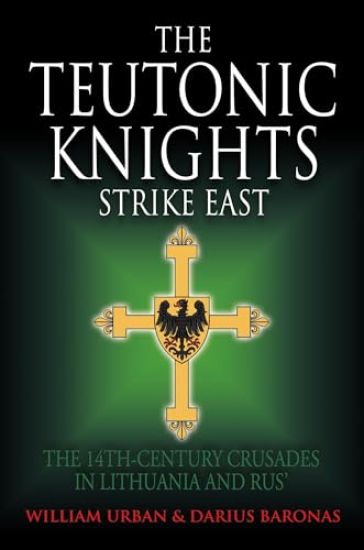
The Teutonic Knights Strike East

The Teutonic Knights Strike East

William Urban; Darius Baronas

GREENHILL BOOKS
2024
sidottu
The history of the Teutonic Knights is one of crusading in an era of wars, intrigues, assassinations and betrayals. Originally established as a hospital order during the Third Crusade in the Holy Land in the late 12th century, the order evolved into a formidable military force dedicated to defending and expanding Christianity in the Baltic region. This book explores the crusade aimed at Lithuanian pagans in the Middle Ages, when crusaders from the Holy Roman Empire, France, England and Scotland came to Prussia to fight alongside the Teutonic Knights. What ensued was a long-drawn out, many-sided struggle, with Lithuania and Poland first becoming powerful states, then expanding into Belarus and Ukraine, where the Mongols and Tatars had long held sway. The book culminates with Lithuania converting to the Roman Catholic Church and the dramatic sieges of Vilnius. Written by two leading experts on the Crusades in an enjoyable and compelling style, this is an accessible narrative of a complex political and military history.

Matchlocks to Flintlocks

Matchlocks to Flintlocks

William Urban

PEN SWORD BOOKS LTD
2023
nidottu
In the early modern world three dominant cultures of war were shaped by a synergy of their internal and external interactions. One was Latin Christian western Europe. Another was Ottoman Islam. The third, no less vital for so often being overlooked, was eastcentral Europe: Poland/Lithuania, Livonia, Russia, the freebooting Cossacks, a volatile mix of variations on a general Christian theme. William Urbans fascinating narrative is an integrated account of early modern war at the sharp end: of campaigns and battles, soldiers and generals. Temporally it extends from the French invasion of Italy in 1494 to Austrias Balkan victories culminating in the 1718 Treaty of Peterwardein. Geographically it covers ground from the Low Countries to the depths of the Ukraine. That narrative in turn focuses Urbans major analytical points: the replacement of crowd armies by professionals, and the professionals integration into crown armies: government-supervised, bureaucratised institutions. The key to this process was the mercenary. Originally recruited because the obligations of feudal levies were too limited, mercenary forces evolved operationally into skilled users of an increasingly complex gunpowder technology in ever more complex tactical situations. By the end of the seventeenth century, soldiers were identifying with the states and the rulers they served.
The Last Years of the Teutonic Knights

The Last Years of the Teutonic Knights

William Urban

Greenhill Books
2018
sidottu
The Battle of Grunwald was one of the largest battles in Medieval Europe and was the most important in the histories of Poland and Lithuania. It was fought on 15 July 1410 during the Polish-Lithuania-Teutonic War between the alliance of the Kingdom of Poland (led by King Jagiello) and the Grand Duchy of Lithuania (led by Grand Duke Vytautas) against the German-Prussian Teutonic Knights (led by Grand Master Ulrich von Jungingen) and with the assistance of Sigismund, then King of Hungary and Croatia. The Teutonic Knights, a crusading military order, were defeated and most of their leaders were killed or taken prisoner. This defeat would mark the beginning of their decline and they would never again regain their former power. Following the battle, the balance of power shifted in Central and Eastern Europe and so came the rise of the Polish-Lithuanian union as the dominant political and military force. In this compelling account the action takes place in Lithuania, Poland, the Czech Republic, Hungary, Russia and Germany. There are bloody battles; fascinating characters; intrigue; betrayals; sex; unexpected twists of fate; religious heresy and a smattering of saints. There is also the monumental end of one era making way for the beginning of another. Written by William L Urban, an internationally respected authority on the history of European warfare, while there has long been interest on the crusades outside of the Holy Land, this book is unique in the sheer breadth and depth of its research.
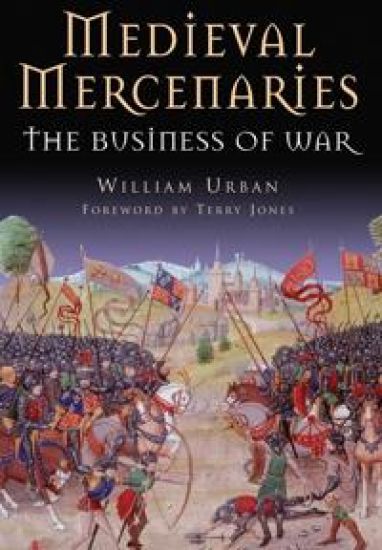
Medieval Mercenaries

Medieval Mercenaries

William Urban

Frontline Books
2016
nidottu
The Middle Ages were a turbulent and violent time, when the fate of nations was most often decided on the battlefield, and strength of arms was key to acquiring and maintaining power. Feudal oaths and local militias were more often than not incapable of providing the skilled and disciplined warriors necessary to keep the enemy at bay. It was the mercenary who stepped in to fill the ranks. A mercenary was a professional soldier who took employment with no concern for the morals or cause of the paymaster. But within these confines we discover a surprising array of men, from the lowest-born foot soldier to the wealthiest aristocrat the occasional clergyman, even. What united them all was a willingness, and often the desire, to fight for their supper. In this benchmark work, William Urban explores the vital importance of the mercenary to the medieval power-broker, from the Byzantine Varangian Guard to fifteenth-century soldiers of fortune in the Baltic. Through contemporary chronicles and the most up-to-date scholarship, he presents an in-depth portrait of the mercenary across the Middle Ages.