Kirjojen hintavertailu. Mukana 12 595 353 kirjaa ja 12 kauppaa.

Kirjailija

Willis W. Harman

Kirjat ja teokset yhdessä paikassa: 9 kirjaa, julkaisuja vuosilta 1984-2024, suosituimpien joukossa Paths To Peace. Vertaile teosten hintoja ja tarkista saatavuus suomalaisista kirjakaupoista.

Mukana myös kirjoitusasut: Willis W Harman

9 kirjaa

Kirjojen julkaisuhaarukka 1984-2024.

Strategies For Conducting Technology Assessments

Strategies For Conducting Technology Assessments

Joe E. Armstrong; Willis W. Harman

TAYLOR FRANCIS LTD
2024
nidottu
Using reviews of special reports and personal interviews with team members of recent National Science Foundation-sponsored assessments, the authors have assembled an eight-step functional strategy for conducting technology assessments. The steps are set within a framework that embodies the three key elements of all assessments: technology descripti
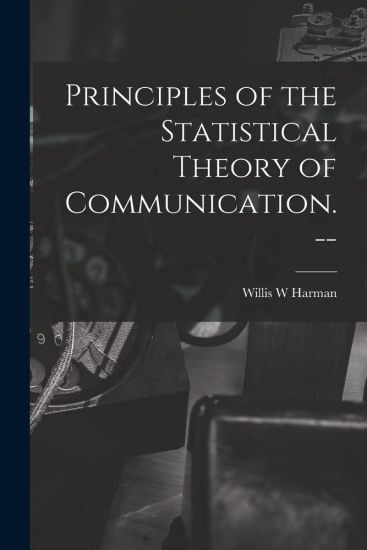
Principles of the Statistical Theory of Communication. --
This work has been selected by scholars as being culturally important and is part of the knowledge base of civilization as we know it.This work is in the public domain in the United States of America, and possibly other nations. Within the United States, you may freely copy and distribute this work, as no entity (individual or corporate) has a copyright on the body of the work.Scholars believe, and we concur, that this work is important enough to be preserved, reproduced, and made generally available to the public. To ensure a quality reading experience, this work has been proofread and republished using a format that seamlessly blends the original graphical elements with text in an easy-to-read typeface.We appreciate your support of the preservation process, and thank you for being an important part of keeping this knowledge alive and relevant.
Fundamentals of Electronic Motion

Fundamentals of Electronic Motion

Willis W. Harman

Hassell Street Press
2021
sidottu
This work has been selected by scholars as being culturally important and is part of the knowledge base of civilization as we know it.This work is in the public domain in the United States of America, and possibly other nations. Within the United States, you may freely copy and distribute this work, as no entity (individual or corporate) has a copyright on the body of the work.Scholars believe, and we concur, that this work is important enough to be preserved, reproduced, and made generally available to the public. To ensure a quality reading experience, this work has been proofread and republished using a format that seamlessly blends the original graphical elements with text in an easy-to-read typeface.We appreciate your support of the preservation process, and thank you for being an important part of keeping this knowledge alive and relevant.
Principles of the Statistical Theory of Communication. --
This work has been selected by scholars as being culturally important and is part of the knowledge base of civilization as we know it.This work is in the public domain in the United States of America, and possibly other nations. Within the United States, you may freely copy and distribute this work, as no entity (individual or corporate) has a copyright on the body of the work.Scholars believe, and we concur, that this work is important enough to be preserved, reproduced, and made generally available to the public. To ensure a quality reading experience, this work has been proofread and republished using a format that seamlessly blends the original graphical elements with text in an easy-to-read typeface.We appreciate your support of the preservation process, and thank you for being an important part of keeping this knowledge alive and relevant.
Paths To Peace

Paths To Peace

Richard Smoke; Willis W Harman

Routledge
2020
nidottu
A primer on thinking about peace in a nuclear age, this book describes the kinds of peace efforts that have been tried–and those that might be tried–from the highest echelons of government policymaking to the grassroots level of individual endeavour. Its primary goal is to enable the reader to understand ways of eliminating the threat of nuclear war and to be empowered to take action. The book describes and compares nine basic methods people have used to achieve peace, ranging from such conventional approaches as the theories of deterrence and balance of power to more unconventional strategies such as nonviolent resistance. Essentially all significant ideas for achieving and maintaining international peace fall into one of these nine categories or combine features from several. Many have been tried, but all clearly have been found wanting. Yet the authors' tone is one of optimism as they explore some of the major changes of the past quarter century. They contend that these changes alter the balance of advantages and disadvantages among the various paths to peace, so that what seemed partially workable in the past may not be appropriate to the present and what seemed totally impractical in the past might have a chance of working today. The book concludes with a scenario that may make a stable peace possible in the foreseeable future.
Strategies For Conducting Technology Assessments

Strategies For Conducting Technology Assessments

Joe E. Armstrong; Willis W. Harman

Routledge
2020
sidottu
Using reviews of special reports and personal interviews with team members of recent National Science Foundation-sponsored assessments, the authors have assembled an eight-step functional strategy for conducting technology assessments. The steps are set within a framework that embodies the three key elements of all assessments: technology descripti
Paths To Peace

Paths To Peace

Richard Smoke; Willis W Harman

Routledge
2019
sidottu
A primer on thinking about peace in a nuclear age, this book describes the kinds of peace efforts that have been tried–and those that might be tried–from the highest echelons of government policymaking to the grassroots level of individual endeavour. Its primary goal is to enable the reader to understand ways of eliminating the threat of nuclear war and to be empowered to take action. The book describes and compares nine basic methods people have used to achieve peace, ranging from such conventional approaches as the theories of deterrence and balance of power to more unconventional strategies such as nonviolent resistance. Essentially all significant ideas for achieving and maintaining international peace fall into one of these nine categories or combine features from several. Many have been tried, but all clearly have been found wanting. Yet the authors' tone is one of optimism as they explore some of the major changes of the past quarter century. They contend that these changes alter the balance of advantages and disadvantages among the various paths to peace, so that what seemed partially workable in the past may not be appropriate to the present and what seemed totally impractical in the past might have a chance of working today. The book concludes with a scenario that may make a stable peace possible in the foreseeable future.