Kirjojen hintavertailu. Mukana 12 595 353 kirjaa ja 12 kauppaa.

Kirjailija

Wim Schoutens

Kirjat ja teokset yhdessä paikassa: 10 kirjaa, julkaisuja vuosilta 2000-2022, suosituimpien joukossa Levy Processes in Credit Risk. Vertaile teosten hintoja ja tarkista saatavuus suomalaisista kirjakaupoista.

10 kirjaa

Kirjojen julkaisuhaarukka 2000-2022.

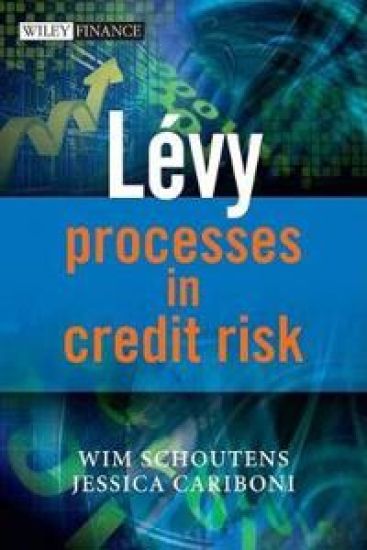
Levy Processes in Credit Risk

Levy Processes in Credit Risk

Wim Schoutens; Jessica Cariboni

John Wiley Sons Inc
2009
sidottu
This book is an introductory guide to using Lévy processes for credit risk modelling. It covers all types of credit derivatives: from the single name vanillas such as Credit Default Swaps (CDSs) right through to structured credit risk products such as Collateralized Debt Obligations (CDOs), Constant Proportion Portfolio Insurances (CPPIs) and Constant Proportion Debt Obligations (CPDOs) as well as new advanced rating models for Asset Backed Securities (ABSs). Jumps and extreme events are crucial stylized features, essential in the modelling of the very volatile credit markets - the recent turmoil in the credit markets has once again illustrated the need for more refined models. Readers will learn how the classical models (driven by Brownian motions and Black-Scholes settings) can be significantly improved by using the more flexible class of Lévy processes. By doing this, extreme event and jumps can be introduced into the models to give more reliable pricing and a better assessment of the risks. The book brings in high-tech financial engineering models for the detailed modelling of credit risk instruments, setting up the theoretical framework behind the application of Lévy Processes to Credit Risk Modelling before moving on to the practical implementation. Complex credit derivatives structures such as CDOs, ABSs, CPPIs, CPDOs are analysed and illustrated with market data.
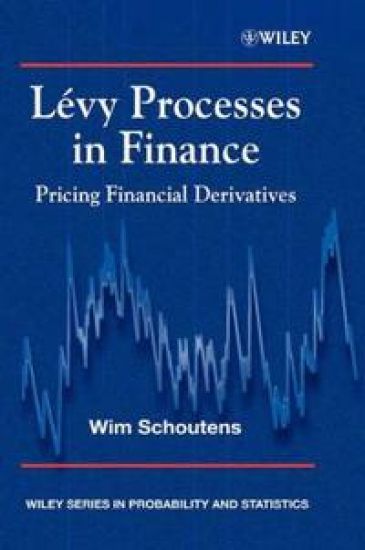
Lévy Processes in Finance

Lévy Processes in Finance

Wim Schoutens

John Wiley Sons Inc
2003
sidottu
Financial mathematics has recently enjoyed considerable interest on account of its impact on the finance industry. In parallel, the theory of Lévy processes has also seen many exciting developments. These powerful modelling tools allow the user to model more complex phenomena, and are commonly applied to problems in finance. Lévy Processes in Finance: Pricing Financial Derivatives takes a practical approach to describing the theory of Lévy-based models, and features many examples of how they may be used to solve problems in finance. *Provides an introduction to the use of Lévy processes in finance. *Features many examples using real market data, with emphasis on the pricing of financial derivatives. *Covers a number of key topics, including option pricing, Monte Carlo simulations, stochastic volatility, exotic options and interest rate modelling. *Includes many figures to illustrate the theory and examples discussed. *Avoids unnecessary mathematical formalities. The book is primarily aimed at researchers and postgraduate students of mathematical finance, economics and finance. The range of examples ensures the book will make a valuable reference source for practitioners from the finance industry including risk managers and financial product developers.
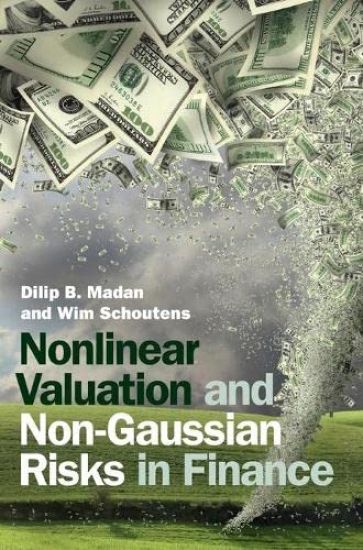
Nonlinear Valuation and Non-Gaussian Risks in Finance

Nonlinear Valuation and Non-Gaussian Risks in Finance

Dilip B. Madan; Wim Schoutens

Cambridge University Press
2022
sidottu
What happens to risk as the economic horizon goes to zero and risk is seen as an exposure to a change in state that may occur instantaneously at any time? All activities that have been undertaken statically at a fixed finite horizon can now be reconsidered dynamically at a zero time horizon, with arrival rates at the core of the modeling. This book, aimed at practitioners and researchers in financial risk, delivers the theoretical framework and various applications of the newly established dynamic conic finance theory. The result is a nonlinear non-Gaussian valuation framework for risk management in finance. Risk-free assets disappear and low risk portfolios must pay for their risk reduction with negative expected returns. Hedges may be constructed to enhance value by exploiting risk interactions. Dynamic trading mechanisms are synthesized by machine learning algorithms. Optimal exposures are designed for option positioning simultaneously across all strikes and maturities.
Financial Risk Management for Cryptocurrencies

Financial Risk Management for Cryptocurrencies

Eline Van der Auwera; Wim Schoutens; Marco Petracco Giudici; Lucia Alessi

Springer Nature Switzerland AG
2020
nidottu
This book explores the emerging field of risk management and risk analysis of cryptocurrencies, an area that has been generating considerable research. It begins by providing an introduction to digital finance and the concept of cryptocurrencies and blockchain technologies. It then describes in detail the intrinsic risks involved in cryptocurrencies, an area that, to date, has not been fully documented or investigated. Lastly, it discusses the various types of risk, with a focus on design, operational, market and quantitative risks.Providing insights into the analysis and management of cryptocurrencies, and serving as a starting point for a more in-depth risk analysis, this book will appeal to professionals and researchers interested in familiarizing themselves with the risks in cryptocurrencies, including academics, portfolio managers, risk-managers, quants, financial professionals, regulators, economists, asset managers and traders.
The Risk Management of Contingent Convertible (CoCo) Bonds

The Risk Management of Contingent Convertible (CoCo) Bonds

Jan De Spiegeleer; Ine Marquet; Wim Schoutens

Springer Nature Switzerland AG
2018
nidottu
This book provides an overview of the risk components of CoCo bonds. CoCos are hybrid financial instruments that convert into equity or suffer a write-down of the face value upon the appearance of a trigger event. The loss-absorption mechanism is automatically enforced either via the breaching of a particular accounting ratio, typically in terms of the Common Equity Tier 1 (CET1) ratio, or via a regulatory trigger. CoCos are non-standardised instruments with different loss-absorption and trigger mechanisms. They might also contain additional features such as the cancellation of coupon payments. Different pricing models are discussed in detail. These models use market data such as share prices, CDS levels and implied volatility in order to calculate the theoretical price of a CoCo bond and its sensitivities, providing the investor with insides to hedge from adverse changes in the market conditions. The audience are professionals as well as academics who want to learn how to risk manage CoCo bonds using cutting edge techniques as well as all the risk involved in CoCo bonds.
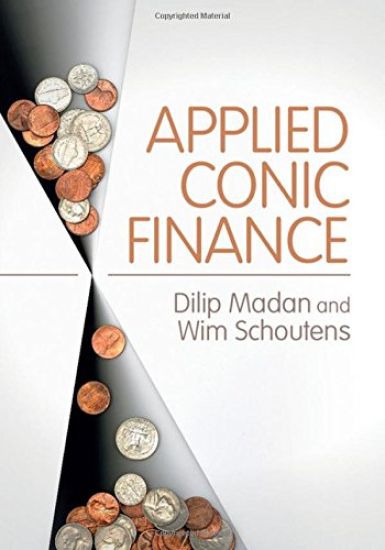
Applied Conic Finance

Applied Conic Finance

Dilip Madan; Wim Schoutens

Cambridge University Press
2016
sidottu
This is a comprehensive introduction to the brand new theory of conic finance, also referred to as the two-price theory, which determines bid and ask prices in a consistent and fundamentally motivated manner. Whilst theories of one price classically eliminate all risk, the concept of acceptable risks is critical to the foundations of the two-price theory which sees risk elimination as typically unattainable in a modern financial economy. Practical examples and case studies provide the reader with a comprehensive introduction to the fundamentals of the theory, a variety of advanced quantitative models, and numerous real-world applications, including portfolio theory, option positioning, hedging, and trading contexts. This book offers a quantitative and practical approach for readers familiar with the basics of mathematical finance to allow them to boldly go where no quant has gone before.
The Handbook of Hybrid Securities

The Handbook of Hybrid Securities

Jan De Spiegeleer; Wim Schoutens; Cynthia Van Hulle

John Wiley Sons Inc
2014
sidottu
Introducing a revolutionary new quantitative approach to hybrid securities valuation and risk management To an equity trader they are shares. For the trader at the fixed income desk, they are bonds (after all, they pay coupons, so what's the problem?). They are hybrid securities. Neither equity nor debt, they possess characteristics of both, and carry unique risks that cannot be ignored, but are often woefully misunderstood. The first and only book of its kind, The Handbook of Hybrid Securities dispels the many myths and misconceptions about hybrid securities and arms you with a quantitative, practical approach to dealing with them from a valuation and risk management point of view. Describes a unique, quantitative approach to hybrid valuation and risk management that uses new structural and multi-factor modelsProvides strategies for the full range of hybrid asset classes, including convertible bonds, preferreds, trust preferreds, contingent convertibles, bonds labeled "additional Tier 1," and moreOffers an expert review of current regulatory climate regarding hybrids, globally, and explores likely political developments and their potential impact on the hybrid marketThe most up-to-date, in-depth book on the subject, this is a valuable working resource for traders, analysts and risk managers, and a indispensable reference for regulators
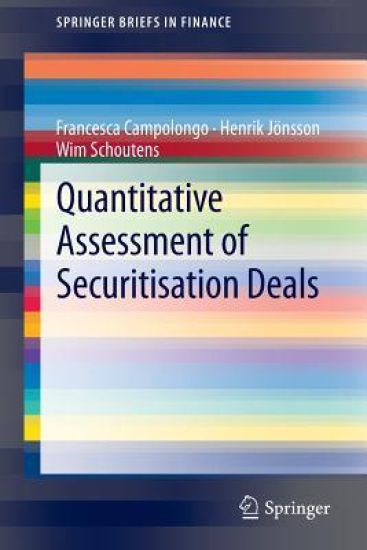
Quantitative Assessment of Securitisation Deals

Quantitative Assessment of Securitisation Deals

Francesca Campolongo; Henrik Jönsson; Wim Schoutens

Springer-Verlag Berlin and Heidelberg GmbH Co. K
2012
nidottu
The book draws on current research on model risk and parameter sensitivity of securitisation ratings. It provides practical ideas and tools that can facilitate a more informed usage of securitisation ratings. We show how global sensitivity analysis techniques can be used to better analyse and to enhance the understanding of the uncertainties inherent in ratings due to uncertainty in the input parameters. The text introduces a novel global rating approach that takes the uncertainty in the ratings into account when assigning ratings to securitisation products. The book also covers new prepayment and default models that overcome flaws in current models.?
Exotic Option Pricing and Advanced Lévy Models

Exotic Option Pricing and Advanced Lévy Models

Andreas Kyprianou; Wim Schoutens; Paul Wilmott

John Wiley Sons Inc
2005
sidottu
Since around the turn of the millennium there has been a general acceptance that one of the more practical improvements one may make in the light of the shortfalls of the classical Black-Scholes model is to replace the underlying source of randomness, a Brownian motion, by a Lévy process. Working with Lévy processes allows one to capture desirable distributional characteristics in the stock returns. In addition, recent work on Lévy processes has led to the understanding of many probabilistic and analytical properties, which make the processes attractive as mathematical tools. At the same time, exotic derivatives are gaining increasing importance as financial instruments and are traded nowadays in large quantities in OTC markets. The current volume is a compendium of chapters, each of which consists of discursive review and recent research on the topic of exotic option pricing and advanced Lévy markets, written by leading scientists in this field. In recent years, Lévy processes have leapt to the fore as a tractable mechanism for modeling asset returns. Exotic option values are especially sensitive to an accurate portrayal of these dynamics. This comprehensive volume provides a valuable service for financial researchers everywhere by assembling key contributions from the world's leading researchers in the field. Peter Carr, Head of Quantitative Finance, Bloomberg LP. This book provides a front-row seat to the hottest new field in modern finance: options pricing in turbulent markets. The old models have failed, as many a professional investor can sadly attest. So many of the brightest minds in mathematical finance across the globe are now in search of new, more accurate models. Here, in one volume, is a comprehensive selection of this cutting-edge research. Richard L. Hudson, former Managing Editor of The Wall Street Journal Europe, and co-author with Benoit B. Mandelbrot of The (Mis)Behaviour of Markets: A Fractal View of Risk, Ruin and Reward
Stochastic Processes and Orthogonal Polynomials

Stochastic Processes and Orthogonal Polynomials

Wim Schoutens

Springer-Verlag New York Inc.
2000
nidottu
It has been known for a long time that there is a close connection between stochastic processes and orthogonal polynomials. For example, N. Wiener [112] and K. Ito [56] knew that Hermite polynomials play an important role in the integration theory with respect to Brownian motion. In the 1950s D. G. Kendall [66], W. Ledermann and G. E. H. Reuter [67] [74], and S. Kar- lin and J. L. McGregor [59] established another important connection. They expressed the transition probabilities of a birth and death process by means of a spectral representation, the so-called Karlin-McGregor representation, in terms of orthogonal polynomials. In the following years these relation- ships were developed further. Many birth and death models were related to specific orthogonal polynomials. H. Ogura [87], in 1972, and D. D. En- gel [45], in 1982, found an integral relation between the Poisson process and the Charlier polynomials. Some people clearly felt the potential im- portance of orthogonal polynomials in probability theory. For example, P. Diaconis and S. Zabell [29] related Stein equations for some well-known distributions, including Pearson's class, with the corresponding orthogonal polynomials. The most important orthogonal polynomials are brought together in the so-called Askey scheme of orthogonal polynomials. This scheme classifies the hypergeometric orthogonal polynomials that satisfy some type of differ- ential or difference equation and stresses the limit relations between them.