Kirjojen hintavertailu. Mukana 12 300 526 kirjaa ja 12 kauppaa.

Kirjailija

Winfried Bruns

Kirjat ja teokset yhdessä paikassa: 6 kirjaa, julkaisuja vuosilta 1988-2023, suosituimpien joukossa Cohen-Macaulay Rings. Vertaile teosten hintoja ja tarkista saatavuus suomalaisista kirjakaupoista.

6 kirjaa

Kirjojen julkaisuhaarukka 1988-2023.

Cohen-Macaulay Rings

Cohen-Macaulay Rings

Winfried Bruns; H. Jürgen Herzog

Cambridge University Press
1998
pokkari
In the last two decades Cohen-Macaulay rings and modules have been central topics in commutative algebra. This book meets the need for a thorough, self-contained introduction to the homological and combinatorial aspects of the theory of Cohen-Macaulay rings, Gorenstein rings, local cohomology, and canonical modules. A separate chapter is devoted to Hilbert functions (including Macaulay’s theorem) and numerical invariants derived from them. The authors emphasize the study of explicit, specific rings, making the presentation as concrete as possible. So the general theory is applied to Stanley-Reisner rings, semigroup rings, determinantal rings, and rings of invariants. Their connections with combinatorics are highlighted, e.g. Stanley’s upper bound theorem or Ehrhart’s reciprocity law for rational polytopes. The final chapters are devoted to Hochster's theorem on big Cohen-Macaulay modules and its applications, including Peskine-Szpiro’s intersection theorem, the Evans-Griffith syzygy theorem, bounds for Bass numbers, and tight closure. Throughout each chapter the authors have supplied many examples and exercises which, combined with the expository style, will make the book very useful for graduate courses in algebra. As the only modern, broad account of the subject it will be essential reading for researchers in commutative algebra.
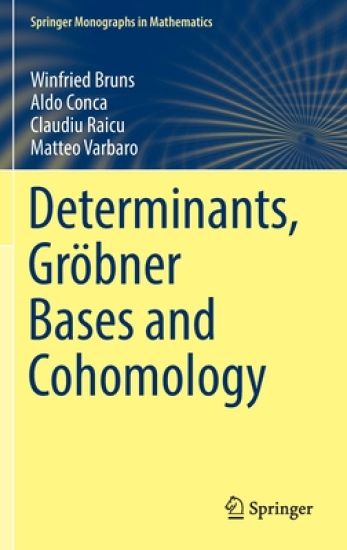
Determinants, Gröbner Bases and Cohomology

Determinants, Gröbner Bases and Cohomology

Winfried Bruns; Aldo Conca; Claudiu Raicu; Matteo Varbaro

Springer International Publishing AG
2023
nidottu
This book offers an up-to-date, comprehensive account of determinantal rings and varieties, presenting a multitude of methods used in their study, with tools from combinatorics, algebra, representation theory and geometry.After a concise introduction to Gröbner and Sagbi bases, determinantal ideals are studied via the standard monomial theory and the straightening law. This opens the door for representation theoretic methods, such as the Robinson–Schensted–Knuth correspondence, which provide a description of the Gröbner bases of determinantal ideals, yielding homological and enumerative theorems on determinantal rings. Sagbi bases then lead to the introduction of toric methods. In positive characteristic, the Frobenius functor is used to study properties of singularities, such as F-regularity and F-rationality. Castelnuovo–Mumford regularity, an important complexity measure in commutative algebra and algebraic geometry, is introduced in the general setting of a Noetherian base ring and then applied to powers and products of ideals. The remainder of the book focuses on algebraic geometry, where general vanishing results for the cohomology of line bundles on flag varieties are presented and used to obtain asymptotic values of the regularity of symbolic powers of determinantal ideals. In characteristic zero, the Borel–Weil–Bott theorem provides sharper results for GL-invariant ideals. The book concludes with a computation of cohomology with support in determinantal ideals and a survey of their free resolutions.Determinants, Gröbner Bases and Cohomology provides a unique reference for the theory of determinantal ideals and varieties, as well as an introduction to the beautiful mathematics developed in their study. Accessible to graduate students with basic grounding in commutative algebra and algebraic geometry, it can be used alongside general texts to illustrate the theory with a particularly interestingand important class of varieties.
Determinants, Gröbner Bases and Cohomology

Determinants, Gröbner Bases and Cohomology

Winfried Bruns; Aldo Conca; Claudiu Raicu; Matteo Varbaro

Springer International Publishing AG
2022
sidottu
This book offers an up-to-date, comprehensive account of determinantal rings and varieties, presenting a multitude of methods used in their study, with tools from combinatorics, algebra, representation theory and geometry.After a concise introduction to Gröbner and Sagbi bases, determinantal ideals are studied via the standard monomial theory and the straightening law. This opens the door for representation theoretic methods, such as the Robinson–Schensted–Knuth correspondence, which provide a description of the Gröbner bases of determinantal ideals, yielding homological and enumerative theorems on determinantal rings. Sagbi bases then lead to the introduction of toric methods. In positive characteristic, the Frobenius functor is used to study properties of singularities, such as F-regularity and F-rationality. Castelnuovo–Mumford regularity, an important complexity measure in commutative algebra and algebraic geometry, is introduced in the general setting of a Noetherian base ring and then applied to powers and products of ideals. The remainder of the book focuses on algebraic geometry, where general vanishing results for the cohomology of line bundles on flag varieties are presented and used to obtain asymptotic values of the regularity of symbolic powers of determinantal ideals. In characteristic zero, the Borel–Weil–Bott theorem provides sharper results for GL-invariant ideals. The book concludes with a computation of cohomology with support in determinantal ideals and a survey of their free resolutions.Determinants, Gröbner Bases and Cohomology provides a unique reference for the theory of determinantal ideals and varieties, as well as an introduction to the beautiful mathematics developed in their study. Accessible to graduate students with basic grounding in commutative algebra and algebraic geometry, it can be used alongside general texts to illustrate the theory with a particularly interestingand important class of varieties.
Polytopes, Rings, and K-Theory

Polytopes, Rings, and K-Theory

Winfried Bruns; Joseph Gubeladze

Springer-Verlag New York Inc.
2010
nidottu
For every mathematician, ring theory and K-theory are intimately connected: al- braic K-theory is largely the K-theory of rings. At ?rst sight, polytopes, by their very nature, must appear alien to surveyors of this heartland of algebra. But in the presence of a discrete structure, polytopes de?ne a?ne monoids, and, in their turn, a?ne monoids give rise to monoid algebras. Teir spectra are the building blocks of toric varieties, an area that has developed rapidly in the last four decades. From a purely systematic viewpoint, "monoids" should therefore replace "po- topes" in the title of the book. However, such a change would conceal the geometric ?avor that we have tried to preserve through all chapters. Before delving into a description of the contents we would like to mention three general features of the book: (?) the exhibiting of interactions of convex geometry, ring theory, and K-theory is not the only goal; we present some of the central results in each of these ?elds; (?) the exposition is of constructive (i. e., algorithmic) nature at many places throughout the text-there is no doubt that one of the driving forces behind the current popularity of combinatorial geometry is the quest for visualization and computation; (? ) despite the large amount of information from various ?elds, we have strived to keep the polytopal perspective as the major organizational principle.
Polytopes, Rings, and K-Theory

Polytopes, Rings, and K-Theory

Winfried Bruns; Joseph Gubeladze

Springer-Verlag New York Inc.
2009
sidottu
For every mathematician, ring theory and K-theory are intimately connected: al- braic K-theory is largely the K-theory of rings. At ?rst sight, polytopes, by their very nature, must appear alien to surveyors of this heartland of algebra. But in the presence of a discrete structure, polytopes de?ne a?ne monoids, and, in their turn, a?ne monoids give rise to monoid algebras. Teir spectra are the building blocks of toric varieties, an area that has developed rapidly in the last four decades. From a purely systematic viewpoint, "monoids" should therefore replace "po- topes" in the title of the book. However, such a change would conceal the geometric ?avor that we have tried to preserve through all chapters. Before delving into a description of the contents we would like to mention three general features of the book: (?) the exhibiting of interactions of convex geometry, ring theory, and K-theory is not the only goal; we present some of the central results in each of these ?elds; (?) the exposition is of constructive (i. e., algorithmic) nature at many places throughout the text-there is no doubt that one of the driving forces behind the current popularity of combinatorial geometry is the quest for visualization and computation; (? ) despite the large amount of information from various ?elds, we have strived to keep the polytopal perspective as the major organizational principle.
Determinantal Rings

Determinantal Rings

Winfried Bruns; Udo Vetter

Springer-Verlag Berlin and Heidelberg GmbH Co. K
1988
nidottu
Determinantal rings and varieties have been a central topic of commutative algebra and algebraic geometry. Their study has attracted many prominent researchers and has motivated the creation of theories which may now be considered part of general commutative ring theory. The book gives a first coherent treatment of the structure of determinantal rings. The main approach is via the theory of algebras with straightening law. This approach suggest (and is simplified by) the simultaneous treatment of the Schubert subvarieties of Grassmannian. Other methods have not been neglected, however. Principal radical systems are discussed in detail, and one section is devoted to each of invariant and representation theory. While the book is primarily a research monograph, it serves also as a reference source and the reader requires only the basics of commutative algebra together with some supplementary material found in the appendix. The text may be useful for seminars following a course in commutative ring theory since a vast number of notions, results, and techniques can be illustrated significantly by applying them to determinantal rings.