Kirjojen hintavertailu. Mukana 12 657 676 kirjaa ja 12 kauppaa.

Kirjailija

Wolfgang Banzhaf

Kirjat ja teokset yhdessä paikassa: 4 kirjaa, julkaisuja vuosilta 1998-2024, suosituimpien joukossa Linear Genetic Programming. Vertaile teosten hintoja ja tarkista saatavuus suomalaisista kirjakaupoista.

4 kirjaa

Kirjojen julkaisuhaarukka 1998-2024.

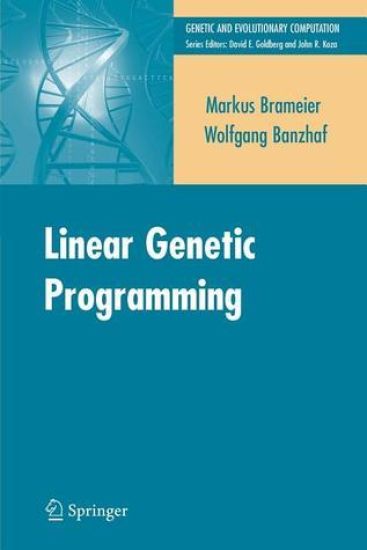
Linear Genetic Programming

Linear Genetic Programming

Markus F. Brameier; Wolfgang Banzhaf

Springer-Verlag New York Inc.
2010
nidottu
Linear Genetic Programming presents a variant of genetic programming (GP) that evolves imperative computer programs as linear sequences of instructions, in contrast to the more traditional functional expressions or syntax trees. Primary characteristics of linear program structure are exploited to achieve acceleration of both execution time and evolutionary progress. Online analysis and optimization of program code lead to more efficient techniques and contribute to a better understanding of the method and its parameters. In particular, the reduction of structural variation step size and non-effective variations play a key role in finding higher quality and less complex solutions. Typical GP phenomena, such as non-effective code, neutral variations, and code growth are investigated from the perspective of linear GP. This book serves as a reference for researchers; it also contains sufficient introductory material for students and those who are new to the field.

Artificial Chemistries

Artificial Chemistries

Wolfgang Banzhaf; Lidia Yamamoto

MIT PRESS LTD
2024
pokkari
An introduction to the fundamental concepts of the emerging field of Artificial Chemistries, covering both theory and practical applications. The field of Artificial Life (ALife) is now firmly established in the scientific world, but it has yet to achieve one of its original goals: an understanding of the emergence of life on Earth. The new field of Artificial Chemistries draws from chemistry, biology, computer science, mathematics, and other disciplines to work toward that goal. For if, as it has been argued, life emerged from primitive, prebiotic forms of self-organization, then studying models of chemical reaction systems could bring ALife closer to understanding the origins of life. In Artificial Chemistries (ACs), the emphasis is on creating new interactions rather than new materials. The results can be found both in the virtual world, in certain multiagent systems, and in the physical world, in new (artificial) reaction systems. This book offers an introduction to the fundamental concepts of ACs, covering both theory and practical applications. After a general overview of the field and its methodology, the book reviews important aspects of biology, including basic mechanisms of evolution; discusses examples of ACs drawn from the literature; considers fundamental questions of how order can emerge, emphasizing the concept of chemical organization (a closed and self-maintaining set of chemicals); and surveys a range of applications, which include computing, systems modeling in biology, and synthetic life. An appendix provides a Python toolkit for implementing ACs.
Linear Genetic Programming

Linear Genetic Programming

Markus F. Brameier; Wolfgang Banzhaf

Springer-Verlag New York Inc.
2006
sidottu
Linear Genetic Programming presents a variant of genetic programming (GP) that evolves imperative computer programs as linear sequences of instructions, in contrast to the more traditional functional expressions or syntax trees. Primary characteristics of linear program structure are exploited to achieve acceleration of both execution time and evolutionary progress. Online analysis and optimization of program code lead to more efficient techniques and contribute to a better understanding of the method and its parameters. In particular, the reduction of structural variation step size and non-effective variations play a key role in finding higher quality and less complex solutions. Typical GP phenomena, such as non-effective code, neutral variations, and code growth are investigated from the perspective of linear GP. This book serves as a reference for researchers; it also contains sufficient introductory material for students and those who are new to the field.
Genetic Programming

Genetic Programming

Wolfgang Banzhaf; Peter Nordin; Robert E. Keller; Frank D. Francone

Morgan Kaufmann Publishers In
1998
sidottu
Since the early 1990s, genetic programming (GP)—a discipline whose goal is to enable the automatic generation of computer programs—has emerged as one of the most promising paradigms for fast, productive software development. GP combines biological metaphors gleaned from Darwin's theory of evolution with computer-science approaches drawn from the field of machine learning to create programs that are capable of adapting or recreating themselves for open-ended tasks.This unique introduction to GP provides a detailed overview of the subject and its antecedents, with extensive references to the published and online literature. In addition to explaining the fundamental theory and important algorithms, the text includes practical discussions covering a wealth of potential applications and real-world implementation techniques. Software professionals needing to understand and apply GP concepts will find this book an invaluable practical and theoretical guide.