Kirjojen hintavertailu. Mukana 12 582 978 kirjaa ja 12 kauppaa.

Kirjailija

Wolfgang Mieder

Kirjat ja teokset yhdessä paikassa: 43 kirjaa, julkaisuja vuosilta 1977-2026, suosituimpien joukossa Proverbial Democracy. Vertaile teosten hintoja ja tarkista saatavuus suomalaisista kirjakaupoista.

43 kirjaa

Kirjojen julkaisuhaarukka 1977-2026.

Proverbial Democracy

Proverbial Democracy

Wolfgang Mieder

Peter Lang AG, Internationaler Verlag der Wissenschaften
2026
nidottu
In the Gettysburg Address of 1863, Abraham Lincoln famously declared that ‘government of the people, by the people, for the people, shall not perish from the earth’. Since then the phrase has become the proverbial definition of American democracy. In this book, internationally renowned folklorist Wolfgang Mieder explains why and how this happened. Drawing on a lifetime of studying political rhetoric, Mieder shows how the phrase drew on earlier formulations, and how it was rapidly adopted around the English-speaking world, including by leaders such as Theodore Roosevelt, Franklin D. Roosevelt, Winston Churchill, Harry Truman, John F. Kennedy, Ronald Reagan, and Barack Obama. The phrase echoes down the centuries, and continues to reverberate in the most recent political discourse and in the rhetoric of presidents in our own time. This historical survey of the democratic proverb is, above all, a passionate affirmation that ‘of the people, by the people, for the people’ has served the country well, in stating the fundamental premise of a democracy, and that it will continue to do so in turbulent times.

Worth a Thousand Words

Worth a Thousand Words

Wolfgang Mieder

UNIVERSITY PRESS OF MISSISSIPPI
2025
sidottu
In 2014, Wolfgang Mieder published Behold the Proverbs of a People: Proverbial Wisdom in Culture, Literature, and Politics with the University Press of Mississippi. The book created an informative entry into the world of proverb scholarship, illustrating that proverbs have always been and continue to be wisdom's international currency. Picking up where Behold the Proverbs of a People left off, this new book brings traditional proverbs into the modern era, analyzing proverbs under four headings: American proverbs, proverbs in politics, proverbs in literature, and proverbs in culture.Within these sections, a wide array of proverbs and the topics they express are addressed and shown to still be relevant to the political and cultural landscape of today. Worth a Thousand Words discusses the global spread of American proverbs and the reliance of proverbs in politics and everyday life in America and internationally. It also examines proverbs in literature such as Don Quixote and Destined to Witness, as well as proverbs in fairy tales. Proving the pen is mightier than the sword, Mieder’s book demonstrates the ubiquity of proverbs. By recognizing and documenting the proverbial linguistic patterns of our culture, people, and systems, Mieder shows us how creative language serves as the guideposts for a free and idealistic world for ages past and ages to come.
Worth a Thousand Words

Worth a Thousand Words

Wolfgang Mieder

UNIVERSITY PRESS OF MISSISSIPPI
2025
pokkari
In 2014, Wolfgang Mieder published Behold the Proverbs of a People: Proverbial Wisdom in Culture, Literature, and Politics with the University Press of Mississippi. The book created an informative entry into the world of proverb scholarship, illustrating that proverbs have always been and continue to be wisdom's international currency. Picking up where Behold the Proverbs of a People left off, this new book brings traditional proverbs into the modern era, analyzing proverbs under four headings: American proverbs, proverbs in politics, proverbs in literature, and proverbs in culture. Within these sections, a wide array of proverbs and the topics they express are addressed and shown to still be relevant to the political and cultural landscape of today. Worth a Thousand Words discusses the global spread of American proverbs and the reliance of proverbs in politics and everyday life in America and internationally. It also examines proverbs in literature such as Don Quixote and Destined to Witness, as well as proverbs in fairy tales. Proving the pen is mightier than the sword, Mieder’s book demonstrates the ubiquity of proverbs. By recognizing and documenting the proverbial linguistic patterns of our culture, people, and systems, Mieder shows us how creative language serves as the guideposts for a free and idealistic world for ages past and ages to come.
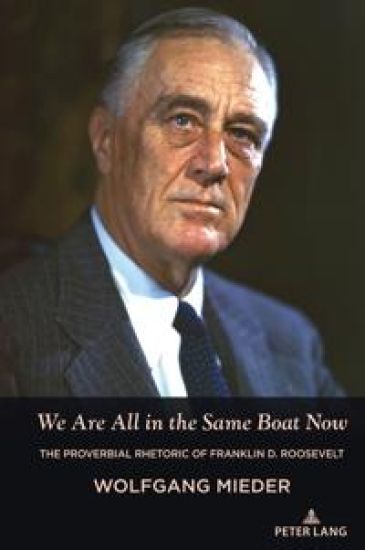
We Are All in the Same Boat Now

We Are All in the Same Boat Now

Wolfgang Mieder

Peter Lang AG, Internationaler Verlag der Wissenschaften
2024
sidottu
The book is based on Franklin Delano Roosevelt’s speeches, press conferences, proclamations, and letters. The eleven chapters of the first part address his interest in language, his visionary outlook in his four inaugural addresses, his "four freedoms" phrase, his use of proverbial language for world peace, his reliance on quotations, his tendency to coin sententious remarks, his dependence on Biblical proverbs, his use of folk proverbs, his employment of proverbial phrases, his reliance on animal metaphors, and his use of maritime expressions. The second part provides a comprehensive index of the numerous passages that include proverbial references. The study demonstrates that Roosevelt was a skilled communicator, persuader, and, at times, manipulator. His effective use of proverbial language added significant figurative expressiveness to his communications. The phrase "We are all in the same boat now" aptly captures his worldview in dealing with the depression, the war, and his hope for peace.
A Rising Tide Lifts All the Boats

A Rising Tide Lifts All the Boats

Wolfgang Mieder

PETER LANG PUBLISHING INC
2023
sidottu
The book is based on eight thousand pages of former President John F. Kennedy’s printed communications, including his books, innumerable speeches, addresses, press conferences, debates, and letters. The first part is dedicated to detailed interpretations of the use, function, and meaning of the many proverbs, proverbial expressions, sententious remarks, and other formulaic language. Themes include: Kennedy’s concern for appropriate language and elevated style; his visionary inaugural address, which was based to a large degree on formulaic language; his frequent employment of wisdom from the Old and New Testaments; his use of folk proverbs in the call for justice, freedom, and peace; his interest in animal metaphors to reflect human behavior; and his maritime expressions as indicators of life’s ebb and flow. The second part of the book provides a comprehensive index of the many passages that include sententious and proverbial references, listed in their verbal contexts. Overall this study shows that John F. Kennedy was indeed a highly gifted communicator on the national and international stage, whose effective political discourse was informed to a considerable degree by proverbial language. The title proverb of this book – "A rising tide lifts all the boats" – was one of his favorites, and might well serve as a fitting symbol of his uplifting optimism in his struggle for freedom and peace throughout the world.
Anti-Proverbs in Five Languages

Anti-Proverbs in Five Languages

Anna T. Litovkina; Hrisztalina Hrisztova-Gotthardt; Péter Barta; Katalin Vargha; Wolfgang Mieder

Springer Nature Switzerland AG
2023
nidottu
This book is the first comparative study of English, German, French, Russian and Hungarian anti-proverbs based on well-known proverbs. Proverbs are by no means fossilized texts but are adaptable to different times and changed values. While anti-proverbs can be considered as variants of older proverbs, they can also become new proverbs reflecting a more modern worldview. Anti-proverbs are therefore a lingo-cultural phenomenon that deserves the attention of cultural and literary historians, folklorists, linguists, and general readers interested in language and wordplay.
Anti-Proverbs in Five Languages

Anti-Proverbs in Five Languages

Anna T. Litovkina; Hrisztalina Hrisztova-Gotthardt; Péter Barta; Katalin Vargha; Wolfgang Mieder

Springer Nature Switzerland AG
2022
sidottu
This book is the first comparative study of English, German, French, Russian and Hungarian anti-proverbs based on well-known proverbs. Proverbs are by no means fossilized texts but are adaptable to different times and changed values. While anti-proverbs can be considered as variants of older proverbs, they can also become new proverbs reflecting a more modern worldview. Anti-proverbs are therefore a lingo-cultural phenomenon that deserves the attention of cultural and literary historians, folklorists, linguists, and general readers interested in language and wordplay.
Dictionary of Authentic American Proverbs

Dictionary of Authentic American Proverbs

Wolfgang Mieder

Berghahn Books
2021
sidottu
Dictionary of Authentic American Proverbs offers a comprehensive reference guide for distinctly American proverbs. Compiled by Wolfgang Mieder, a key figure in the field of proverb studies, this compendium features nearly 1,500 proverbs with American origins, spanning the 17th century to present day, including a scholarly introduction exploring the history of proverbs in America, the structure and variants of these proverbs, known authors and sources, and cultural values expressed in these proverbs. Along with a comprehensive bibliography of proverb collections and interpretive scholarship, this dictionary offers a glimpse into the history of American social and cultural attitudes through uniquely American language.
The Worldview of Modern American Proverbs

The Worldview of Modern American Proverbs

Wolfgang Mieder

Peter Lang Publishing Inc
2020
sidottu
There was a time when the word "modern" would not have appeared in folklore scholarship in general and in proverb studies in particular. After all, folklorists and cultural historians were primarily interested in traditional materials with some consideration also being given to their innovative adaptations. While this interplay of tradition and innovation informed many studies that exemplified a certain constancy in change, little attention was paid to new or modern folklore items. But there has been a revolutionary change during the past few decades in that scholars have looked at the creation of new folklore. This change of emphasis has also influenced paremiographers (proverb collectors) and paremiologists (proverb scholars). In fact, the Dictionary of Modern Proverbs (2012) edited by Charles Clay Doyle, Wolfgang Mieder, and Fred R. Shapiro has become solid proof that there is such a phenomenon as modern proverbs. This is the first study of authentic modern American proverbs without including proverbs of British origin. The first of nine chapters discusses the origin, nature, and meaning of modern American proverbs based on about 1500 texts. The next large chapter contains a general overview of their forward-looking message that includes the American spirit of mobility with its emphasis toward a successful and exciting future. The third chapter treats proverbial emotions about modern life, with the fourth chapter considering the modern wisdom about age and aging. The next two chapters cover somatic aspects of these proverbs and also the preoccupation with time. This is followed by a discussion about pecuniary proverbs that reflect the attitudes of a capitalistic society. The next chapter shows that modern proverbs continue to include references to animals as has been the case with older proverbs. Finally, there is the ninth chapter about sexuality and scatology in modern proverbs, indicating that these topics play a considerable role in this modern wisdom. Such proverbs were often excluded form proverb collections. With the much greater openness about love, sex, and various taboos, proverbs have become much more open literally or figuratively about these matters that are an obsession of sorts throughout the society. Altogether these nine chapters with their many modern American proverbs present a fascinating metaphorical picture of a general of composite American worldview.
"Right Makes Might"

"Right Makes Might"

Wolfgang Mieder

Indiana University Press
2019
sidottu
In 1860 Abraham Lincoln employed the proverb, Right makes might, (opposite of the more aggressive Might makes right) in his famed Cooper Union address. While Lincoln did not originate the proverb, his use of it in this critical speech indicates that the 14th century phrase had taken on new ethical and democratic connotations in the 19th century. In this collection, famed scholar of proverbs Wolfgang Mieder explores the multifaceted use and function of proverbs through the history of the United States, from their early beginnings up through their use by today's well-known politicians, including Barack Obama, Hillary Rodham Clinton, and Bernie Sanders. Building on previous publications and unpublished research, Mieder explores sociopolitical aspects of the American worldview as expressed through the use of proverbs in politics, women's rights, and the civil rights movement. By looking at the use of proverbial phrases, Mieder demonstrates how one traditional phrase can take on numerous expressive roles over time and how they continue to play a key role in our contemporary moment.
"Right Makes Might"

"Right Makes Might"

Wolfgang Mieder

Indiana University Press
2019
pokkari
In 1860 Abraham Lincoln employed the proverb, Right makes might, (opposite of the more aggressive Might makes right) in his famed Cooper Union address. While Lincoln did not originate the proverb, his use of it in this critical speech indicates that the 14th century phrase had taken on new ethical and democratic connotations in the 19th century. In this collection, famed scholar of proverbs Wolfgang Mieder explores the multifaceted use and function of proverbs through the history of the United States, from their early beginnings up through their use by today's well-known politicians, including Barack Obama, Hillary Rodham Clinton, and Bernie Sanders. Building on previous publications and unpublished research, Mieder explores sociopolitical aspects of the American worldview as expressed through the use of proverbs in politics, women's rights, and the civil rights movement. By looking at the use of proverbial phrases, Mieder demonstrates how one traditional phrase can take on numerous expressive roles over time and how they continue to play a key role in our contemporary moment.
Behold the Proverbs of a People

Behold the Proverbs of a People

Wolfgang Mieder

University Press of Mississippi
2017
nidottu
The thirteen chapters of this book comprise an intriguing and informative entry into the world of proverb scholarship, illustrating that proverbs have always been and continue to be wisdom’s international currency. The first section of the book focuses on the field of paremiology (proverb studies) in general, the spread of Anglo-American proverbs in Europe, and the phenomenon of modern proverbs. The second section analyzes the use of proverbs in the world of politics, including a chapter on President Obama, while the third concentrates on the uses of proverbs in literature. The final section ends with detailed cultural studies of the origin, history, dissemination, use, function, and meaning of specific proverbs.Noted scholar Wolfgang Mieder shows that proverbs matter in culture, literature, and politics. Proverbs remain part and parcel of oral and written communication, and, he demonstrates, they deserve to be studied from a range of viewpoints. While various chapters deal with a variety of issues and approaches, they cohere through a rhetorical perspective that looks at the text, texture, and context of proverbs as speech acts that make a noteworthy impact on culture and society. Whether proverbs appear in everyday speech, on the radio, on television, in films, on the pages of newspapers or magazines, in advertisements, in literary works, or in political speeches, they serve as formulaic verbal devices to add authoritative weight through tradition, convention, and wisdom.
Tradition and Innovation in Folk Literature
In this book, first published in 1987, Wolfgang Mieder follows the intriguing trail of some of the best known pieces of folk literature, tracing them from their roots to modern uses in advertising, journalism, politics, cartoons, and poetry. He reveals both the remarkable adaptability of these tales and how each variation reflects cultural and historical changes. Fairy tales, legends, folk songs, riddles, nursery rhymes, and proverbs are passed from generation to generation, changing both in form and meaning with each use. This book will be of interest to students of literature.
Wise Words (RLE Folklore)

Wise Words (RLE Folklore)

Wolfgang Mieder

Routledge
2016
nidottu
This book is the first volume in the Garland Folklore Casebook series. It contains 20 essays on various aspects of proverb studies. These 20 essays touch upon the major concerns of paremiology, and they are representative results of the trends and themes of modem proverb scholarship.
Tradition and Innovation in Folk Literature
In this book, first published in 1987, Wolfgang Mieder follows the intriguing trail of some of the best known pieces of folk literature, tracing them from their roots to modern uses in advertising, journalism, politics, cartoons, and poetry. He reveals both the remarkable adaptability of these tales and how each variation reflects cultural and historical changes. Fairy tales, legends, folk songs, riddles, nursery rhymes, and proverbs are passed from generation to generation, changing both in form and meaning with each use. This book will be of interest to students of literature.
Wise Words Pbdirect

Wise Words Pbdirect

Wolfgang Mieder

Routledge
2015
sidottu
The twenty essays that comprise this book, which was first published in 1994, were written by leading paremiologists and folklorists from Africa, Canada, Great Britain, Germany and the US. They represent the best scholarship on proverbs in the English language, and together they give an impressive overview of the fascinating advances in the field of paremiology.
Behold the Proverbs of a People

Behold the Proverbs of a People

Wolfgang Mieder

University Press of Mississippi
2014
sidottu
The thirteen chapters of this book comprise an intriguing and informative entry into the world of proverb scholarship, illustrating that proverbs have always been and continue to be wisdom's international currency. The first section of the book focuses on the field of paremiology (proverb studies) in general, the spread of Anglo-American proverbs in Europe, and the phenomenon of modern proverbs. The second section analyzes the use of proverbs in the world of politics, including a chapter on President Obama, while the third concentrates on the uses of proverbs in literature. The final section ends with detailed cultural studies of the origin, history, dissemination, use, function, and meaning of specific proverbs.Noted scholar Wolfgang Mieder shows that proverbs matter in culture, literature, and politics. Proverbs remain part and parcel of oral and written communication, and, he demonstrates, they deserve to be studied from a range of viewpoints. While various chapters deal with a variety of issues and approaches, they cohere through a rhetorical perspective that looks at the text, texture, and context of proverbs as speech acts that make a noteworthy impact on culture and society. Whether proverbs appear in everyday speech, on the radio, on television, in films, on the pages of newspapers or magazines, in advertisements, in literary works, or in political speeches, they serve as formulaic verbal devices to add authoritative weight through tradition, convention, and wisdom.