Kirjojen hintavertailu. Mukana 12 390 323 kirjaa ja 12 kauppaa.

Kirjailija

Wolfgang Minker

Kirjat ja teokset yhdessä paikassa: 31 kirjaa, julkaisuja vuosilta 1999-2014, suosituimpien joukossa Incorporating Knowledge Sources into Statistical Speech Recognition. Vertaile teosten hintoja ja tarkista saatavuus suomalaisista kirjakaupoista.

31 kirjaa

Kirjojen julkaisuhaarukka 1999-2014.

Introducing Spoken Dialogue Systems into Intelligent Environments

Introducing Spoken Dialogue Systems into Intelligent Environments

Tobias Heinroth; Wolfgang Minker

Springer-Verlag New York Inc.
2014
nidottu
Introducing Spoken Dialogue Systems into Intelligent Environments outlines the formalisms of a novel knowledge-driven framework for spoken dialogue management and presents the implementation of a model-based Adaptive Spoken Dialogue Manager(ASDM) called OwlSpeak. The authors have identified three stakeholders that potentially influence the behavior of the ASDM: the user, the SDS, and a complex Intelligent Environment (IE) consisting of various devices, services, and task descriptions. The theoretical foundation of a working ontology-based spoken dialogue description framework, the prototype implementation of the ASDM, and the evaluation activities that are presented as part of this book contribute to the ongoing spoken dialogue research by establishing the fertile ground of model-based adaptive spoken dialogue management. This monograph is ideal for advanced undergraduate students, PhD students, and postdocs as well as academic and industrial researchers and developers in speech and multimodal interactive systems.

Handling Emotions in Human-Computer Dialogues

Handling Emotions in Human-Computer Dialogues

Johannes Pittermann; Angela Pittermann; Wolfgang Minker

Springer
2014
nidottu
In this book, a novel approach that combines speech-based emotion recognition with adaptive human-computer dialogue modeling is described. With the robust recognition of emotions from speech signals as their goal, the authors analyze the effectiveness of using a plain emotion recognizer, a speech-emotion recognizer combining speech and emotion recognition, and multiple speech-emotion recognizers at the same time. The semi-stochastic dialogue model employed relates user emotion management to the corresponding dialogue interaction history and allows the device to adapt itself to the context, including altering the stylistic realization of its speech. This comprehensive volume begins by introducing spoken language dialogue systems and providing an overview of human emotions, theories, categorization and emotional speech. It moves on to cover the adaptive semi-stochastic dialogue model and the basic concepts of speech-emotion recognition. Finally, the authors show how speech-emotion recognizers can be optimized, and how an adaptive dialogue manager can be implemented. The book, with its novel methods to perform robust speech-based emotion recognition at low complexity, will be of interest to a variety of readers involved in human-computer interaction.
Hierarchical Neural Network Structures for Phoneme Recognition

Hierarchical Neural Network Structures for Phoneme Recognition

Daniel Vasquez; Rainer Gruhn; Wolfgang Minker

Springer-Verlag Berlin and Heidelberg GmbH Co. K
2014
nidottu
In this book, hierarchical structures based on neural networks are investigated for automatic speech recognition. These structures are mainly evaluated within the phoneme recognition task under the Hybrid Hidden Markov Model/Artificial Neural Network (HMM/ANN) paradigm. The baseline hierarchical scheme consists of two levels each which is based on a Multilayered Perceptron (MLP). Additionally, the output of the first level is used as an input for the second level. This system can be substantially speeded up by removing the redundant information contained at the output of the first level.
Proactive Spoken Dialogue Interaction in Multi-Party Environments

Proactive Spoken Dialogue Interaction in Multi-Party Environments

Petra-Maria Strauss; Wolfgang Minker

Springer-Verlag New York Inc.
2014
nidottu
Proactive Spoken Dialogue Interaction in Multi-Party Environments describes spoken dialogue systems that act as independent dialogue partners in the conversation with and between users. The resulting novel characteristics such as proactiveness and multi-party capabilities pose new challenges on the dialogue management component of such a system and require the use and administration of an extensive dialogue history. In order to assist the proactive spoken dialogue systems development, a comprehensive data collection seems mandatory and may be performed in a Wizard-of-Oz environment. Such an environment builds also the appropriate basis for an extensive usability and acceptance evaluation. Proactive Spoken Dialogue Interaction in Multi-Party Environments is a useful reference for students and researchers in speech processing.
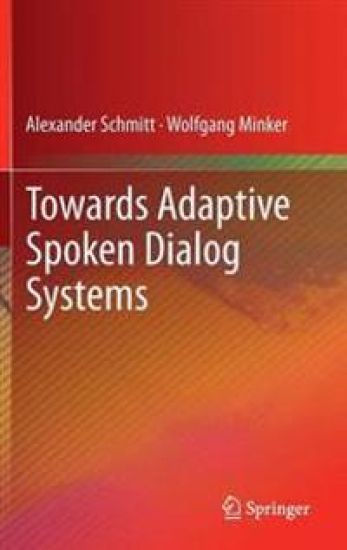
Towards Adaptive Spoken Dialog Systems

Towards Adaptive Spoken Dialog Systems

Alexander Schmitt; Wolfgang Minker

Springer-Verlag New York Inc.
2014
nidottu
In Monitoring Adaptive Spoken Dialog Systems, authors Alexander Schmitt and Wolfgang Minker investigate statistical approaches that allow for recognition of negative dialog patterns in Spoken Dialog Systems (SDS). The presented stochastic methods allow a flexible, portable and accurate use. Beginning with the foundations of machine learning and pattern recognition, this monograph examines how frequently users show negative emotions in spoken dialog systems and develop novel approaches to speech-based emotion recognition using hybrid approach to model emotions. The authors make use of statistical methods based on acoustic, linguistic and contextual features to examine the relationship between the interaction flow and the occurrence of emotions using non-acted recordings several thousand real users from commercial and non-commercial SDS.Additionally, the authors present novel statistical methods that spot problems within a dialog based on interaction patterns. The approaches enable future SDS to offer more natural and robust interactions. This work provides insights, lessons and inspiration for future research and development, not only for spoken dialog systems, but for data-driven approaches to human-machine interaction in general.
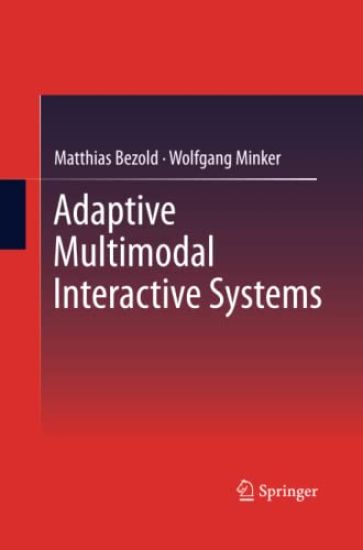
Adaptive Multimodal Interactive Systems

Adaptive Multimodal Interactive Systems

Matthias Bezold; Wolfgang Minker

Springer-Verlag New York Inc.
2014
nidottu
Adaptive Multimodal Interactive Systems introduces a general framework for adapting multimodal interactive systems and comprises a detailed discussion of each of the steps required for adaptation. This book also investigates how interactive systems may be improved in terms of usability and user friendliness while describing the exhaustive user tests employed to evaluate the presented approaches. After introducing general theory, a generic approach for user modeling in interactive systems is presented, ranging from an observation of basic events to a description of higher-level user behavior. Adaptations are presented as a set of patterns similar to those known from software or usability engineering.These patterns describe recurring problems and present proven solutions. The authors include a discussion on when and how to employ patterns and provide guidance to the system designer who wants to add adaptivity to interactive systems. In addition to these patterns, the book introduces an adaptation framework, which exhibits an abstraction layer using Semantic Web technology.Adaptations are implemented on top of this abstraction layer by creating a semantic representation of the adaptation patterns. The patterns cover both graphical interfaces as well as speech-based and multimodal interactive systems.
Domain-Level Reasoning for Spoken Dialogue Systems

Domain-Level Reasoning for Spoken Dialogue Systems

Dirk Bühler; Wolfgang Minker

Springer-Verlag New York Inc.
2014
nidottu
Reasoning for Information: Seeking and Planning Dialogues provides a logic-based reasoning component for spoken language dialogue systems. This component, called Problem Assistant is responsible for processing constraints on a possible solution obtained from various sources, namely user and the system's domain-specific information. The authors also present findings on the implementation of a dialogue management interface to the Problem Assistant. The dialogue system supports simple mixed-initiative planning interactions in the TRAINS domain, which is still a relatively complex domain involving a number of logical constraints and relations forming the basis for the collaborative problem-solving behavior that drives the dialogue.
Novel Techniques for Dialectal Arabic Speech Recognition

Novel Techniques for Dialectal Arabic Speech Recognition

Mohamed Elmahdy; Rainer Gruhn; Wolfgang Minker

Springer-Verlag New York Inc.
2014
nidottu
Novel Techniques for Dialectal Arabic Speech describes approaches to improve automatic speech recognition for dialectal Arabic. Since speech resources for dialectal Arabic speech recognition are very sparse, the authors describe how existing Modern Standard Arabic (MSA) speech data can be applied to dialectal Arabic speech recognition, while assuming that MSA is always a second language for all Arabic speakers. In this book, Egyptian Colloquial Arabic (ECA) has been chosen as a typical Arabic dialect. ECA is the first ranked Arabic dialect in terms of number of speakers, and a high quality ECA speech corpus with accurate phonetic transcription has been collected. MSA acoustic models were trained using news broadcast speech. In order to cross-lingually use MSA in dialectal Arabic speech recognition, the authors have normalized the phoneme sets for MSA and ECA. After this normalization, they have applied state-of-the-art acoustic model adaptation techniques like Maximum Likelihood Linear Regression (MLLR) and Maximum A-Posteriori (MAP) to adapt existing phonemic MSA acoustic models with a small amount of dialectal ECA speech data. Speech recognition results indicate a significant increase in recognition accuracy compared to a baseline model trained with only ECA data.
Self-Learning Speaker Identification

Self-Learning Speaker Identification

Tobias Herbig; Franz Gerl; Wolfgang Minker

Springer-Verlag Berlin and Heidelberg GmbH Co. K
2013
nidottu
Current speech recognition systems are based on speaker independent speech models and suffer from inter-speaker variations in speech signal characteristics. This work develops an integrated approach for speech and speaker recognition in order to gain space for self-learning opportunities of the system. This work introduces a reliable speaker identification which enables the speech recognizer to create robust speaker dependent models In addition, this book gives a new approach to solve the reverse problem, how to improve speech recognition if speakers can be recognized. The speaker identification enables the speaker adaptation to adapt to different speakers which results in an optimal long-term adaptation.
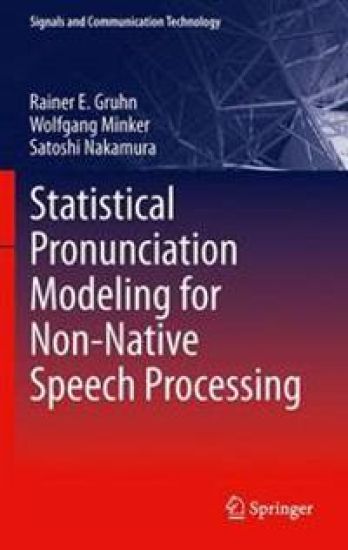
Statistical Pronunciation Modeling for Non-Native Speech Processing

Statistical Pronunciation Modeling for Non-Native Speech Processing

Rainer E. Gruhn; Wolfgang Minker; Satoshi Nakamura

Springer-Verlag Berlin and Heidelberg GmbH Co. K
2013
nidottu
In this work, the authors present a fully statistical approach to model non--native speakers' pronunciation. Second-language speakers pronounce words in multiple different ways compared to the native speakers. Those deviations, may it be phoneme substitutions, deletions or insertions, can be modelled automatically with the new method presented here.The methods is based on a discrete hidden Markov model as a word pronunciation model, initialized on a standard pronunciation dictionary. The implementation and functionality of the methodology has been proven and verified with a test set of non-native English in the regarding accent.The book is written for researchers with a professional interest in phonetics and automatic speech and speaker recognition.
Speech and Human-Machine Dialog

Speech and Human-Machine Dialog

Wolfgang Minker; Samir Bennacef

Springer-Verlag New York Inc.
2013
nidottu
Speech and Human-Machine Dialog focuses on the dialog management component of a spoken language dialog system. Spoken language dialog systems provide a natural interface between humans and computers. These systems are of special interest for interactive applications, and they integrate several technologies including speech recognition, natural language understanding, dialog management and speech synthesis. Due to the conjunction of several factors throughout the past few years, humans are significantly changing their behavior vis-à-vis machines. In particular, the use of speech technologies will become normal in the professional domain, and in everyday life. The performance of speech recognition components has also significantly improved. This book includes various examples that illustrate the different functionalities of the dialog model in a representative application for train travel information retrieval (train time tables, prices and ticket reservation). Speech and Human-Machine Dialog is designed for a professional audience, composed of researchers and practitioners in industry. This book is also suitable as a secondary text for graduate-level students in computer science and engineering.
Introducing Spoken Dialogue Systems into Intelligent Environments

Introducing Spoken Dialogue Systems into Intelligent Environments

Tobias Heinroth; Wolfgang Minker

Springer-Verlag New York Inc.
2012
sidottu
Introducing Spoken Dialogue Systems into Intelligent Environments outlines the formalisms of a novel knowledge-driven framework for spoken dialogue management and presents the implementation of a model-based Adaptive Spoken Dialogue Manager(ASDM) called OwlSpeak. The authors have identified three stakeholders that potentially influence the behavior of the ASDM: the user, the SDS, and a complex Intelligent Environment (IE) consisting of various devices, services, and task descriptions. The theoretical foundation of a working ontology-based spoken dialogue description framework, the prototype implementation of the ASDM, and the evaluation activities that are presented as part of this book contribute to the ongoing spoken dialogue research by establishing the fertile ground of model-based adaptive spoken dialogue management. This monograph is ideal for advanced undergraduate students, PhD students, and postdocs as well as academic and industrial researchers and developers in speech and multimodal interactive systems.
Hierarchical Neural Network Structures for Phoneme Recognition

Hierarchical Neural Network Structures for Phoneme Recognition

Daniel Vasquez; Rainer Gruhn; Wolfgang Minker

Springer-Verlag Berlin and Heidelberg GmbH Co. K
2012
sidottu
In this book, hierarchical structures based on neural networks are investigated for automatic speech recognition. These structures are mainly evaluated within the phoneme recognition task under the Hybrid Hidden Markov Model/Artificial Neural Network (HMM/ANN) paradigm. The baseline hierarchical scheme consists of two levels each which is based on a Multilayered Perceptron (MLP). Additionally, the output of the first level is used as an input for the second level. This system can be substantially speeded up by removing the redundant information contained at the output of the first level.
Stochastically-Based Semantic Analysis

Stochastically-Based Semantic Analysis

Wolfgang Minker; Alex Waibel; Joseph Mariani

Springer-Verlag New York Inc.
2012
nidottu
Stochastically-Based Semantic Analysis investigates the problem of automatic natural language understanding in a spoken language dialog system. The focus is on the design of a stochastic parser and its evaluation with respect to a conventional rule-based method. Stochastically-Based Semantic Analysis will be of most interest to researchers in artificial intelligence, especially those in natural language processing, computational linguistics, and speech recognition. It will also appeal to practicing engineers who work in the area of interactive speech systems.
Towards Adaptive Spoken Dialog Systems

Towards Adaptive Spoken Dialog Systems

Alexander Schmitt; Wolfgang Minker

Springer-Verlag New York Inc.
2012
sidottu
In Monitoring Adaptive Spoken Dialog Systems, authors Alexander Schmitt and Wolfgang Minker investigate statistical approaches that allow for recognition of negative dialog patterns in Spoken Dialog Systems (SDS). The presented stochastic methods allow a flexible, portable and accurate use. Beginning with the foundations of machine learning and pattern recognition, this monograph examines how frequently users show negative emotions in spoken dialog systems and develop novel approaches to speech-based emotion recognition using hybrid approach to model emotions. The authors make use of statistical methods based on acoustic, linguistic and contextual features to examine the relationship between the interaction flow and the occurrence of emotions using non-acted recordings several thousand real users from commercial and non-commercial SDS.Additionally, the authors present novel statistical methods that spot problems within a dialog based on interaction patterns. The approaches enable future SDS to offer more natural and robust interactions. This work provides insights, lessons and inspiration for future research and development, not only for spoken dialog systems, but for data-driven approaches to human-machine interaction in general.
Novel Techniques for Dialectal Arabic Speech Recognition

Novel Techniques for Dialectal Arabic Speech Recognition

Mohamed Elmahdy; Rainer Gruhn; Wolfgang Minker

Springer-Verlag New York Inc.
2012
sidottu
Novel Techniques for Dialectal Arabic Speech describes approaches to improve automatic speech recognition for dialectal Arabic. Since speech resources for dialectal Arabic speech recognition are very sparse, the authors describe how existing Modern Standard Arabic (MSA) speech data can be applied to dialectal Arabic speech recognition, while assuming that MSA is always a second language for all Arabic speakers. In this book, Egyptian Colloquial Arabic (ECA) has been chosen as a typical Arabic dialect. ECA is the first ranked Arabic dialect in terms of number of speakers, and a high quality ECA speech corpus with accurate phonetic transcription has been collected. MSA acoustic models were trained using news broadcast speech. In order to cross-lingually use MSA in dialectal Arabic speech recognition, the authors have normalized the phoneme sets for MSA and ECA. After this normalization, they have applied state-of-the-art acoustic model adaptation techniques like Maximum Likelihood Linear Regression (MLLR) and Maximum A-Posteriori (MAP) to adapt existing phonemic MSA acoustic models with a small amount of dialectal ECA speech data. Speech recognition results indicate a significant increase in recognition accuracy compared to a baseline model trained with only ECA data.
Adaptive Multimodal Interactive Systems

Adaptive Multimodal Interactive Systems

Matthias Bezold; Wolfgang Minker

Springer-Verlag New York Inc.
2011
sidottu
Adaptive Multimodal Interactive Systems introduces a general framework for adapting multimodal interactive systems and comprises a detailed discussion of each of the steps required for adaptation. This book also investigates how interactive systems may be improved in terms of usability and user friendliness while describing the exhaustive user tests employed to evaluate the presented approaches. After introducing general theory, a generic approach for user modeling in interactive systems is presented, ranging from an observation of basic events to a description of higher-level user behavior. Adaptations are presented as a set of patterns similar to those known from software or usability engineering.These patterns describe recurring problems and present proven solutions. The authors include a discussion on when and how to employ patterns and provide guidance to the system designer who wants to add adaptivity to interactive systems. In addition to these patterns, the book introduces an adaptation framework, which exhibits an abstraction layer using Semantic Web technology.Adaptations are implemented on top of this abstraction layer by creating a semantic representation of the adaptation patterns. The patterns cover both graphical interfaces as well as speech-based and multimodal interactive systems.
Self-Learning Speaker Identification

Self-Learning Speaker Identification

Tobias Herbig; Franz Gerl; Wolfgang Minker

Springer-Verlag Berlin and Heidelberg GmbH Co. K
2011
sidottu
Current speech recognition systems are based on speaker independent speech models and suffer from inter-speaker variations in speech signal characteristics. This work develops an integrated approach for speech and speaker recognition in order to gain space for self-learning opportunities of the system. This work introduces a reliable speaker identification which enables the speech recognizer to create robust speaker dependent models In addition, this book gives a new approach to solve the reverse problem, how to improve speech recognition if speakers can be recognized. The speaker identification enables the speaker adaptation to adapt to different speakers which results in an optimal long-term adaptation.
Statistical Pronunciation Modeling for Non-Native Speech Processing

Statistical Pronunciation Modeling for Non-Native Speech Processing

Rainer E. Gruhn; Wolfgang Minker; Satoshi Nakamura

Springer-Verlag Berlin and Heidelberg GmbH Co. K
2011
sidottu
In this work, the authors present a fully statistical approach to model non--native speakers' pronunciation. Second-language speakers pronounce words in multiple different ways compared to the native speakers. Those deviations, may it be phoneme substitutions, deletions or insertions, can be modelled automatically with the new method presented here.The methods is based on a discrete hidden Markov model as a word pronunciation model, initialized on a standard pronunciation dictionary. The implementation and functionality of the methodology has been proven and verified with a test set of non-native English in the regarding accent.The book is written for researchers with a professional interest in phonetics and automatic speech and speaker recognition.
Domain-Level Reasoning for Spoken Dialogue Systems

Domain-Level Reasoning for Spoken Dialogue Systems

Dirk Bühler; Wolfgang Minker

Springer-Verlag New York Inc.
2011
sidottu
Reasoning for Information: Seeking and Planning Dialogues provides a logic-based reasoning component for spoken language dialogue systems. This component, called Problem Assistant is responsible for processing constraints on a possible solution obtained from various sources, namely user and the system's domain-specific information. The authors also present findings on the implementation of a dialogue management interface to the Problem Assistant. The dialogue system supports simple mixed-initiative planning interactions in the TRAINS domain, which is still a relatively complex domain involving a number of logical constraints and relations forming the basis for the collaborative problem-solving behavior that drives the dialogue.