Kirjailija
Wolfgang Wimmer
Kirjat ja teokset yhdessä paikassa: 16 kirjaa, julkaisuja vuosilta 1994-2024, suosituimpien joukossa Wir haben fast immer was Neues.. Vertaile teosten hintoja ja tarkista saatavuus suomalaisista kirjakaupoista.
16 kirjaa
Kirjojen julkaisuhaarukka 1994-2024.

Be it eyeglasses or telescopes, camera or movie lenses, microscopes or microsurgical instruments, the ZEISS brand stands for technology that pushes the limits of what is possible. Relatively little is known about the company's founder Carl Zeiss (1816 - 1888). Who was the man who set about revolutionizing optical device construction from his workshop in the small town of Jena ? Was the company established on solid entrepreneurial foundations, or was Carl Zeiss surprised, and ultimately overwhelmed, by his own success? The historian Stephan Paetrow and the Head of the ZEISS Archives, Wolfgang Wimmer, have embarked on a journey to discover the life and work of a man who was a husband, a technician and an entrepreneur: this is the story of Carl Zeiss. This biography also takes a look at how topical the Zeiss legacy is by talking to a family member, company representatives and an extraordinary scientist of the modern era.

Carl Zeiss in Jena
Otto Haueis; Franz-Ferdinand von Falkenhausen; Wolfgang Wimmer
Sutton Verlag GmbH
2016
nidottu
Carl Zeiss gründete 1846 in Jena eine feinmechanische Werkstatt. Aus der Zusammenarbeit mit Ernst Abbe entstanden seit 1866 völlig neue Technologien und Produkte, die dem Unternehmen eine einzigartige Marktposition auf dem Gebiet des optischen Gerätebaus verschafften. Wie kein anderes prägte es das Gesicht der Universitätsstadt an der Saale und das Leben ganzer Generationen. Die ersten 100 Jahre bis 1946 waren gekennzeichnet von bedeutenden Innovationen und einem rasanten Wachstum zum größten Arbeitgeber seiner Branche. Dieser Zeitabschnitt endete mit den Zerstörungen großer Teile des Werkes im Zweiten Weltkrieg, der Demontage und dem beginnenden Wiederaufbau. Diese Geschichte wird in dem Bildband mit 220 bisher kaum veröffentlichten Bildern erzählt. Im Mittelpunkt der Fotoauswahl stehen die Menschen, die Zeissianer, ihre Arbeitsplätze, die bauliche Entwicklung ihres Werkes, die Produkte, die sie herstellten und die ihnen Weltruhm brachten. Auch ihr Zusammenleben und die sozialen, sportlichen sowie kulturellen Einrichtungen der Firma Carl Zeiss und der Carl-Zeiss-Stiftung werden gezeigt.

Carl Zeiss wurde am 11. September 1816 in Weimar geboren. 1846 legte er mit einer kleinen Werkstatt fur Feinmechanik und Optik in Jena den Grundstein fur das heute weltweit erfolgreiche Unternehmen ZEISS. Anlasslich seines 200. Geburtstages erscheint eine aktuelle Biografie uber den Pionier des optischen Geratebaus, der der Wissenschaft die Augen fur neue Welten offnete. Ob Brillen- und Fernglaser, Foto- und Filmobjektive, Mikroskope, Planetarien oder mikrochirurgische Instrumente: Die Marke ZEISS steht fur Technologie an der Grenze des Machbaren. Uber den Unternehmensgrunder Carl Zeiss (1816-1888) ist relativ wenig bekannt. Wer war der Mann, der von Jena aus den optischen Geratebau zu revolutionieren begann? Stand hinter dem Aufstieg der Firma ein durchdachtes unternehmerisches Konzept, oder wurde Carl Zeiss vom eigenen Erfolg uberrascht und schliesslich uberholt? Der Historiker Stephan Paetrow und das Carl Zeiss Archiv folgen dem Leben und Wirken der Privatperson, des Technikers und Unternehmers Carl Zeiss. Die Biografie fragt aber auch nach der Aktualitat des Zeiss'schen Vermachtnisses - in Gesprachen mit der Familie, Vertretern des Unternehmens und herausragenden Wissenschaftlern der Gegenwart.

ECODESIGN -- The Competitive Advantage
Wolfgang Wimmer; Kun Mo LEE; Ferdinand Quella; John Polak
Springer
2012
nidottu
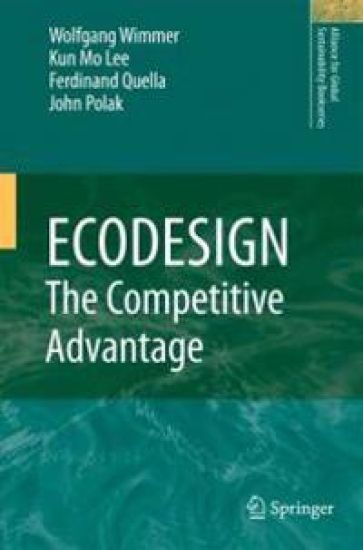
Dealing with environmental issues should no longer be considered simply as a cost of doing business. Effective environmental improvements to a company’s products and services can be turned into business opportunities. This book was written with the express purpose of helping managers of companies, in particular of Small to Medium sized Enterprises (SMEs), to better deal with environmental challenges and address customer requirements, all in order to turn their environmental inve- ments into competitive market advantages. Several examples are provided throughout the book, but also warning signs (Alert Boxes). These “Alerts” are posted to help managers avoid typical traps when working with environmental considerations in business processes. The authors have many years of experience in the various aspects of impleme- ing Ecodesign. This experience includes working in industry for many years; le- ing the environmental departments in a multinational company; managing research projects in eco-product development; Life Cycle Assessment; and national and international environmental communication and marketing. This book is the latest in a series. The 2002 “Ecodesign Pilot” introduced a tool and software to help design more environmentally compatible products. It was directed specifically at designers. The 2004 book, “Ecodesign Implementation”, was written to help project managers optimize product development processes from an environmental perspective.

Stakeholders such as environmental directives and customer demands for reducing environmental impacts of a product require innovative and environmentally improved products. Therefore a systematic approach and effective methods and tools are needed in the early phase of product development. The basic elements for optimized process management in the design department are described in this book. The book provides twelve easy to follow steps for implementing ECODESIGN in a company. It gives clear advice how to integrate environmental considerations into product design and development, and combines ECODESIGN with Life Cycle Assessment and Environmental Communication. Chapters on Product modeling, Life Cycle Assessment, ECODESIGN tasks, Product Improvement and Environmental Communication use the previously developed ECODESIGN PILOT (www.ecodesign.at/pilot) and show its application to a real product example. The book comes with two web tools: one is the ECODESIGN PILOT, used to find measures to environmentally improve a product within a short time. The other is the ECODESIGN PILOT's Assistant (www.ecodesign.at/assist): an expert system, which helps to find the right improvement strategy for a product. Audience: This book will be of interest to environmental and sustainability managers, engineers in research and product development, to designers, environmental experts, and consultants, as well as to students working in this field.
ECODESIGN -- The Competitive Advantage
Wolfgang Wimmer; Kun Mo LEE; Ferdinand Quella; John Polak
Springer
2010
sidottu
Dealing with environmental issues should no longer be considered simply as a cost of doing business. Effective environmental improvements to a company’s products and services can be turned into business opportunities. This book was written with the express purpose of helping managers of companies, in particular of Small to Medium sized Enterprises (SMEs), to better deal with environmental challenges and address customer requirements, all in order to turn their environmental inve- ments into competitive market advantages. Several examples are provided throughout the book, but also warning signs (Alert Boxes). These “Alerts” are posted to help managers avoid typical traps when working with environmental considerations in business processes. The authors have many years of experience in the various aspects of impleme- ing Ecodesign. This experience includes working in industry for many years; le- ing the environmental departments in a multinational company; managing research projects in eco-product development; Life Cycle Assessment; and national and international environmental communication and marketing. This book is the latest in a series. The 2002 “Ecodesign Pilot” introduced a tool and software to help design more environmentally compatible products. It was directed specifically at designers. The 2004 book, “Ecodesign Implementation”, was written to help project managers optimize product development processes from an environmental perspective.



ECODESIGN Implementation
Wolfgang Wimmer; Rainer Züst; Kun Mo LEE
Springer-Verlag New York Inc.
2004
sidottu
Stakeholders such as environmental directives and customer demands for reducing environmental impacts of a product require innovative and environmentally improved products. Therefore a systematic approach and effective methods and tools are needed in the early phase of product development. The basic elements for optimized process management in the design department are described in this book. The book provides twelve easy to follow steps for implementing ECODESIGN in a company. It gives clear advice how to integrate environmental considerations into product design and development, and combines ECODESIGN with Life Cycle Assessment and Environmental Communication. Chapters on Product modeling, Life Cycle Assessment, ECODESIGN tasks, Product Improvement and Environmental Communication use the previously developed ECODESIGN PILOT (www.ecodesign.at/pilot) and show its application to a real product example. The book comes with two web tools: one is the ECODESIGN PILOT, used to find measures to environmentally improve a product within a short time. The other is the ECODESIGN PILOT's Assistant (www.ecodesign.at/assist): an expert system, which helps to find the right improvement strategy for a product. Audience: This book will be of interest to environmental and sustainability managers, engineers in research and product development, to designers, environmental experts, and consultants, as well as to students working in this field.
Up to now, environmental policies have relied mainly on rules, regulations, and prohibitions. This kind of environmental policy -- a clearly reactive approach – has shown a mounting array of limitations. There is a clear need to seek new solutions, in particular those involving the initiative of firms themselves. Since the mid-1980’s, a new approach called “environmental management” has been established in research and practical applications; it is designed to systematically integrate environmental considerations into company activities. If, for instance, environmental objectives are being formulated for an enterprise, it is imperative to identify, highlight, and analyze real and significant environmental impacts of the firm's activities and to take appropriate measures to improve its performance. Controlling and implementing these environmental objectives requires suitable structures, procedures, and tools. Many motivated companies have approached the issue of environmental management through incorporating methods such “continual improvement processes” and “Life Cycle Assessment” into the various operational activities of the enterprise. Some firms initiated such transformation processes at their own production sites because it was easier to identify their own environmental impacts than to analyze, let alone mitigate, the effects of upstream and downstream processes. However, in many cases these processes are decisive factors in the overall environmental performance of a product. It has become clear that product design can influence these processes to a great extent.
Up to now, environmental policies have relied mainly on rules, regulations, and prohibitions. This kind of environmental policy -- a clearly reactive approach – has shown a mounting array of limitations. There is a clear need to seek new solutions, in particular those involving the initiative of firms themselves. Since the mid-1980’s, a new approach called “environmental management” has been established in research and practical applications; it is designed to systematically integrate environmental considerations into company activities. If, for instance, environmental objectives are being formulated for an enterprise, it is imperative to identify, highlight, and analyze real and significant environmental impacts of the firm's activities and to take appropriate measures to improve its performance. Controlling and implementing these environmental objectives requires suitable structures, procedures, and tools. Many motivated companies have approached the issue of environmental management through incorporating methods such “continual improvement processes” and “Life Cycle Assessment” into the various operational activities of the enterprise. Some firms initiated such transformation processes at their own production sites because it was easier to identify their own environmental impacts than to analyze, let alone mitigate, the effects of upstream and downstream processes. However, in many cases these processes are decisive factors in the overall environmental performance of a product. It has become clear that product design can influence these processes to a great extent.