Kirjojen hintavertailu. Mukana 12 105 231 kirjaa ja 12 kauppaa.

Kirjailija

Wouter A. Serdijn

Kirjat ja teokset yhdessä paikassa: 12 kirjaa, julkaisuja vuosilta 1998-2024, suosituimpien joukossa EMI-Resilient Amplifier Circuits. Vertaile teosten hintoja ja tarkista saatavuus suomalaisista kirjakaupoista.

12 kirjaa

Kirjojen julkaisuhaarukka 1998-2024.

Analog IC Design Techniques for Nanopower Biomedical Signal Processing

Analog IC Design Techniques for Nanopower Biomedical Signal Processing

Chutham Sawigun; Wouter A. Serdijn

River Publishers
2024
nidottu
As the requirements for low power consumption and very small physical dimensions in portable, wearable and implantable medical devices are calling for integrated circuit design techniques using MOSFETs operating in the subthreshold regime, this book first revisits some well-known circuit techniques that use CMOS devices biased in subthreshold in order to establish nanopower integrated circuit designs. Based on the these findings, this book shows the development of a class-AB current-mode sample-and-hold circuit with an order of magnitude improvement in its figure of merit compared to other state-of-the-art designs. Also, the concepts and design procedures of 1) single-branch filters 2) follower-integrator-based lowpass filters and 3) modular transconductance reduction techniques for very low frequency filters are presented. Finally, to serve the requirement of a very large signal swing in an energy-based action potential detector, a nanopower class-AB current-mode analog multiplier is designed to handle input current amplitudes of more than 10 times the bias current of the multiplier circuit. The invented filter circuits have been fabricated in a standard 0.18 µ CMOS process in order to verify our circuit concepts and design procedures. Their experimental results are reported.
Analog IC Design Techniques for Nanopower Biomedical Signal Processing

Analog IC Design Techniques for Nanopower Biomedical Signal Processing

Chutham Sawigun; Wouter A. Serdijn

River Publishers
2016
sidottu
As the requirements for low power consumption and very small physical dimensions in portable, wearable and implantable medical devices are calling for integrated circuit design techniques using MOSFETs operating in the subthreshold regime, this book first revisits some well-known circuit techniques that use CMOS devices biased in subthreshold in order to establish nanopower integrated circuit designs. Based on the these findings, this book shows the development of a class-AB current-mode sample-and-hold circuit with an order of magnitude improvement in its figure of merit compared to other state-of-the-art designs. Also, the concepts and design procedures of 1) single-branch filters 2) follower-integrator-based lowpass filters and 3) modular transconductance reduction techniques for very low frequency filters are presented. Finally, to serve the requirement of a very large signal swing in an energy-based action potential detector, a nanopower class-AB current-mode analog multiplier is designed to handle input current amplitudes of more than 10 times the bias current of the multiplier circuit. The invented filter circuits have been fabricated in a standard 0.18 µ CMOS process in order to verify our circuit concepts and design procedures. Their experimental results are reported.
EMI-Resilient Amplifier Circuits

EMI-Resilient Amplifier Circuits

Marcel J. van der Horst; Wouter A. Serdijn; André C. Linnenbank

Springer International Publishing AG
2015
nidottu
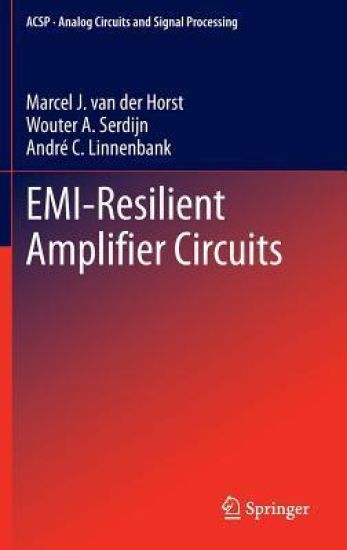
This book enables circuit designers to reduce the errors introduced by the fundamental limitations (noise, bandwith, and signal power) and electromagnetic interference (EMI) in negative-feedback amplifiers. The authors describe a systematic design approach for application specific negative-feedback amplifiers, with specified signal-to-error ratio (SER). This approach enables designers to calculate noise, bandwidth, EMI, and the required bias parameters of the transistors used in application specific amplifiers in order to meet the SER requirements.
EMI-Resilient Amplifier Circuits

EMI-Resilient Amplifier Circuits

Marcel J. van der Horst; Wouter A. Serdijn; André C. Linnenbank

Springer International Publishing AG
2013
sidottu
This book enables circuit designers to reduce the errors introduced by the fundamental limitations (noise, bandwith, and signal power) and electromagnetic interference (EMI) in negative-feedback amplifiers. The authors describe a systematic design approach for application specific negative-feedback amplifiers, with specified signal-to-error ratio (SER). This approach enables designers to calculate noise, bandwidth, EMI, and the required bias parameters of the transistors used in application specific amplifiers in order to meet the SER requirements.
Dynamic Translinear and Log-Domain Circuits

Dynamic Translinear and Log-Domain Circuits

Jan Mulder; Wouter A. Serdijn; Albert C. van der Woerd; Arthur H.M. van Roermund

Springer-Verlag New York Inc.
2012
nidottu
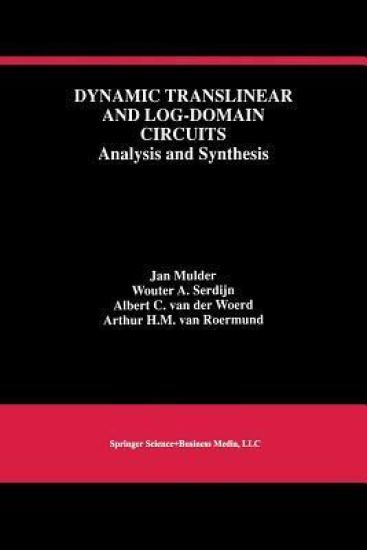
Log-domain and translinear filters provide a competitive alternative to the challenges of ever increasing low-voltage, low-power and high frequency demands in the area of continuous-time filters. Since translinear filters are fundamentally large-signal linear, they are capable of realizing a large dynamic range in combination with excellent tunability characteristics. Large-signal linearity is achieved by exploiting the accurate exponential behavior of the bipolar transistor or the subthreshold MOS transistor. A generalization of the dynamic translinear principle exploiting the square law behavior of the MOS transistor is theoretically possible, but not practically relevant. Translinear and log-domain filters are based on the dynamic translinear principle, a generalization of the conventional (static) translinear principle. Besides their application for linear filters, dynamic translinear circuits can also be used for the realization of non-linear dynamic functions, such as oscillators, RMS-DC converters and phase-locked loops. Dynamic Translinear and Log-Domain Circuits: Analysis and Synthesis covers both the analysis and synthesis of translinear circuits. The theory is presented using one unifying framework for both static and dynamic translinear networks, which is based on a current-mode approach. General analysis methods are presented, including the large-signal and non-stationary analysis of noise. A well-structured synthesis method is described greatly enhancing the designability of log-domain and translinear circuits. Comparisons are made with respect to alternative analysis and synthesis methods presented in the literature. The theory is illustrated and verified by various examples and realizations. Dynamic Translinear and Log-Domain Circuits: Analysis and Synthesis is an excellent reference for researchers and circuit designers, and may be used as a text for advanced courses on the topic.
Adaptive Low-Power Circuits for Wireless Communications

Adaptive Low-Power Circuits for Wireless Communications

Aleksandar Tasic; Wouter A. Serdijn; John R. Long

Springer
2010
nidottu
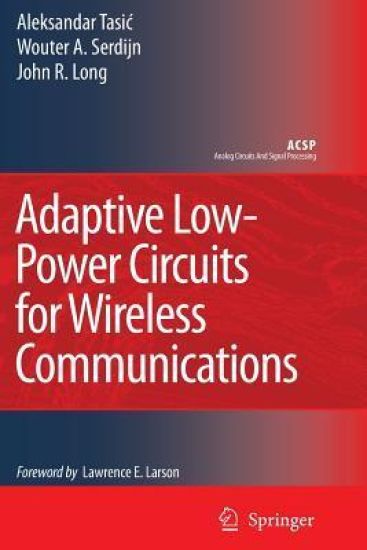
Adaptive radio transceivers require a comprehensive theoretical framework in order to optimize their performance. Adaptive Low-Power Circuits for Wireless Communications provides this framework with a discussion of joint optimization of Noise Figure and Input Intercept Point in receiver systems. Original techniques to optimize voltage controlled oscillators and low-noise amplifiers to minimize their power consumption while maintaining adequate system performance are also provided. The experimental results presented at the end of the book confirm the utility of the proposed techniques.
Ultra Low-Power Biomedical Signal Processing

Ultra Low-Power Biomedical Signal Processing

Sandro Augusto Pavlik Haddad; Wouter A. Serdijn

Springer
2010
nidottu
Often WT systems employ the discrete wavelet transform, implemented on a digital signal processor. However, in ultra low-power applications such as biomedical implantable devices, it is not suitable to implement the WT by means of digital circuitry due to the relatively high power consumption associated with the required A/D converter. Low-power analog realization of the wavelet transform enables its application in vivo, e.g. in pacemakers, where the wavelet transform provides a means to extremely reliable cardiac signal detection. In Ultra Low-Power Biomedical Signal Processing we present a novel method for implementing signal processing based on WT in an analog way. The methodology presented focuses on the development of ultra low-power analog integrated circuits that implement the required signal processing, taking into account the limitations imposed by an implantable device.
Power-Aware Architecting

Power-Aware Architecting

Maarten Ditzel; R.H. Otten; Wouter A. Serdijn

Springer
2010
nidottu
Thecomplexityofembeddedsystems-on-a-chipisrapidlygrowing.Di?erentexpertsareinvolvedin the design process: application software designers, programmable core architects, on-chip com- nication engineers, analog and digital designers, deep submicron specialists and process engineers. In order to arrive at an optimum implementation compromises are needed across boundaries of the di?erent domains of expertise. Therefore, the authors of this book take the point of view of the system architect who is a generalist rather than an expert. He is responsible for the de?nition of a high level architecture, whichisgloballyoptimal.Findinganoptimumrequiresaproperbalancebetweenarea,performance and last but not least energy consumption. The challenge is not only the size of the design space but also the fact that the most important decisions are taken during the early design phases. The advantage of an early decision is that the impact on area, performance and energy consumption is large. But the disadvantage is that the available information is often limited, incomplete and inaccurate. The task of the system architect is to take the correct early decisions despite the uncertainties.
Ultra Low-Power Biomedical Signal Processing

Ultra Low-Power Biomedical Signal Processing

Sandro Augusto Pavlik Haddad; Wouter A. Serdijn

Springer-Verlag New York Inc.
2009
sidottu
Often WT systems employ the discrete wavelet transform, implemented on a digital signal processor. However, in ultra low-power applications such as biomedical implantable devices, it is not suitable to implement the WT by means of digital circuitry due to the relatively high power consumption associated with the required A/D converter. Low-power analog realization of the wavelet transform enables its application in vivo, e.g. in pacemakers, where the wavelet transform provides a means to extremely reliable cardiac signal detection. In Ultra Low-Power Biomedical Signal Processing we present a novel method for implementing signal processing based on WT in an analog way. The methodology presented focuses on the development of ultra low-power analog integrated circuits that implement the required signal processing, taking into account the limitations imposed by an implantable device.
Power-Aware Architecting

Power-Aware Architecting

Maarten Ditzel; R.H. Otten; Wouter A. Serdijn

Springer-Verlag New York Inc.
2007
sidottu
Thecomplexityofembeddedsystems-on-a-chipisrapidlygrowing.Di?erentexpertsareinvolvedin the design process: application software designers, programmable core architects, on-chip com- nication engineers, analog and digital designers, deep submicron specialists and process engineers. In order to arrive at an optimum implementation compromises are needed across boundaries of the di?erent domains of expertise. Therefore, the authors of this book take the point of view of the system architect who is a generalist rather than an expert. He is responsible for the de?nition of a high level architecture, whichisgloballyoptimal.Findinganoptimumrequiresaproperbalancebetweenarea,performance and last but not least energy consumption. The challenge is not only the size of the design space but also the fact that the most important decisions are taken during the early design phases. The advantage of an early decision is that the impact on area, performance and energy consumption is large. But the disadvantage is that the available information is often limited, incomplete and inaccurate. The task of the system architect is to take the correct early decisions despite the uncertainties.
Adaptive Low-Power Circuits for Wireless Communications

Adaptive Low-Power Circuits for Wireless Communications

Aleksandar Tasic; Wouter A. Serdijn; John R. Long

Springer-Verlag New York Inc.
2006
sidottu
Adaptive radio transceivers require a comprehensive theoretical framework in order to optimize their performance. Adaptive Low-Power Circuits for Wireless Communications provides this framework with a discussion of joint optimization of Noise Figure and Input Intercept Point in receiver systems. Original techniques to optimize voltage controlled oscillators and low-noise amplifiers to minimize their power consumption while maintaining adequate system performance are also provided. The experimental results presented at the end of the book confirm the utility of the proposed techniques.
Dynamic Translinear and Log-Domain Circuits

Dynamic Translinear and Log-Domain Circuits

Jan Mulder; Wouter A. Serdijn; Albert C. van der Woerd; Arthur H.M. van Roermund

Springer
1998
sidottu
Log-domain and translinear filters provide a competitive alternative to the challenges of ever increasing low-voltage, low-power and high frequency demands in the area of continuous-time filters. Since translinear filters are fundamentally large-signal linear, they are capable of realizing a large dynamic range in combination with excellent tunability characteristics. Large-signal linearity is achieved by exploiting the accurate exponential behavior of the bipolar transistor or the subthreshold MOS transistor. A generalization of the dynamic translinear principle exploiting the square law behavior of the MOS transistor is theoretically possible, but not practically relevant. Translinear and log-domain filters are based on the dynamic translinear principle, a generalization of the conventional (static) translinear principle. Besides their application for linear filters, dynamic translinear circuits can also be used for the realization of non-linear dynamic functions, such as oscillators, RMS-DC converters and phase-locked loops. Dynamic Translinear and Log-Domain Circuits: Analysis and Synthesis covers both the analysis and synthesis of translinear circuits. The theory is presented using one unifying framework for both static and dynamic translinear networks, which is based on a current-mode approach. General analysis methods are presented, including the large-signal and non-stationary analysis of noise. A well-structured synthesis method is described greatly enhancing the designability of log-domain and translinear circuits. Comparisons are made with respect to alternative analysis and synthesis methods presented in the literature. The theory is illustrated and verified by various examples and realizations. Dynamic Translinear and Log-Domain Circuits: Analysis and Synthesis is an excellent reference for researchers and circuit designers, and may be used as a text for advanced courses on the topic.