Kirjojen hintavertailu. Mukana 12 297 549 kirjaa ja 12 kauppaa.

Kirjailija

Wynn C. Stirling

Kirjat ja teokset yhdessä paikassa: 6 kirjaa, julkaisuja vuosilta 2003-2020, suosituimpien joukossa Theory of Social Choice on Networks. Vertaile teosten hintoja ja tarkista saatavuus suomalaisista kirjakaupoista.

6 kirjaa

Kirjojen julkaisuhaarukka 2003-2020.

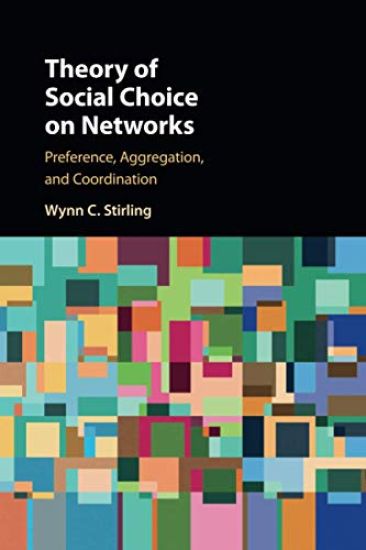
Theory of Social Choice on Networks

Theory of Social Choice on Networks

Wynn C. Stirling

Cambridge University Press
2020
pokkari
Classical social choice theory relies heavily on the assumption that all individuals have fixed preference orderings. This highly original book presents a new theory of social preferences that explicitly accounts for important social phenomena such as coordination, compromise, negotiation and altruism. Drawing on cybernetics and network theory, it extends classical social choice theory by constructing a framework that allows for dynamic preferences that are modulated by the situation-dependent social influence that they exert on each other. In this way the book shows how members of a social network may modulate their preferences to account for social context. This important expansion of social choice theory will be of interest to readers in a wide variety of disciplines, including economists and political scientists concerned with choice theory as well as computer scientists and engineers working on network theory.
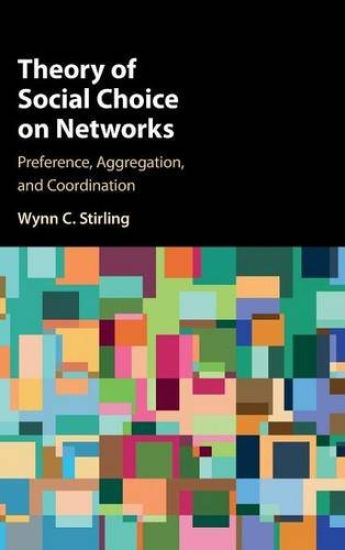
Theory of Social Choice on Networks

Theory of Social Choice on Networks

Wynn C. Stirling

Cambridge University Press
2016
sidottu
Classical social choice theory relies heavily on the assumption that all individuals have fixed preference orderings. This highly original book presents a new theory of social preferences that explicitly accounts for important social phenomena such as coordination, compromise, negotiation and altruism. Drawing on cybernetics and network theory, it extends classical social choice theory by constructing a framework that allows for dynamic preferences that are modulated by the situation-dependent social influence that they exert on each other. In this way the book shows how members of a social network may modulate their preferences to account for social context. This important expansion of social choice theory will be of interest to readers in a wide variety of disciplines, including economists and political scientists concerned with choice theory as well as computer scientists and engineers working on network theory.

Theory of Conditional Games

Theory of Conditional Games

Wynn C. Stirling

Cambridge University Press
2014
pokkari
Game theory explains how to make good choices when different decision makers have conflicting interests. The classical approach assumes that decision makers are committed to making the best choices for themselves regardless of the effect on others, but such an approach is less appropriate when cooperation, compromise and negotiation are important. This book describes conditional games, a form of game theory that accommodates multiple stakeholder decision-making scenarios where cooperation and negotiation are significant issues and where notions of concordant group behavior are important. Using classical binary preference relations as a point of departure, the book extends the concept of a preference ordering that permits stakeholders to modulate their preferences as functions of the preferences of others. As these conditional preferences propagate through a group of decision makers, they create social bonds that lead to notions of group concordance. This book is intended for all students and researchers of decision theory and game theory.
Theory of Conditional Games

Theory of Conditional Games

Wynn C. Stirling

Cambridge University Press
2011
sidottu
Game theory explains how to make good choices when different decision makers have conflicting interests. The classical approach assumes that decision makers are committed to making the best choices for themselves regardless of the effect on others, but such an approach is less appropriate when cooperation, compromise and negotiation are important. This book describes conditional games, a form of game theory that accommodates multiple stakeholder decision-making scenarios where cooperation and negotiation are significant issues and where notions of concordant group behavior are important. Using classical binary preference relations as a point of departure, the book extends the concept of a preference ordering that permits stakeholders to modulate their preferences as functions of the preferences of others. As these conditional preferences propagate through a group of decision makers, they create social bonds that lead to notions of group concordance. This book is intended for all students and researchers of decision theory and game theory.
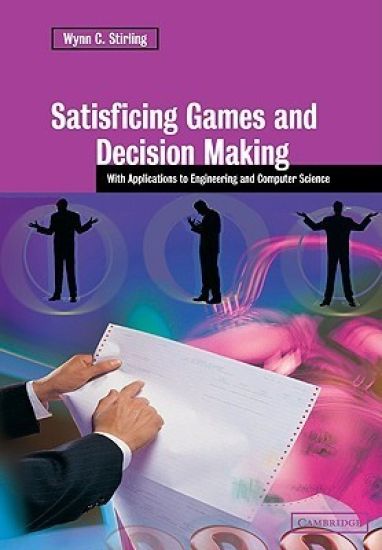
Satisficing Games and Decision Making

Satisficing Games and Decision Making

Wynn C. Stirling

Cambridge University Press
2007
pokkari
In our day-to-day lives we constantly make decisions which are simply 'good enough' rather than optimal. Most computer-based decision-making algorithms, on the other hand, doggedly seek only the optimal solution based on rigid criteria and reject any others. In this book, Professor Stirling outlines an alternative approach, using novel algorithms and techniques which can be used to find satisficing solutions. Building on traditional decision and game theory, these techniques allow decision-making systems to cope with more subtle situations where self and group interests conflict, perfect solutions can't be found and human issues need to be taken into account - in short, more closely modelling the way humans make decisions. The book will therefore be of great interest to engineers, computer scientists and mathematicians working on artificial intelligence and expert systems.
Satisficing Games and Decision Making

Satisficing Games and Decision Making

Wynn C. Stirling

Cambridge University Press
2003
sidottu
In our day-to-day lives we constantly make decisions which are simply 'good enough' rather than optimal. Most computer-based decision-making algorithms, on the other hand, doggedly seek only the optimal solution based on rigid criteria and reject any others. In this book, Professor Stirling outlines an alternative approach, using novel algorithms and techniques which can be used to find satisficing solutions. Building on traditional decision and game theory, these techniques allow decision-making systems to cope with more subtle situations where self and group interests conflict, perfect solutions can't be found and human issues need to be taken into account - in short, more closely modelling the way humans make decisions. The book will therefore be of great interest to engineers, computer scientists and mathematicians working on artificial intelligence and expert systems.